
Waste transfer stations, composting facilities, and wastewater treatment plants all generate odor from microbial decomposition of organic material, and the common control method is to disperse a neutralizing or masking agent as a fine fog that contacts odorous air directly. Ultrasonic fogging nozzles are well suited to this duty because they turn a low water flow into a dense fog without needing a high-pressure pump, and they hold up to continuous outdoor duty. This guide covers how fogging nozzles are applied for odor and VOC control at these facility types.
respuesta rapida: Ultrasonic atomizing nozzles control odor by dispersing a neutralizing or counteractant solution as a 1-10 micron fog that maximizes surface area and contact time with odorous air, working best when the fog is placed directly at the emission source — tipping floors, active compost windrows, or aeration basins — rather than only around the facility perimeter.
Why Ultrasonic Fogging Nozzles Maximize Fog Contact Area
Odor-causing compounds are airborne and disperse quickly, so a neutralizing agent works by chemically reacting with or masking those compounds as they pass through the fog, not by settling on surfaces afterward. A fine fog with a very small droplet size creates far more total surface area per unit of liquid than a coarser spray, which increases the chance an odor molecule contacts a treated droplet before drifting past the treatment zone. This is the same physical principle that makes fine fog effective at capturing airborne dust, applied here to gas-phase odor compounds instead of particulate. See our ultrasonic atomizing nozzle guide for the underlying atomization mechanism.
Waste Transfer Stations: Tipping Floor and Bay Door Treatment
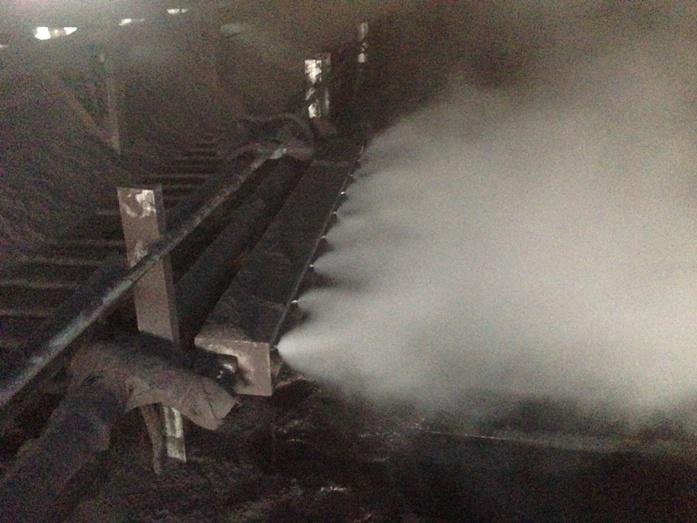
Odor at a transfer station is concentrated at the tipping floor where waste is unloaded and at bay doors where odorous air can escape to the outside. A fogging header positioned along the tipping floor or across open bay doors treats odor at the point of release rather than trying to manage it after it has dispersed into the surrounding area. Because transfer stations often operate on a continuous receiving schedule, the compressed air and treatment solution supply should be sized for extended duty; see our installation guide for header sizing.
Instalaciones de compostaje: Windrow and Building Perimeter Control
Active composting releases odor continuously as microbial decomposition proceeds, with intensity varying by feedstock, turning schedule, and pile moisture. Fogging nozzles are commonly installed along windrow rows or at building perimeters and exhaust points to treat odor as air moves off the pile or out of an enclosed composting building. Outdoor installations need nozzles and headers built for continuous weather exposure, which is why stainless steel construction and simple, no-moving-parts nozzle designs are preferred over more maintenance-intensive equipment in this setting.
Plantas de Tratamiento de Aguas Residuales: Aeration Basin and Headworks Odor
Headworks, screening, and aeration basins are typically the strongest odor sources at a treatment plant, driven by hydrogen sulfide and other compounds released during preliminary treatment. Fogging systems positioned around these process areas treat odor close to the source, which is generally more effective than perimeter-only treatment for a large plant footprint. Because plant water often contains solids or chemical residue, confirm water quality and filtration ahead of the nozzle header to avoid clogging the small resonant orifice.
Comparing Odor Control Approaches
| Método | Droplet Size | Coverage Style | Best Fit |
|---|---|---|---|
| Ultrasonic atomizing (dry fog) | 1-10 micras | Point-source or line treatment at emission zone | Tipping floors, windrows, headworks, bay doors |
| High-pressure misting | 20-100 micras | Broader perimeter or open-area coverage | Landfill perimeters, larger open composting sites |
| Chemical dosing without atomization | N/A | Liquid-phase treatment in process water | In-line odor control within the wastewater process itself |
Frequently Asked Questions
What type of solution is used with the fogging nozzle for odor control?
Facilities typically use a neutralizing agent, enzyme-based treatment, or masking fragrance mixed into the water supply; the specific product should be selected by an odor control specialist based on the compounds present at your facility.
Can the same nozzle handle both dust and odor control at a facility?
The same ultrasonic atomizing nozzle architecture works for both, since both rely on a fine fog with high surface area, but the water supply may need a treatment agent for odor duty versus plain filtered water for dust suppression, so headers are often kept separate or switchable.
Does outdoor weather affect fogging nozzle performance?
Wind can disperse or redirect a fog plume before it treats the intended zone, so nozzle orientation and placement should account for prevailing wind direction and seasonal variation at outdoor sites.
How close to the odor source should nozzles be placed?
Treating odor as close to the emission point as practical — the tipping floor, windrow, or headworks screen — is generally more effective than relying on perimeter treatment alone, especially at larger facilities where odor has more distance and time to disperse before reaching a perimeter fog line.
Get an Odor Control Recommendation
Specifying ultrasonic fogging nozzles correctly up front avoids under-treating odor sources after installation. For general background on this odor-control approach, see this overview of odor control methods.
Jeltecn’s boquilla de atomización ultrasónica is built in 303 o 316 stainless steel for continuous outdoor duty in waste and wastewater environments. For dust suppression and humidification applications using the same technology, see our guides on dry fog dust suppression y ultrasonic humidification for manufacturing. Send us your facility layout and odor source locations through our Contáctenos page for a nozzle placement recommendation.