
respuesta rapida
- Need the finest, most uniform mist from a clean, low-viscosity liquid? Choose internal mix.
- Spraying something viscous, abrasive, or prone to clogging? Choose external mix – the air and liquid only meet outside the nozzle, so there is nothing inside to plug.
- Need to mist a low flow of oil or lubricant without installing a metering pump? Choose siphon-fed – compressed air draws the liquid up from an open reservoir.
Internal mix nozzles
In an internal mix design, compressed air and liquid meet and combine inside the nozzle cap before exiting through a single orifice as an already-atomized spray. Because the two fluids interact in a confined space, internal mix nozzles generally produce the finest, most uniform droplets of the three types, and they do it efficiently, using less air per unit of liquid than an external mix design.
The trade-off is that the internal mixing chamber is a tight passage. It works best with clean, low-viscosity fluids such as water, light oils, or dilute chemical solutions. Liquids with suspended solids or high viscosity are more likely to build up inside the cap and require more frequent cleaning.
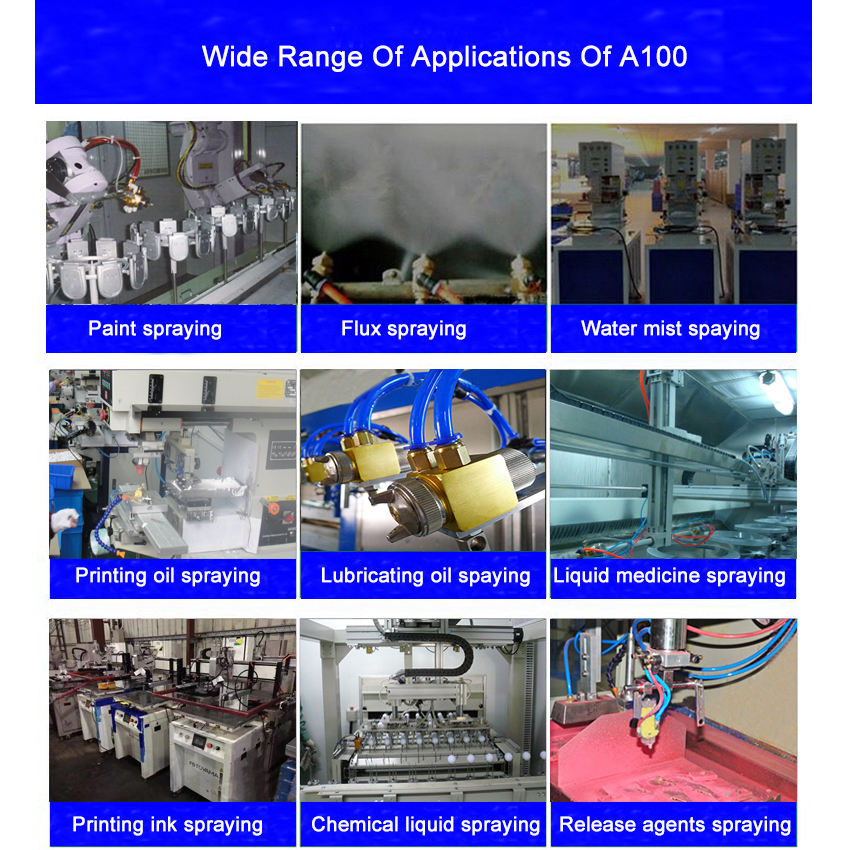
Best fit: humidificación, fine coating and painting, and general-purpose misting with clean fluids.
External mix nozzles
External mix nozzles keep the air and liquid passages separate until they meet just outside the cap face. The liquid exits through its own orifice, and one or more jets of high-velocity air strike it immediately after, shearing it into droplets in open air rather than inside a chamber.
Because there is no internal mixing chamber for solids or viscous liquid to clog, external mix nozzles are significantly more tolerant of thicker fluids, slurries, and liquids with fine suspended particles. They are also easier to inspect and clean. The trade-off is a slightly coarser, less uniform spray than an equivalent internal mix nozzle, and typically higher air consumption for the same droplet size.
Best fit: viscous or particle-laden liquids, water-mixing and evaporative cooling duty, and applications where uptime and clog resistance matter more than absolute droplet fineness. Jeltecn’s adjustable brass air atomizing water mixing nozzle is built for this kind of continuous-duty, adjustable-angle spraying.
Siphon-fed nozzles
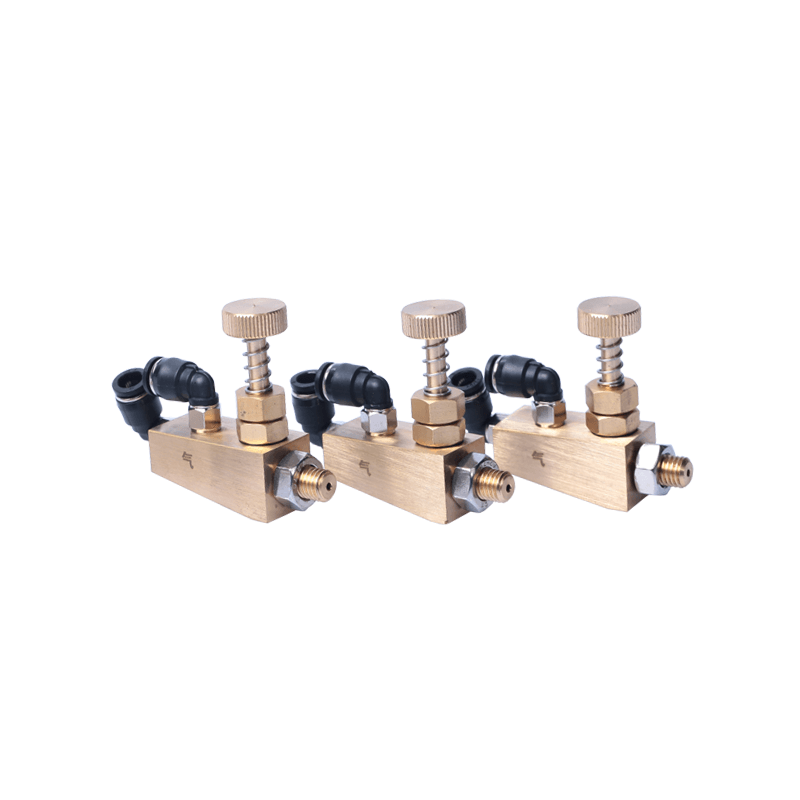
A siphon-fed nozzle uses the same high-velocity air jet as the other two types, but instead of liquid being pumped or gravity-fed into the nozzle, the air stream creates a vacuum that draws liquid up a tube from an open container. No liquid pump, pressure tank, or metering system is required – only compressed air and a reservoir.
This makes siphon-fed nozzles the simplest way to add a low, controllable flow of liquid to a compressed-air stream, which is why they are the standard choice for oil misting and lubrication. The flow rate is inherently limited by how much liquid the vacuum can lift, so siphon-fed designs are best suited to low-flow duty rather than high-volume spraying.
Best fit: lubricación, release-agent misting, and light oil atomization where installing a pump isn’t practical. Jeltecn’s siphon air atomizing oil nozzle is purpose-built for this duty.

Side-by-side comparison
| Factor | Internal mix | External mix | Siphon-fed |
|---|---|---|---|
| Droplet fineness | Finest | Fine to medium | Medium, flow-limited |
| Viscosity / solids tolerance | Bajo | Alto | Low to medium |
| Liquid feed required | Pressurized or gravity | Pressurized or gravity | None – vacuum-fed |
| Relative air consumption | Lower | Higher | Bajo |
| Typical duty | humidificación, revestimiento | Enfriamiento, water-mixing, viscous fluids | Lubricación, oil misting |
How to decide
- Check your fluid first. Anything viscous, abrasive, or with suspended solids points to external mix; clean, thin liquids can use any of the three.
- Decide how the liquid will be supplied. If you don’t want to install a pump or pressure tank, siphon-fed is usually the only practical option.
- Confirm the droplet size you actually need. Don’t default to the finest option (internal mix) if your process tolerates a coarser spray – external mix will usually run longer between cleanings.
- Verify available air supply. External mix designs generally need more air volume for an equivalent droplet size, so confirm your compressor can keep up.
For the broader picture – how air atomizing nozzles work, applications, and full specifications – ver el air atomizing nozzle pillar guide. Then review these air atomizing nozzle applications to match the selected mix type to coating, enfriamiento, supresión de polvo, humidificación, or lubrication duty.
Preguntas más frecuentes
Can one nozzle body be ordered in more than one mix type?
Sometimes. Always confirm the mix type on the specific model’s datasheet rather than assuming it from the product name.
Which type clogs least often?
External mix, because the air and liquid only combine outside the nozzle, leaving no internal passage for solids to collect in.
Do siphon-fed nozzles work with any liquid?
They work best with low-viscosity fluids such as light oils; thicker liquids are harder to lift by suction alone.