
Once you’ve decided a spiral nozzle is the right fit for a dirty, high-solids, or corrosive spraying job, the real work starts: picking the exact size, material, and connection that will hold up in your specific process without over-spending on capacity you don’t need. This guide walks through the practical decisions behind ordering a spiral nozzle, so you can go from “we need an anti-clogging nozzle” to a specific part number with confidence.
respuesta rapida: Sizing a spiral nozzle correctly means matching free passage diameter to your largest expected particle, selecting flow rate and spray angle against your actual operating pressure, and choosing a material rated for your liquid’s chemistry and temperature; getting any one of these wrong is the most common reason a “clog-resistant” nozzle still under-performs.
Start With Free Passage, Not Just Flow Rate
It’s tempting to size a spiral nozzle the same way you would size any other spray nozzle: pick a flow rate and pressure, done. But the entire reason to choose a spiral design is clog resistance, and that resistance comes from the free passage diameter, the largest particle that can pass through the nozzle without bridging or catching. Two nozzles rated for the same flow rate can have meaningfully different free passage sizes depending on internal geometry, so ask your supplier for the free passage dimension specifically, not just the orifice or flow rating. If your liquid carries visible solids, fibers, or sludge, confirm free passage against the largest particle size you expect in normal operation, not just the average.

Matching Material to Chemistry and Temperature
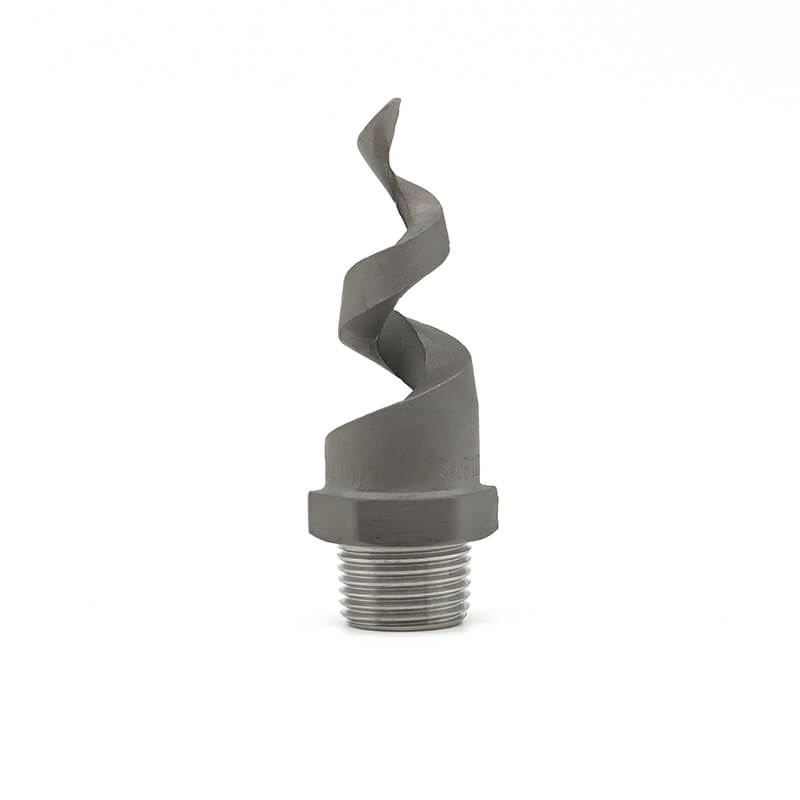
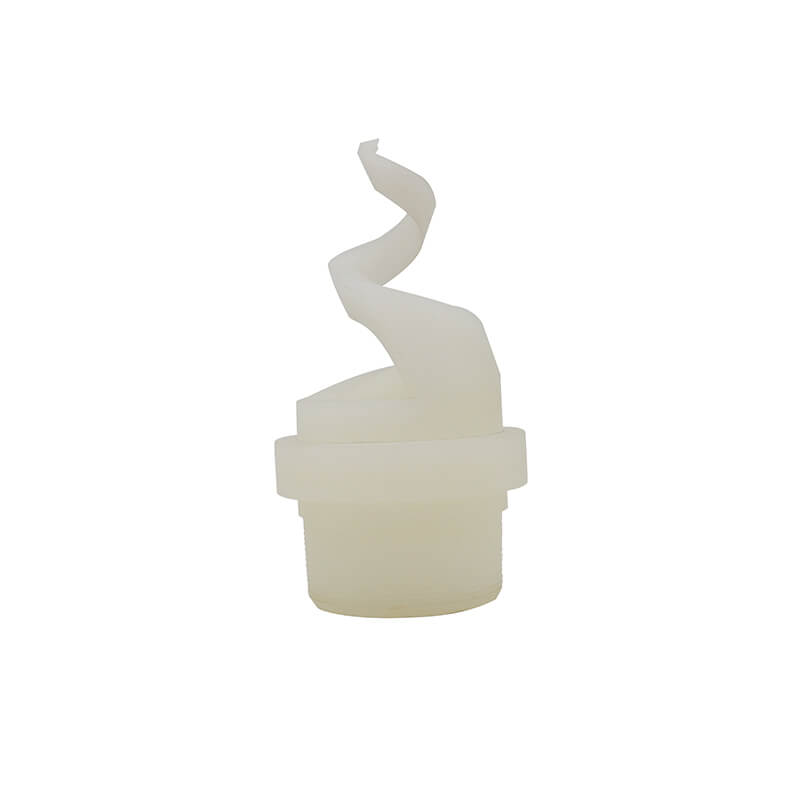
Jeltecn’s spiral nozzle line is available in 303 acero inoxidable, 316 acero inoxidable, latón, and PVDF as standard options, with silicon carbide, PTFE, and PVC available for specialty duty. As a general starting point: 316 stainless steel is the default choice for most industrial slurry and scrubbing liquids where moderate corrosion resistance is needed; PVDF and PTFE suit strongly acidic or highly corrosive chemical streams where metal materials would degrade quickly; and silicon carbide is reserved for the most abrasive slurries, where erosion rather than corrosion is the main wear mechanism. Temperature matters as much as chemistry, confirm the rated temperature limit of your chosen material against your process temperature including startup and upset conditions, not just steady-state operation.
Tipo de hilo, Size, and Retrofit Considerations
Spiral nozzles are available with NPT or BSPT threads, in both male and female connections, across a size range from about 1/4 inch up to 4 inches in the same basic open-channel geometry. This wide range is one of the practical advantages of the spiral design: because the internal geometry scales cleanly, it’s usually possible to retrofit a spiral nozzle onto existing piping without redesigning the connection, which matters when you’re replacing a failing vaned nozzle without a planned shutdown for pipework changes. Confirm your existing thread standard and gender before ordering, and check insertion depth against your duct or vessel drawing so the spray pattern fully develops before hitting an obstruction.
Ángulo de pulverización: What 60° to 180° Actually Means for Coverage
Spiral nozzles produce full cone or hollow cone patterns across a spray angle range of roughly 60 para 180 grados, and that range is wide enough that angle selection meaningfully changes your header layout. Narrower angles concentrate spray over a longer throw distance and are common in smaller ducts or where the nozzle sits farther from the target zone; wider angles cover more cross-sectional area at shorter throw distances and reduce the nozzle count needed in a large duct or open vessel. If you’re unsure which end of the range fits your geometry, share duct diameter or vessel dimensions with your supplier rather than guessing, since an oversized angle can spray liquid onto duct walls before it reaches the gas stream, wasting liquid and reducing scrubbing or suppression efficiency.
Pressure and Flow: Confirm at the Nozzle, Not the Pump
Spray angle and droplet size both depend on the pressure actually delivered at the nozzle inlet, which is often meaningfully lower than pump discharge pressure once you account for line losses, elevation change, and header pressure drop across multiple nozzles. Before finalizing an order, confirm expected pressure at the specific nozzle location, especially on long headers where the last nozzle in line may see noticeably less pressure than the first. This is a common reason a system underperforms even when every individual nozzle matches its published specification.
A Practical Ordering Checklist
To get an accurate quote and avoid a second round of questions, gather the following before you request pricing: liquid type, contenido de sólidos, and largest expected particle size; required flow rate and expected pressure at the nozzle (not pump discharge); desired spray angle and pattern (full cone or hollow cone); operating and upset-condition temperature range; chemical compatibility requirements; thread standard, size, and gender for your existing connection; and quantity along with any documentation or certification requirements. Our engineering team at Jeltecn can also review a duct or vessel drawing if you’re unsure about insertion depth or nozzle count.
When a Spiral Nozzle Isn’t the Right Fit
If your liquid is clean or lightly filtered and you need precise, uniform distribution more than clog resistance, a vaned full cone nozzle will generally give more consistent coverage per nozzle. Our Full Cone Spray Nozzle guide covers that selection path in detail, and our Spiral vs Full Cone comparison article (linked from the Spiral Nozzle Guide) walks through several side-by-side scenarios if you’re deciding between the two. For the underlying mechanics of how the spiral design achieves its clog resistance, see our full Spiral Nozzle Guide, and for general troubleshooting, our article on why spray nozzles clog and how to prevent it is a useful companion reference.
Frequently Asked Questions
What’s the difference between free passage and orifice diameter?
Orifice diameter describes the nozzle’s exit opening, while free passage describes the largest particle that can travel through the internal flow path without catching; for clog resistance, free passage is the more important number to confirm.
Can I get a custom size outside the standard range?
Jeltecn manufactures spiral nozzles from 1/4 inch up to 4 inches as standard, and can discuss custom sizing or OEM/ODM branding for specific project requirements.
How do I know if I need 316 stainless steel or PVDF?
316 stainless steel handles most general industrial slurries and moderate chemical exposure; PVDF is generally preferred for strongly acidic or aggressive chemical streams where stainless steel would corrode faster than acceptable. Share your chemistry and concentration for a specific recommendation.
Get a Sizing Recommendation and Quote
Share your liquid, fluir, presión, and connection details, and our team will confirm the right spiral nozzle size, material, and thread for your application. Contact us for a free application review, or view the Spiral Spray Nozzle product page to see current specifications.