
Quick overview
| 애플리케이션 | Typical droplet need | Common mix type |
|---|---|---|
| 코팅 / 페인트 등 | Very fine, uniform | Internal mix |
| Evaporative cooling / 가스 컨디셔닝 | Sub-50 micron, flash-evaporating | Internal or external mix |
| 먼지 억제 | Fine, sized to capture particles | Internal or external mix |
| 가습 | Very fine, low flow | Internal mix / ultrasonic |
| 매끄럽게 하기 / release agents | Low flow, metered | Siphon-fed |
Coating and painting
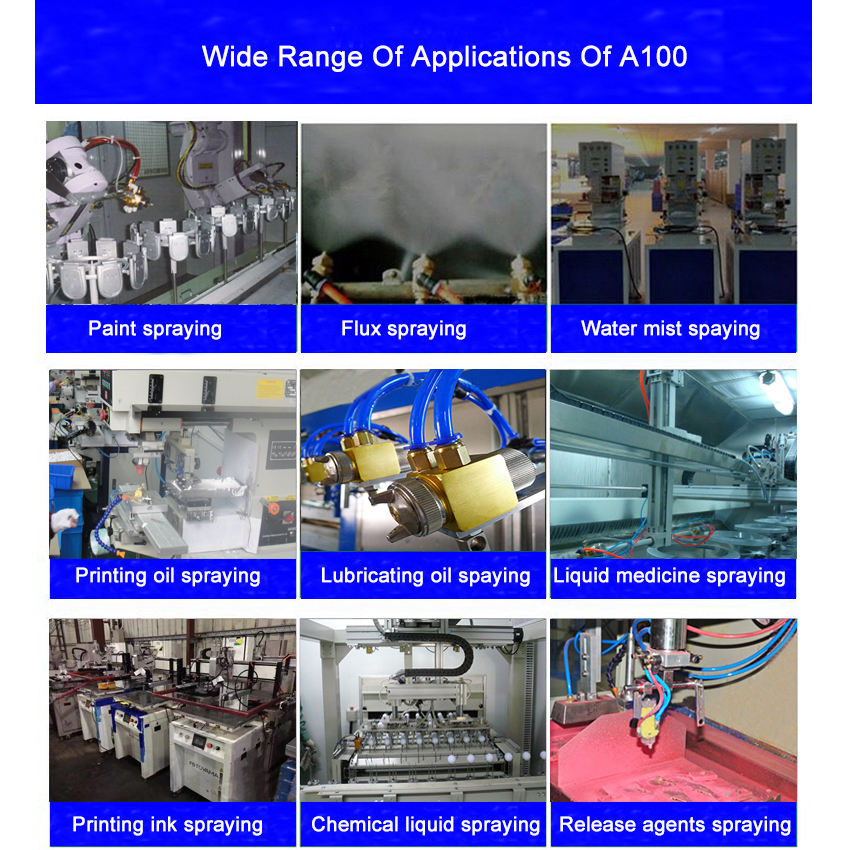
In coating and painting lines, an air atomizing nozzle breaks paint, primer, or another liquid coating into a fine, even spray so it lays down as a smooth, uniform film rather than heavy droplets or streaks. Fine, consistent atomization directly reduces material waste and rework, which is why coating is one of the most demanding use cases for droplet uniformity.
Jeltecn’s A100 automatic atomizing nozzle is built as a compact mini spray gun for exactly this kind of automated or semi-automated coating duty.
Evaporative cooling and gas conditioning
When very fine water droplets are introduced into a hot air or gas stream, they flash-evaporate quickly, pulling heat out of the surrounding gas and lowering its temperature – without soaking equipment or product downstream. Air atomizing nozzles are a common choice here because they hit the sub-50-micron droplet range needed for fast, complete evaporation, at flow rates that are easy to control.
This same principle is used to condition process gas before it enters downstream equipment such as bag filters or scrubbers, protecting them from excess heat.
먼지 억제
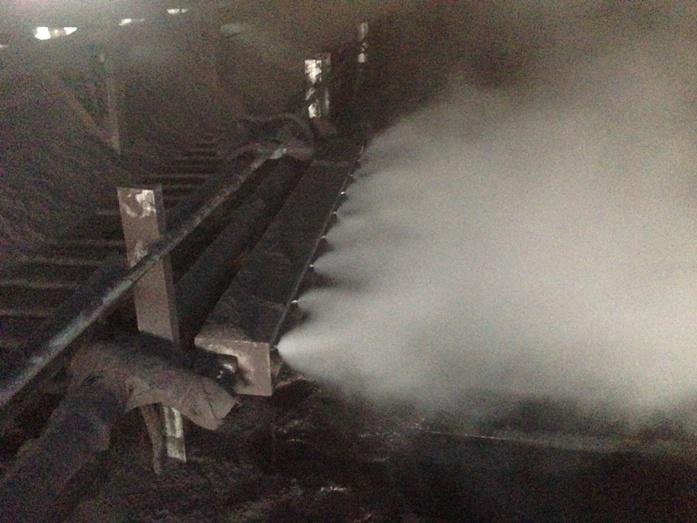
Capturing airborne dust works best when the water droplet size is close to the size of the dust particles themselves – droplets that are too large simply fall past the dust without catching it, while droplets that are too fine drift away as fog instead of settling. Air atomizing nozzles let operators tune droplet size independently of liquid flow, which makes it easier to hit that target range at material handling points, crushers, and conveyor transfer points.
Anti-drip designs, such as Jeltecn’s anti-drip high pressure misting nozzle, are frequently specified for dust suppression because they stop dripping when the system shuts off, avoiding puddling around the equipment.
가습
Precise humidity control – in greenhouses, cold storage, textile plants, or cleanrooms – depends on adding a controlled, very fine mist that evaporates into the air rather than wetting surfaces. Air atomizing nozzles are well suited to this because their fine droplet size and low, adjustable flow make it possible to raise humidity gradually and evenly across a space.
Jeltecn offers several humidification-focused models, including the brass air atomizing water mixing nozzle, the AAZ fine atomizing spray nozzle, 그리고 초음파 분무 노즐 for even denser fog at lower air use – 참조 초음파 분무 노즐 가이드 for how it compares.
Lubrication and release agents
Applying oil, release agent, or another lubricant as a light, even mist – rather than pouring or brushing it on – reduces consumption and gives more consistent coverage on molds, dies, chains, and other moving parts. Because the required flow rate is usually very low, this is the classic use case for a siphon-fed nozzle: compressed air draws the liquid straight from an open container, with no pump needed.
Jeltecn’s siphon air atomizing oil nozzle is designed specifically for this kind of pump-free lubrication and oil-misting duty.

Matching a nozzle to your application
- Start with the outcome you need – 냉각, 코팅, 먼지 포집, humidity, or lubrication – and use the overview table above to see the droplet range that outcome typically requires.
- Check whether your liquid is clean and low-viscosity (internal mix works) or viscous/abrasive (external mix is more clog-resistant).
- If you don’t want to install a liquid pump, confirm whether your required flow rate fits a siphon-fed design.
- For the full breakdown of internal mix, external mix, and siphon-fed designs, read the nozzle types comparison guide, or start from the air atomizing nozzle pillar guide for the complete overview.
자주하는 질문
Can the same nozzle be used for both cooling and humidification?
Often yes, since both need a similarly fine, low-flow mist – but confirm the spray angle and mounting orientation suit your space.
Why not just use a hydraulic (liquid-only) nozzle for dust suppression?
Hydraulic nozzles tie droplet size to liquid pressure, which limits how fine a mist you can get at low flow. Air atomizing nozzles control droplet size independently, making it easier to match dust particle size.
Do coating applications always need an internal mix nozzle?
Not always – thicker coatings may need an external mix design; confirm against the coating’s viscosity.