
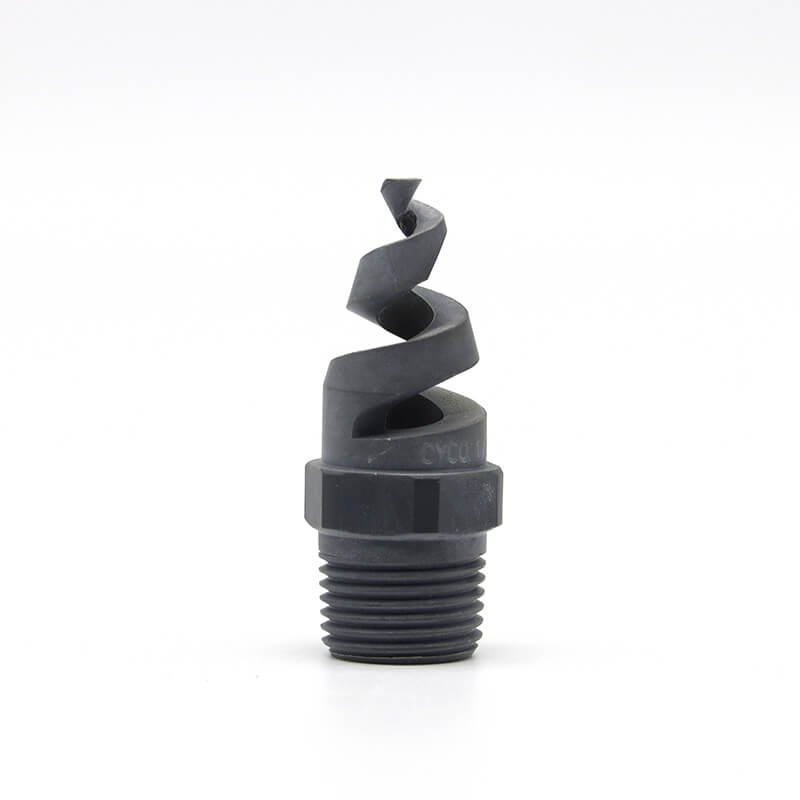
Crushers, conveyor transfer points, and stockpiles generate airborne dust the moment material breaks, drops, or is disturbed by wind, and the water used to suppress that dust is rarely clean. Recycled process water, once-through water carrying sediment, and water drawn from onsite ponds all commonly carry enough suspended solids to clog a conventional dust suppression nozzle within days or weeks. Spiral nozzles are widely used at these locations specifically because their open flow passage tolerates that water quality without constant maintenance intervention.
빠른 답변: Spiral nozzles are used for dust suppression at crushers, conveyor transfer points, and stockpiles because their open helical flow path resists clogging from sediment and recycled water, while still producing a wide-angle spray that captures airborne fines effectively at moderate operating pressure.
Why Dust Suppression Water Quality Is Rarely Clean
Unlike a process that can specify treated or filtered water, dust suppression systems are typically designed to use whatever water source is most economical on site, often recycled water from settling ponds, water carrying fines washed off equipment, or raw water with no filtration at all. This is a deliberate operational tradeoff: filtering water to protect nozzles adds cost and maintenance of its own, so the more practical solution is to specify a nozzle that tolerates the water quality actually available rather than to over-invest in filtration. That is precisely the gap spiral nozzles fill in mining, quarrying, aggregate, and bulk material handling operations.
Where to Place Nozzles on Crushers and Conveyors
Dust generation is concentrated at specific mechanical events rather than spread evenly across a system, so nozzle placement matters more than raw flow rate. Crusher discharge chutes and breakage chambers generate an immediate burst of impact dust as material fractures; positioning nozzles to spray directly into this zone knocks down dust before it becomes airborne. Conveyor transfer points and loading hoppers create dust as material velocity changes suddenly during the drop; spray placed around the drop zone intercepts fines during that transition. Belt surfacing and stockpile conditioning use a lower, continuous spray to keep bulk material damp enough to resist wind-driven dust without over-wetting the load. 우리의 Dust Suppression Spray Nozzles for Material Handling page covers general header layout principles that apply across these placements.
Droplet Size and Pressure for Effective Dust Capture
Dust capture efficiency depends heavily on matching droplet size to the particle size of the dust being suppressed; droplets that are too large pass by fine airborne particles without contacting them, while droplets that are too fine may evaporate or drift before reaching the dust cloud. Spiral nozzles operating at moderate pressure typically produce a droplet range well suited to capturing the fine, respirable particles generated at crushers and transfer points, without requiring the high pressure and fine filtration that atomizing mist nozzles demand. This is one of the practical advantages of the spiral design in this application: reasonable droplet performance without the water-quality sensitivity of finer atomizing nozzle types.
Spray Angle and Coverage for Transfer Points
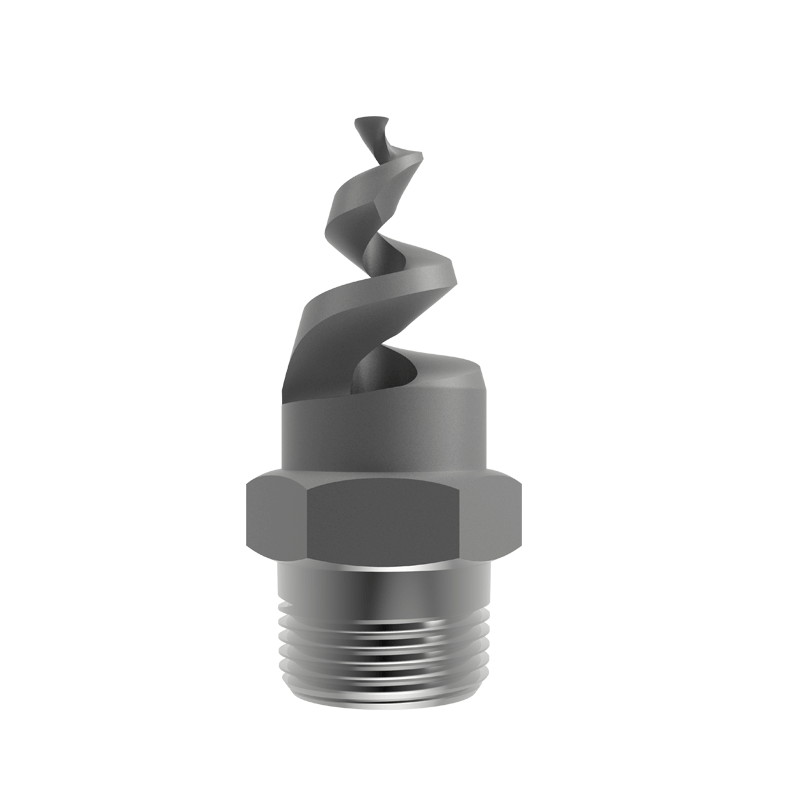
Wider spray angles generally suit open transfer points and stockpile conditioning where broad, even coverage at a moderate throw distance is the goal. Narrower angles concentrate spray into confined chute or chamber geometry where space is limited and the target zone is small. Because spiral nozzles are available across a 60° to 180° angle range, the same basic clog-resistant design can be specified across very different placements on the same site, which simplifies spare parts inventory and maintenance training compared with mixing several different nozzle families.
| Location | Typical Placement Goal | Angle Tendency |
|---|---|---|
| Crusher discharge/breakage chamber | Knock down impact dust at the source | Narrower, targeted |
| Conveyor transfer point/hopper | Intercept dust during drop | 보통의 |
| Belt surfacing/stockpile | Continuous conditioning, wide coverage | Wider |
Reducing Water Consumption and Maintenance
Operations are increasingly under pressure to reduce water consumption in dust suppression, and clog-resistant nozzles contribute in a less obvious way: a header with frequently clogged nozzles is often over-specified with higher flow or more nozzles than necessary to compensate for expected blockages, which wastes water even when nozzles are working. Specifying the correct spiral nozzle size for actual dust load, rather than over-sizing to offset clogging risk, both reduces water use and cuts the labor hours spent clearing blocked nozzles during shift changes.
Specifying Nozzles for Your Site
Share your material type (석탄, aggregate, ore, or other), available water pressure and flow, water source and approximate solids content, and the specific locations needing coverage (chute, transfer point, stockpile), and our team can recommend nozzle size, 스프레이 각도, and material.
Frequently Asked Questions
Do spiral nozzles work with completely untreated pond water?
Spiral nozzles tolerate significantly more sediment than vaned nozzles, but extremely high solids content or large debris can still cause issues; sharing your water source details lets us confirm the right free passage size.
What pressure is typical for dust suppression spiral nozzles?
Most dust suppression duty runs at moderate pressure, commonly in the 30-50 PSI (대충 2-3.5 술집) range, though your specific droplet size target and pump capacity may shift this.
Can the same nozzle be used at both crushers and stockpiles?
The same spiral nozzle family can often be used across both, with spray angle adjusted for each location’s coverage needs; sharing your layout allows a specific recommendation per zone.
Get a Recommendation for Your Site
Tell us about your material, water source, and dust control locations, and we’ll help you specify the right spiral nozzle for reliable, low-maintenance dust suppression. Contact our team, or view the Spiral Spray Nozzle product page.