
“Dry fog” is the industry term for the very fine, low-moisture mist that ultrasonic (air-driven resonant) atomizing nozzles produce, and it is the standard dust suppression method at crushers, conveyor transfer points, screens, and bulk material handling sites where adding excess water to the product is a problem in itself. This guide covers how dry fog dust suppression works at these specific locations and what to check before specifying a system.
Quick answer: Dry fog dust suppression uses ultrasonic atomizing nozzles to produce 1-10 micron droplets that match the size of airborne dust particles, letting droplets collide with and capture dust in the air rather than simply wetting the material below, which keeps moisture addition to a fraction of a percent instead of soaking the product.
Why Crushers and Transfer Points Need Dry Fog, Not Wet Suppression
Crushing, screening, and every conveyor transfer point generates a burst of airborne dust as material breaks, drops, or is disturbed by wind. Conventional water sprays using full cone or flat fan nozzles knock dust down by adding enough water volume to weigh particles out of the air, but that same water often oversaturates the material, which adds handling problems, freezing risk in cold climates, and increased transport weight. Dry fog nozzles instead produce droplets close in size to the dust particles themselves — this is the physical reason 1-10 micron fog captures airborne fines more efficiently per unit of water than a coarser hydraulic spray. See our ultrasonic atomizing nozzle guide for how this droplet size is generated.
How Droplet Size Drives Dust Capture
This is the core science behind why dry fog dust suppression outperforms coarse water sprays at capturing fine particulate. For general background on airborne particulate, see this overview of particulate matter.
Airborne respirable dust particles are typically in a similar micron range to the droplets a dry fog nozzle produces. When droplet and particle size are close, collision and agglomeration are far more efficient than when large water droplets simply fall through a dust cloud without contacting most of the particles. This is why fog systems can suppress dust effectively while adding well under 0.1% moisture to the bulk material, compared to the visible wetting that hydraulic sprays leave behind. The trade-off is that dry fog nozzles need a stable compressed air supply and cannot match the raw water volume of a large hydraulic nozzle for gross material wetting or fire suppression duty.
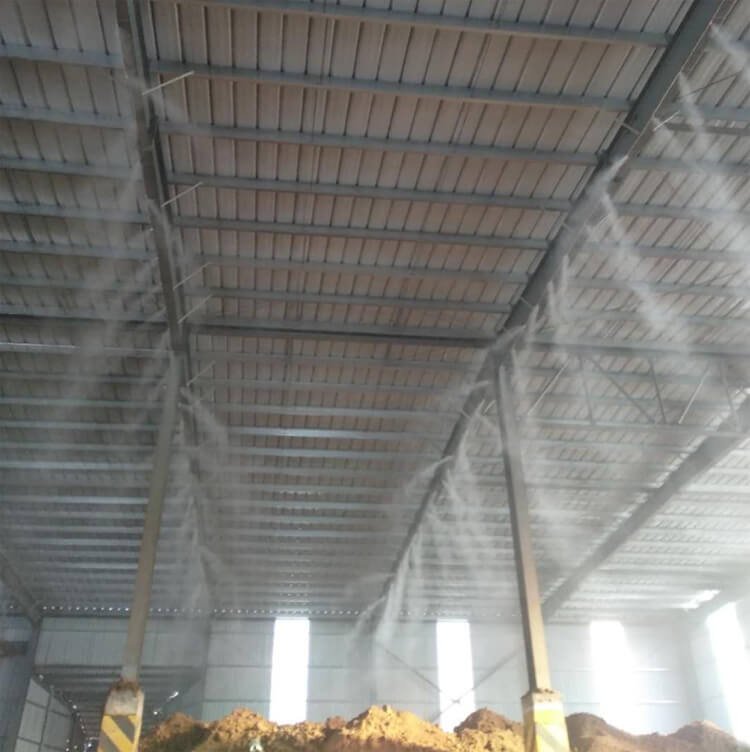
Where to Place Nozzles on Crushers and Conveyors
Dust generation is concentrated at specific mechanical events, so nozzle placement matters more than spreading nozzles evenly across a system. Crusher discharge chutes and breakage chambers generate an immediate burst of dust as material fractures. Conveyor transfer points and loading hoppers create a drop-zone dust cloud as material falls and displaces air. Belt loading and stockpile conditioning benefit from a lighter, continuous fog to keep surface fines damp enough to resist wind-driven dust without over-wetting the load. A ring arrangement around a crusher discharge or chute typically outperforms a single nozzle, since it surrounds the dust plume rather than intercepting it from one side. See our installation guide for header and ring layout for spacing guidance.
Comparing Dry Fog to Other Dust Control Nozzles
| Methode | Typical Droplet Size | Water Added to Material | Best Fit |
|---|---|---|---|
| Dry fog (ultrasonic atomizing) | 1-10 micron | Under 0.1%, minimal | Crushers, transfer points, enclosed dust sources |
| High-pressure misting | 20-100 micron | Low to moderate | Larger open areas, stockyards, outdoor perimeters |
| Full cone / flat fan (hydraulic) | 200+ micron | Moderate to high | Bulk wetting, wash-down, heavier dust knockdown |
| Spiraal mondstuk | Coarse, open pattern | Moderate to high | Slurry, high-solids liquids that would clog a fine orifice |
For a broader look at how these methods compare across industries, see our spray nozzle clogging causes and prevention guide, which covers why open-pattern nozzles are chosen for solids-laden liquids.
Water Quality and Air Supply for Continuous Duty
Reliable dry fog dust suppression over months of continuous duty depends as much on water and air quality as on the nozzle itself.
Mijnbouw, quarrying, and cement plants often run recycled process water or water from on-site settling ponds through dust suppression systems, which is exactly the water quality that can clog a small resonant orifice without adequate filtration. Confirm filtration ahead of the header to the micron rating on the nozzle’s data sheet, and size the compressed air supply for simultaneous operation of every nozzle on the ring or header without pressure sag, since crushers and transfer points often run continuously across a shift.
Frequently Asked Questions
Will dry fog dust suppression affect material handling or product quality?
Because dry fog adds a small fraction of a percent of moisture, it generally does not meaningfully change material handling, freezing behavior, or downstream processing the way a heavier hydraulic spray can. Confirm against your specific material’s moisture tolerance for sensitive processes.
Can dry fog nozzles handle the water quality found at a quarry or mine site?
They can, provided the water is filtered to the nozzle’s specified micron rating before reaching the header. Untreated pond or recycled water with high sediment content should be filtered upstream, not relied upon to pass through the small orifice unfiltered.
How is dry fog different from a standard misting system?
Dry fog nozzles produce finer droplets, generally 1-10 micron, compared to the 20-100+ micron range of typical high-pressure misting nozzles. The finer droplets track airborne dust more efficiently and add less moisture, while misting systems can cover larger open areas with more total water volume.
Do I need a ring of nozzles or is a single nozzle enough at a chute?
A single nozzle rarely surrounds a dust plume escaping in multiple directions from a chute or discharge point. A ring arrangement distributed around the opening typically gives more consistent capture than one point source.
Get a Dust Suppression Recommendation
Jeltecn’s ultrasone verstuivingsmondstuk is built in 303 or 316 stainless steel for continuous dry fog duty in mining, aggregates, and bulk material handling. For humidification and odor-control applications using the same technology, see our guides on ultrasonic humidification for manufacturing en odor and VOC control at waste facilities. Send us your crusher, conveyor, or transfer point layout through our Neem contact met ons op page for a nozzle count and spacing recommendation.