
Ultrasonic misting nozzles produce a dense fine fog for evaporative cooling in loading docks, greenhouses, and livestock housing. Their small droplets evaporate quickly, pulling heat from the surrounding air while minimizing surface wetting. This guide explains how to size and apply ultrasonic misting nozzles across these three settings, including the effects of humidity, airflow, and mounting height.
Quick answer: Ultrasonic misting nozzles cool by evaporative flash-off: very small droplets absorb heat from the surrounding air as they evaporate, lowering ambient temperature without wetting product, floors, or animals, provided the installation accounts for humidity, airflow, and mounting height at the specific site.
How Fine Fog Delivers Evaporative Cooling
Evaporative cooling only works as designed when droplets evaporate into the air rather than falling onto a surface. Smaller droplets have far more surface area relative to their volume than larger ones, so they absorb heat and flash into vapor much faster; this is the same 1-10 micron droplet range described in our ultrasonic atomizing nozzle guide. The cooling effect depends on the relative humidity of the incoming air: dry air has more capacity to absorb moisture and therefore cools more from the same fog volume, while already-humid air limits how much additional cooling evaporation can provide.
Loading Docks: Cooling Open Bay Areas
Loading docks are difficult to cool with conventional air conditioning because bay doors are frequently open to outside air, undermining any sealed cooling system. A misting header positioned across the dock opening or along the working area lowers ambient temperature through evaporation as outside air moves through, without the equipment or energy cost of mechanical cooling. Because dock areas see foot traffic and material handling, mounting height and droplet evaporation distance should be set so fog fully evaporates before reaching workers or product below.
Greenhouses: Cooling and Humidity Together
Greenhouse cooling has a second requirement beyond temperature: many crops also need a specific humidity range for healthy growth, and fine fog cooling delivers both effects from the same installation. As droplets evaporate, they simultaneously cool the air and raise relative humidity, which is why fog cooling is widely used in greenhouse environments compared to methods that only address one variable. Nozzle spacing and header layout should follow the greenhouse’s ventilation pattern, since fans and vents will move the fog plume in a specific direction rather than allowing it to disperse evenly on its own.
Livestock Ventilation: Heat Stress Reduction
Heat stress reduces feed intake, growth rate, and in severe cases survivability in poultry and livestock housing, making cooling a production concern rather than only a comfort issue. Fine fog cooling is used in ventilated barns and open-sided housing to lower air temperature entering the animal zone, typically combined with the facility’s existing ventilation fans to move cooled air across the housing area. Water quality matters here both for nozzle longevity and for animal health, so filtration should meet both the nozzle’s mechanical requirements and any livestock water quality standards that apply to the facility.
Comparing Evaporative Cooling Methods
| Metode | Droplet Size | Wetting Risk | Best Fit |
|---|---|---|---|
| Ultrasonic atomizing (fine fog) | 1-10 mikron | Very low | Loading docks, greenhouses, livestock housing, workspaces |
| High-pressure misting | 20-100 mikron | Low to moderate | Larger outdoor areas, patios, bigger greenhouse zones |
| Evaporative cooling pads | N/A (wetted media) | None at the pad, but requires airflow through wet media | Whole-building ventilation cooling with forced air movement |
| Direct spray wetting | 200+ mikron | High | Not typically used for evaporative cooling due to runoff |
Sizing for Climate and Airflow
Cooling performance depends heavily on ambient relative humidity and airflow through the space, so the same header design will perform differently in a dry inland climate compared to a humid coastal one. Confirm typical seasonal temperature and humidity for the installation site, the available airflow or ventilation fan capacity, and the mounting height needed for full droplet evaporation before finalizing a nozzle count. For sizing the compressed air and water supply itself, see our installation guide.
Frequently Asked Questions
Does evaporative fog cooling work in humid climates?
It still provides cooling, but the effect is smaller than in dry climates because humid air has less capacity to absorb additional moisture through evaporation. Confirm expected performance against your local climate data before sizing a system.
Will misting nozzles leave surfaces wet?
When droplets are small enough and mounting height allows full evaporation before reaching a surface, wetting is minimal. Oversized droplets, excessive pressure, or insufficient evaporation distance can increase wetting risk.
Can the same system be used for both cooling and humidification?
Ja, evaporative cooling and humidification are the same physical process viewed from different goals, so a correctly sized fog system can serve both purposes simultaneously in applications like greenhouses.
How is livestock cooling different from cooling a loading dock?
Livestock housing typically requires closer attention to water quality standards for animal health, and cooling is usually integrated with the facility’s ventilation fan system rather than operating as a standalone header, unlike a dock area where fog is more independent of mechanical ventilation.
Get an Evaporative Cooling Recommendation
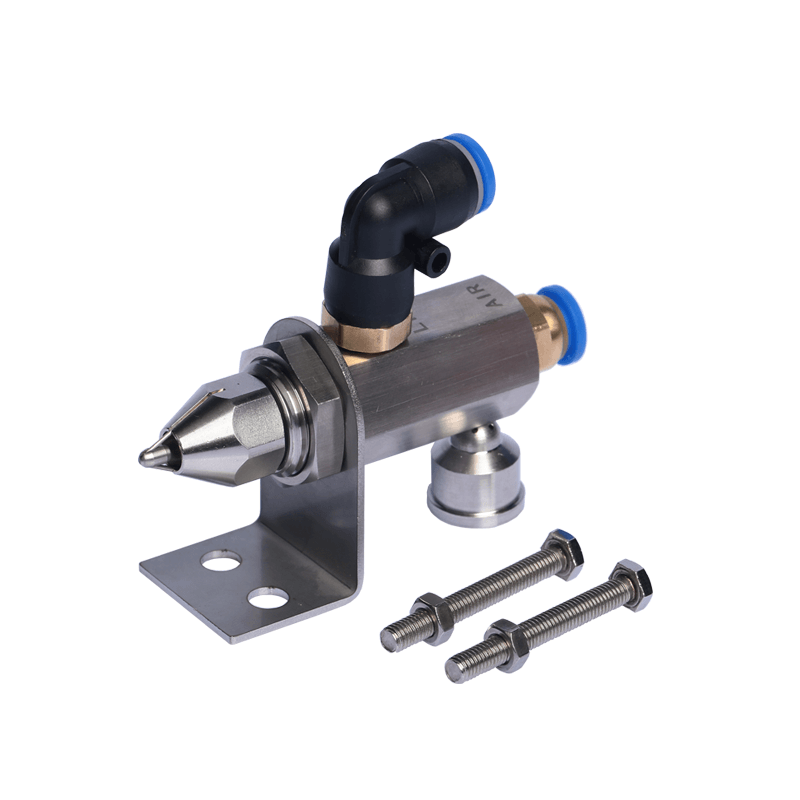
Jeltecn’s ultralyd forstøvningsdyse is built in 303 or 316 stainless steel for continuous evaporative cooling duty. For related applications using the same nozzle technology, see our guides on ultrasonic humidification for manufacturing og dry fog dust suppression, or compare against standard air atomization in our air atomizing vs. ultrasonic nozzle guide. Send us your site climate and layout through our Kontakt oss page for a cooling system recommendation.