
Flat fan nozzles deliver an even, linear spray pattern that makes them the first choice for washing, koeling, and coating lines. But in dirty water, slurry, or high-solids service, flat fan orifices are also the type most likely to block mid-shift. When one nozzle on a wash tunnel, dust suppression header, or wastewater line clogs, operators often have to stop the line, unbolt the fitting, and clean or replace the tip by hand. Self-cleaning and quick-release flat fan nozzles exist specifically to cut that downtime.
Quick answer: A self-cleaning flat fan nozzle uses a wider, less restrictive internal flow path (sometimes with a spring-loaded or moving element that dislodges debris) to resist blockage from solids, while a quick-release design lets the tip or full nozzle body be removed and reinstalled by hand, without tools, so routine cleaning takes seconds per nozzle instead of minutes.
Why Flat Fan Nozzles Clog in the First Place
A flat fan orifice is elongated rather than round, which is what produces the sheet-like spray pattern. That same narrow slot geometry is easy for fibers, scale, rust, and suspended solids to bridge across. Clogging risk increases with lower flow capacity nozzles (small orifices for fine coverage), recirculated or untreated water sources, and processes that carry sludge, pulp, or particulate. Once a single nozzle blocks, the spray fan collapses to a stream or stops entirely, creating an untreated gap in coverage that can mean an unwashed section of product, an uncooled hot spot, or an unsuppressed dust source. For a deeper look at contamination sources and prevention steps, see our guide on why spray nozzles clog and how to prevent it.
What “Self-Cleaning” en “Quick-Release” Actually Mean
These two terms describe different but complementary design goals. Self-cleaning generally refers to the internal flow path: a larger free passage diameter relative to the equivalent orifice size, rounded internal contours with no dead pockets, and in some product lines a spring-loaded pin or ball that is pushed off its seat by flow and reseats when flow stops, sweeping debris clear on every cycle. Quick-release refers to the mechanical connection: a bayonet, snap-clip, or knurled cap that lets the tip be pulled, rinsed, and reseated without wrenches, versus a threaded tip that requires tools and risks thread damage from repeated removal. Many of our customers specify both features together on the same nozzle body so that maintenance staff can pull, inspect, and reinstall an entire header in a single short changeover window.
Where Self-Cleaning Flat Fan Nozzles Earn Their Keep
These designs pay for themselves fastest in processes where the spray liquid itself carries solids or where the line cannot tolerate an unplanned stop. Typical use cases include recycled or gray water spraying on dust suppression and material handling systems, where fines and scale are already suspended in the water; tank and vessel cleaning where residual product or sludge is present in the wash stream; agricultural and fertilizer spraying where suspensions and wettable powders are prone to settling in the tip; wastewater and effluent treatment spraying; and any wash-down header running on untreated or once-through water rather than filtered supply. If your process falls into one of these categories, it is also worth reviewing our dust suppression spray nozzle applications page for related header design guidance.
Jeltecn’s Flat Fan Nozzle Range for Easy Maintenance
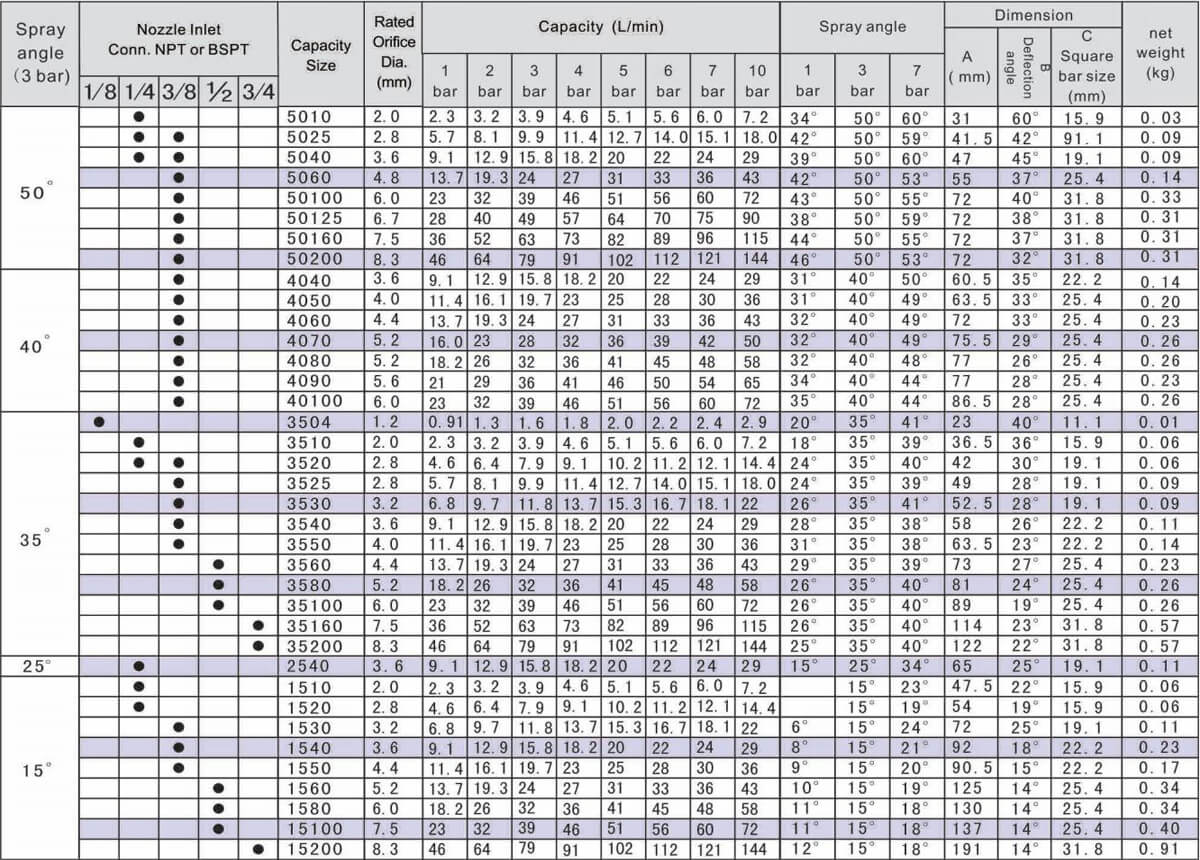
Jeltecn manufactures three flat fan product lines that can be specified with quick-release bodies and self-cleaning internal geometry, covering narrow, standaard-, and wide spray angles so you can match coverage width to nozzle spacing without changing the maintenance approach across a header.
| Product | Typical Spray Angle | Best Fit |
|---|---|---|
| Narrow Angle Flat Fan Nozzle | ~15°–25° | Long, narrow targets: pipe descaling, deep tank rinsing, high-impact spot cleaning |
| Standard Flat Fan Spray Nozzle | ~40°–65° | General washdown, koeling, and lubrication headers |
| Wide-Angle Flat Fan Spray Nozzle | ~80°–110° | Wide coverage at short spray distance: conveyor tunnels, curtain sprays, dust suppression manifolds |
All three lines are available in 303/316 stainless steel and brass, so material selection can be matched to chemical compatibility as well as maintenance frequency. For a full technical comparison of spray angle, orifice size, and pressure-flow data across our flat fan range, see the Flat Fan Spray Nozzle selection guide.

Maintenance Best Practices to Extend Service Life
Even a self-cleaning design benefits from a regular routine: inspect fan angle and pattern uniformity weekly on critical lines, since a distorted or streaky pattern is usually the first visible sign of partial blockage; flush headers before shutdown rather than after startup, so debris does not sit and dry inside the orifice overnight; keep a spare set of tips on hand sized to the same orifice so a quick-release swap can happen without waiting on stock; and log pressure at the header regularly, since a rising pressure at constant flow (or falling flow at constant pressure) usually means partial fouling somewhere in the line before a nozzle fully blocks.
How to Specify a Self-Cleaning Flat Fan Nozzle
To get an accurate recommendation and quote, share the following with our engineering team: liquid type and solids content (including approximate particle size if known), operating pressure and required flow rate per nozzle, spray angle and coverage width needed at your mounting distance, material compatibility requirements (chemical exposure, temperature, food-grade if applicable), and thread size or existing manifold connection so the quick-release adaptor fits your current header without modification.
Frequently Asked Questions
Does a self-cleaning nozzle fully eliminate clogging?
No nozzle is completely immune to blockage if solids are large enough relative to the orifice, but a self-cleaning design significantly reduces frequency and severity compared with a standard fixed-orifice flat fan tip.
Can I retrofit quick-release tips onto an existing header?
In most cases yes, provided the existing thread size and connection type are known. Our team can confirm compatibility or recommend an adaptor.
Do self-cleaning flat fan nozzles cost more than standard tips?
Typically yes, due to the added internal geometry or moving element, but the reduction in labor hours and unplanned downtime usually offsets the difference within the first few maintenance cycles on dirty-water applications.
What spray angle should I choose for a dust suppression header?
Wide-angle flat fan nozzles are generally preferred for dust suppression manifolds because they provide broad coverage at short throw distance; see our Flat Fan vs Full Cone Nozzle comparison if you are also considering full cone coverage for the same application.
Get a Recommendation for Your Application
Tell us about your liquid, flow rate, and maintenance constraints, and our engineers will recommend the right flat fan nozzle body, spray angle, and material for reliable, low-maintenance operation. Contact our team for a free application review, or browse the full Flat Fan Nozzle product range to see specifications and request a quote.