
Wet flue gas desulfurization (FGD) systems remove sulfur dioxide from combustion exhaust by contacting the gas with a limestone or lime slurry, and the spray nozzles that deliver that slurry work in one of the harshest environments in industrial spraying: continuous exposure to abrasive particulate, acidic condensate, and high temperature, running around the clock with essentially no tolerance for nozzle failure. Spiral nozzles are the standard choice for this duty because their open flow passage keeps working with slurry that would quickly block a vaned nozzle.
Quick answer: Spiral nozzles are used in FGD scrubbers because their open helical flow path tolerates the limestone or lime slurry solids content that a conventional vaned nozzle cannot, while still producing the wide-angle full or hollow cone spray needed for effective gas-liquid contact and SO2 absorption.
Why FGD Slurry Demands a Clog-Resistant Nozzle
Limestone slurry used in wet FGD systems typically carries a meaningful percentage of suspended solids by design, since the calcium compounds in the slurry are what react with and neutralize sulfur dioxide. That same solids content is exactly what causes conventional full cone or hollow cone nozzles to block, especially designs that route liquid through a small vaned channel to build the spray pattern. A single blocked nozzle in an absorber tower reduces spray coverage across that level, which can lower SO2 removal efficiency and, over time, contribute to uneven scaling on absorber internals. Because absorber access for maintenance is often limited to scheduled outages, nozzle reliability between shutdowns is a real economic factor, not just a convenience.
How Spiral Nozzles Fit the FGD Absorber
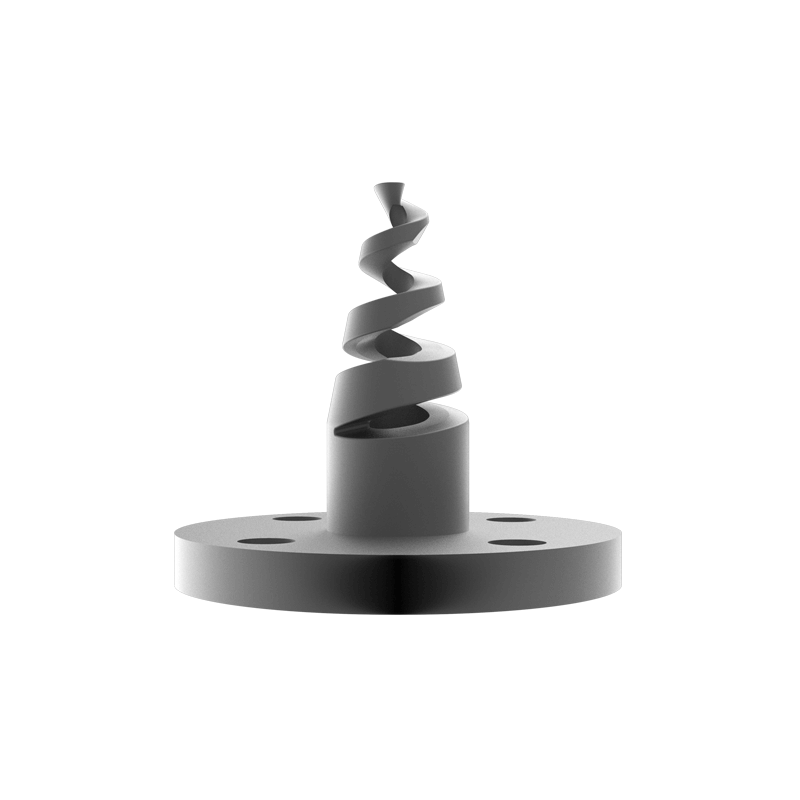
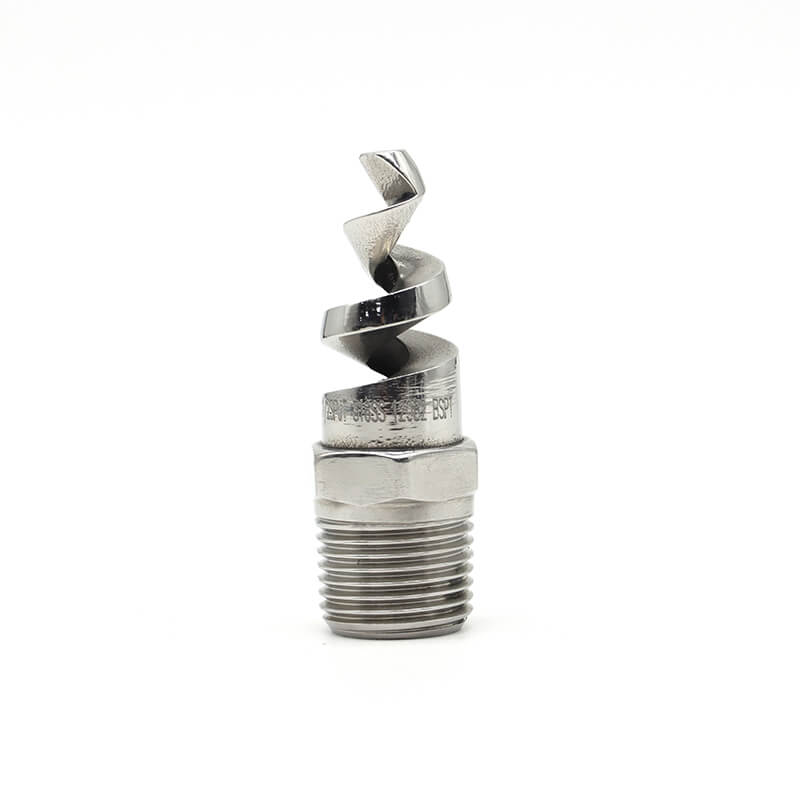
Spiral nozzles are mounted on header laterals inside the absorber tower, spraying downward or across the gas flow path to maximize contact time and surface area between the slurry droplets and the rising flue gas. The open helical ramp design means the nozzle has no narrow vaned passage for scale or solids to catch on, which is why spiral nozzles are sometimes referred to in the industry simply as desulfurization nozzles. Spray angle selection affects how much of the tower cross-section a given header level covers; wider angles reduce the number of nozzles needed per level but require the header to be positioned to avoid excessive wall wetting. For the underlying mechanics of how the spiral design achieves this clog resistance, see our full Spiral Nozzle Guide.
Material Selection for FGD Service
FGD absorber conditions combine abrasion from limestone solids with acidic attack from absorbed SO2 and chloride concentration in recirculated slurry, so material selection matters as much as spray pattern. 316 stainless steel is a common baseline for moderate-duty FGD applications, but many limestone-slurry systems with higher chloride content or lower pH benefit from higher-alloy stainless, or non-metallic materials such as PVDF or silicon carbide where erosion from solids is the dominant wear mechanism rather than corrosion. Confirm your slurry’s chloride concentration, pH range, and solids content with your water treatment or process engineering team before finalizing material selection, since these figures directly affect expected nozzle service life.
| Condition | Typical Material Consideration |
|---|---|
| Moderate solids, moderate chloride | 316 roestvrij staal |
| High chloride or low pH slurry | Higher-alloy stainless or PVDF |
| High solids/abrasive slurry | Silicon carbide or hardened inserts |
Sizing Headers for Absorber Coverage
Absorber towers are typically fitted with multiple spray header levels, each contributing to overall liquid-to-gas ratio and contact time. Nozzle count, spray angle, and mounting elevation per level are engineered together to achieve full cross-sectional coverage without excessive overlap or wall spray, since liquid landing on the tower wall rather than the gas stream does not contribute to SO2 removal. If you are specifying replacement nozzles for an existing absorber, matching existing spray angle and flow rate is usually the safest starting point unless you have specific evidence that current coverage is inadequate; changing spray angle on a subset of nozzles can create uneven coverage across a header. Our related page on Flue Gas Desulfurization Spray Nozzles and our page on Gas Scrubber Spray Nozzles and Liquid Distribution cover header layout principles in more detail for both FGD and general scrubbing duty.
Specifying Nozzles for Your FGD System
Share the following with our engineering team for an accurate recommendation: slurry solids content and particle size, pH and chloride concentration, required flow rate and available pressure at the nozzle, absorber tower diameter and current header layout if replacing existing nozzles, and operating temperature including upset conditions. We can also review existing nozzle specifications if you are matching a legacy system.
Frequently Asked Questions
How often do FGD spray nozzles need replacement?
Service life depends heavily on slurry abrasiveness and chemistry; abrasion-resistant materials and correctly sized free passage both extend service intervals significantly compared with undersized or mismatched materials.
Can spiral nozzles handle both limestone and lime-based slurries?
Ja, spiral nozzles are used across both limestone (forced oxidation) and lime-based FGD chemistries; material selection should still be confirmed against your specific slurry chemistry and solids content.
What spray angle is typical for FGD absorber towers?
Angle selection depends on tower diameter, header elevation, and desired liquid-to-gas ratio; sharing your tower dimensions with our team allows a specific recommendation rather than a general default.
Talk to Our Engineering Team
Share your absorber specifications and slurry chemistry, and we’ll help you specify the right spiral nozzle size, material, and layout for reliable FGD performance. Contact us for an application review, or view the Spiral Spray Nozzle product page.