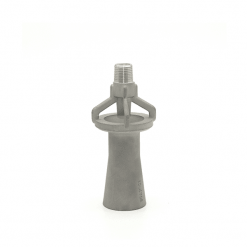
Tank mixing eductors use a pressurized motive stream to entrain surrounding liquid and generate circulation inside a vessel. They are evaluated as part of a complete hydraulic system: tank geometry, pump duty, liquid properties, operating level, mixing objective and installation layout all change the result.
This category is the commercial starting point for Jeltecn mixing eductor selection. For a configuration review, begin with the Tank Mixing Eductor Nozzle product page and send the engineering inputs listed below.
When to consider a mixing eductor
An eductor can be considered when an external recirculation loop is available and the process needs liquid blending, concentration or temperature uniformity, reduced dead zones, or selected solids-suspension duty. It has no rotating element inside the tank, but it is not a universal replacement for an agitator. High viscosity, rapidly settling solids, foaming, gas transfer, sanitary requirements or a very short mixing-time target can change the preferred technology.
Selection starts with the process result
| Question | Information to provide | Design impact |
|---|---|---|
| What must be mixed? | Composition, density, viscosity, temperature and solids | Hydraulics, compatibility, passage size and wear |
| What is the tank geometry? | Diameter, height, volume, internals and level range | Quantity, location, orientation and effective flow field |
| What pump duty is available? | Pump curve, measured flow, pressure and return piping | Actual motive flow at each eductor |
| What is the objective? | Blending, turnover, temperature uniformity or suspension | Acceptance test and required circulation |
| What connection is required? | Size, thread or flange standard and piping material | Mechanical compatibility and pressure loss |
Do not select from an entrainment ratio alone
Published entrainment or circulation ratios are model- and condition-specific. The design must use the selected eductor performance curve at the pressure available at the nozzle, after accounting for pipe, valve, elevation and fitting losses. A ratio quoted for another size or manufacturer is useful background, not a guaranteed system result.
Recommended engineering workflow
- Define the process objective and an observable acceptance condition.
- Calculate the working volume at minimum and maximum liquid levels.
- Establish a preliminary turnover or circulation requirement.
- Determine the pump operating point and pressure available at the eductor header.
- Select size and quantity from verified model performance data.
- Lay out the units to sweep the tank while avoiding short-circuiting into the suction or return.
- Confirm performance during commissioning and record the actual operating point.
Technical resources
- Mixing Eductor Guide: operation, selection and applications
- What Is an Eductor Nozzle?
- Tank Mixing Eductor Sizing Calculator
- How Many Eductors Does a Tank Need?
- Tank Eductor Placement and Orientation
- Pump Sizing for Tank Mixing Eductors
- Tank Turnover Rate and Mixing Time
- Tank Eductor Troubleshooting
Request a configuration review
Provide the tank drawing or dimensions, operating levels, fluid data, pump curve or measured operating point, return-piping layout, connection requirements, material restrictions and the result the process must achieve. Hard performance claims should be confirmed against the final configuration and operating conditions.
Send your tank and pump data to Jeltecn for an eductor selection and quotation.