
Compare flat fan spray nozzles for industrial cleaning, rinsing, coating, cooling, lubrication and product transfer. Select the product route from the required spray angle and coverage width, then confirm flow at pressure, impact, stand-off distance, nozzle spacing and overlap, connection, liquid properties and material compatibility.
This category is the commercial owner for flat fan nozzle comparison and quotation intent. Review the standard, narrow-angle and wide-angle products below, or use the Flat Fan Spray Nozzle Engineering Guide for working principle, spray-angle tradeoffs and header-design checks.


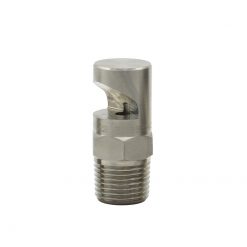

How to Select Flat Fan Spray Nozzles
A flat fan nozzle produces a line-shaped spray for processes that need coverage across a width or concentrated impact on a target. The correct choice depends on the installed operating point and layout—not the nominal spray angle alone. Confirm performance from the model-specific flow table before releasing a purchase order or setting a multi-nozzle header.
| Selection item | What to confirm | Why it matters |
|---|---|---|
| Spray angle | Target width, mounting height and available space | Narrower angles concentrate impact; wider angles increase coverage at a given distance. |
| Flow and pressure | Required flow per nozzle and pressure available at the nozzle inlet | Flow, droplet behavior and impact change with actual nozzle pressure. |
| Header layout | Nozzle spacing, orientation, overlap and edge coverage | Incorrect spacing can create dry zones or heavy double-coverage bands. |
| Impact and distance | Required cleaning force and stand-off distance from the target | Impact falls as the spray travels and spreads across a wider area. |
| Liquid condition | Viscosity, temperature, solids and filtration | These inputs affect pattern quality, blockage risk, wear and material selection. |
| Connection and material | Thread standard, size, orientation, chemistry and cleaning method | Prevents installation mismatch and premature corrosion or erosion. |
Choose a Product Route
- Flat Fan Spray Nozzles: start here for general industrial line-pattern spraying, cleaning, rinsing, cooling or coating requirements.
- Narrow-Angle Flat Fan Nozzle: evaluate when concentrated impact or a narrower coverage band is required.
- Wide Angle Flat Fan Spray Nozzles: evaluate when broad coverage is required at a limited mounting distance.
The product name is only the first filter. Verify flow, pressure, angle, distance, overlap and liquid condition against the application before selecting a model.
Flat Fan Nozzle Applications in Manufacturing
- Parts washing and pretreatment: define the target width, contamination, cleaning chemistry, line speed and required impact. See flat fan nozzles for parts washing and pretreatment.
- Roll cooling and descaling: confirm heat load, spray density, header geometry, pressure and the acceptable overlap profile. Review flat fan nozzles for rolling mills.
- PCB and electronics cleaning: consider liquid compatibility, contamination removal, nozzle spacing and downstream drying. See flat fan nozzles for PCB cleaning lines.
- Lubrication and coating: specify coverage width, application rate, viscosity and uniformity requirement. Review flat fan nozzles for conveyor and chain lubrication.
Flat Fan vs Full Cone Spray
Use a flat fan pattern when the target is a line, moving web, conveyor width or high-impact cleaning zone. Use a full cone pattern when liquid must fill a circular or square area. If the pattern decision is still open, review the Flat Fan vs Full Cone Nozzle comparison and the Full Cone Spray Nozzle Guide.
Flat Fan Header Design and Maintenance Resources
Use these engineering checks after choosing the spray pattern. They support the category and product pages without replacing model-specific flow tables or installation verification.
- Spray nozzle spacing and overlap: calculate a starting header layout, then verify distribution on the installed line.
- Flow rate and pressure relationship: estimate a new operating point and identify when a model-specific table is still required.
- Spray nozzle materials guide: compare stainless steel, brass and plastic against fluid chemistry and operating conditions.
- NPT, BSPT and BSPP thread guide: avoid connection mismatches during replacement or header retrofit work.
- Spray nozzle corrosion guide: review warning signs, material limits and inspection actions.
- Self-cleaning flat fan nozzles: review clogging, quick-release construction and maintenance tradeoffs.
- Strip cooling nozzle design: review flat fan geometry, overlap and impact for runout tables.
Information to Include in a Flat Fan Nozzle RFQ
For a useful engineering and quotation review, send:
- Application and required result: cleaning force, coverage width, cooling, coating or lubrication.
- Liquid name, viscosity, temperature, solids and filtration information.
- Required flow per nozzle and available pressure at the nozzle inlet.
- Target width, mounting height, stand-off distance and header layout.
- Preferred spray angle, connection standard, material and quantity.
- Destination country, documentation requirements, drawing or installation photos.
For an existing line, include the current nozzle marking and the problem being corrected, such as streaking, incomplete coverage, weak impact, blockage or uneven wear. For a new line, include target dimensions and the proposed nozzle positions so spacing and overlap can be reviewed before installation.
Manufacturing and Distributor Enquiries
Manufacturing plants and system integrators should provide process conditions and layout data so the nozzle is evaluated as part of the installed system. Distributors and wholesalers should also state target markets, expected annual volume, required documentation, packaging or marking requirements and whether evaluation samples are needed. These inputs help distinguish application selection from stocking and resale requirements.
Frequently Asked Questions
Does a wider angle always give better coverage?
A wider angle increases nominal coverage at a given distance, but the usable pattern still depends on pressure, mounting height, edge taper and neighboring-nozzle overlap.
How can streaking be reduced on a spray header?
Check nozzle spacing, orientation, mounting height, pressure balance and wear. Adjacent tapered-edge patterns normally require controlled overlap; mixing worn and new nozzles can also produce uneven bands.
What is needed to compare narrow-angle and wide-angle models?
Provide the target width, required impact, stand-off distance, flow, pressure, liquid condition and available installation space.
Request a Flat Fan Spray Nozzle Review
Send the operating data, layout and quantity for product selection and quotation. Contact Jeltecn about flat fan spray nozzles.