
Compare spiral spray nozzles for gas scrubbing, flue-gas desulfurization (FGD), cooling, quenching, process washing and dust control. Start with the required full-cone or hollow-cone pattern, then confirm flow at the nozzle, operating pressure, spray angle, suspended solids, liquid chemistry, temperature, connection and installation geometry.
This category is the commercial selection page for buyers evaluating products and requesting a quotation. View the spiral spray nozzle for gas scrubbing, or read the Spiral Nozzle Engineering Guide for working principle, technical comparisons and maintenance guidance.

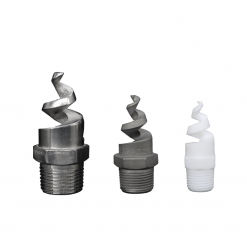
How to Select Spiral Spray Nozzles
Spiral geometry provides an open liquid path and broad spray coverage, which makes this nozzle family a practical starting point for dirty-water, slurry and high-flow duties. It does not make every model suitable for every process. Size the nozzle from actual operating data and confirm the selected model against a model-specific performance table before releasing a purchase order.
| Selection item | What the buyer should confirm | Why it matters |
|---|---|---|
| Spray pattern | Full cone or hollow cone | Determines whether liquid fills the cone or is concentrated toward its perimeter. |
| Flow and pressure | Required flow per nozzle and pressure available at the nozzle inlet | Pump pressure alone does not include piping, elevation and header losses. |
| Coverage | Spray angle, spray distance, vessel or duct dimensions, lance position and overlap | Prevents dry zones, excessive wall wetting and poor use of the available spray area. |
| Liquid and solids | Chemistry, temperature, viscosity, specific gravity, particle size and solids concentration | Controls free-passage, deposition, corrosion, erosion and material decisions. |
| Connection | NPT or BSPT, male or female thread, size, orientation and insertion length | Avoids incompatible threads and installation rework. |
| Material | Process chemistry, temperature, abrasive loading and expected service life | Material should be selected from the real duty, not from price alone. |
Full-Cone or Hollow-Cone Spiral Pattern?
Full-cone spiral nozzles are generally evaluated when liquid must be distributed throughout a three-dimensional volume. Hollow-cone spiral nozzles concentrate liquid toward the outside of the cone and may suit perimeter interaction or rapid gas cooling. The final decision should consider distribution, droplet behaviour, gas velocity, installed geometry and downstream separation—not spray angle alone.
If the liquid is clean and uniform distribution is more important than free passage, compare a conventional design in the Full Cone Spray Nozzle Guide. For a direct design comparison, see Spiral Nozzle vs Full Cone Nozzle.
Common Industrial Applications
- Gas scrubbing and FGD: evaluate slurry properties, liquid-to-gas duty, vessel geometry, nozzle arrangement and mist elimination. See the FGD spiral nozzle selection guide.
- Cooling and quenching: confirm temperature profile, evaporation target, droplet carryover limits, spray distance and available pressure.
- Dust suppression: match coverage and droplet behaviour to the transfer point, crusher or stockpile while accounting for water quality and wind. Review spiral nozzles for mining dust suppression.
- Process washing: define the required impact, coverage, contamination load, drainage and cleaning access.
Product and Technical Routes
For the current product family, review Spiral Spray Nozzles for Gas Scrubbing. Use the product page for the available configuration, application fit and quotation path. Use the technical Spiral Nozzle Guide for mechanism, specification references, installation and maintenance. Buyers who are already defining a connection and material can use the sizing, materials and thread selection guide.
Information to Include in Your RFQ
For a useful first review, send:
- Application and required process result.
- Liquid name, concentration, temperature, viscosity and specific gravity.
- Suspended-solids concentration and maximum particle size.
- Target flow per nozzle and available pressure at the nozzle inlet.
- Required spray pattern, angle, spray distance and coverage geometry.
- Connection standard and size, preferred material, quantity and destination country.
- Installation drawing, header layout or photos of the spray zone when available.
For replacement projects, include the existing nozzle marking, thread dimensions and operating problem. For new systems, state the result that must be achieved and any failure mode—plugging, wall wetting, carryover, erosion or uneven coverage—that the selection must avoid.
Manufacturing and Distributor Enquiries
Manufacturing plants and system integrators should include operating conditions and drawings so the nozzle can be reviewed as part of the installed process. Distributors and wholesalers should also state the destination markets, expected annual volume, required documentation, packaging or marking requirements and whether samples are needed for evaluation. These inputs help separate a technical selection request from a stocking or resale enquiry without making assumptions about the final configuration.
Frequently Asked Questions
Are spiral spray nozzles clog-proof?
No. Their open geometry can improve free passage and reduce blockage sensitivity, but particle size, solids concentration, deposition, filtration, orifice size, pressure and maintenance access still determine reliability.
What is the minimum information needed for sizing?
Provide the liquid properties, solids information, flow per nozzle, pressure at the nozzle, pattern, angle, connection, material, temperature and required coverage distance.
Can I select a nozzle from spray angle alone?
No. Spray angle is only one input. Flow, pressure, droplet behaviour, overlap, vessel geometry, wall clearance and the process objective must be reviewed together.
Request a Spiral Spray Nozzle Review
Send your operating data, quantity and installation information for product selection and quotation. Contact Jeltecn about spiral spray nozzles.