
Compare tank cleaning nozzles for rinsing and cleaning process vessels, storage tanks, drums and intermediate bulk containers. Start with the residue and required cleaning result, then confirm tank dimensions, access opening, spray coverage, impact, flow and pressure at the nozzle, connection, cycle time, liquid chemistry, temperature and material compatibility.
This category is the commercial comparison and quotation owner for tank cleaning nozzle requirements. Review the current Tank Cleaning Nozzle for Pressure Washers product route below and use the selection checklist to prepare operating data for review.

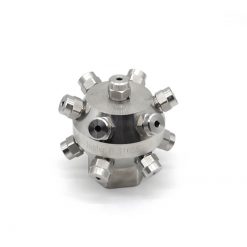
How to Select Tank Cleaning Nozzles
A tank cleaning nozzle must distribute enough liquid and impact across the internal surfaces that actually require cleaning. A nominal 360-degree pattern does not by itself confirm cleaning performance. Select from the residue, vessel geometry, available utilities and required cycle, then validate coverage under representative conditions.
| Selection item | What to confirm | Why it matters |
|---|---|---|
| Cleaning duty | Rinse, removal of deposits, product changeover or general wash-down | The required result determines impact, flow, cycle time and validation method. |
| Tank geometry | Diameter, height, internal obstructions, shadow areas and drain position | Internal fittings can block spray paths and leave surfaces untreated. |
| Access and installation | Insertion opening, connection, mounting position, clearance and removal access | The nozzle must fit the opening and develop its pattern without interference. |
| Flow and pressure | Flow available per nozzle and pressure at the nozzle inlet | Piping and elevation losses can reduce rotation, impact and coverage. |
| Residue and liquid | Residue type, cleaning chemistry, temperature, viscosity and solids | These inputs affect cleaning difficulty, blockage risk and material compatibility. |
| Coverage and cycle | Required spray angles, target surfaces, cleaning duration and duty frequency | Coverage should be evaluated against the actual vessel and operating cycle. |
| Material and maintenance | Body, seals, wear parts, flushing, inspection and replacement criteria | Corrosion, wear or deposit buildup can change flow and spray performance. |
Current Product Route
The category currently lists the Tank Cleaning Nozzle for Pressure Washers, a pressure-supplied rotating product route with listed 180-degree, 270-degree and 360-degree configurations. Use the product page for current specifications and model information. Use this category page to compare the cleaning duty, vessel constraints and quotation inputs before selecting a configuration.
If the project requires a fixed spray head, a different rotation mechanism or another connection arrangement, state that requirement explicitly in the RFQ instead of assuming that adjacent tank-washing terms describe an interchangeable product.
Rotary vs Fixed Tank Cleaning Approach
Fluid-driven rotary nozzles use the supplied liquid to create movement and distribute jets around the vessel. Their performance depends on inlet pressure, flow, residue load, orientation and freedom of movement. Fixed spray devices have no rotating mechanism and can simplify maintenance, but complete vessel coverage may require careful placement or multiple devices. The correct approach depends on cleaning result, tank geometry, access, utilities and maintenance policy.
Common Industrial Evaluation Areas
- Process vessels and mixing tanks: document internal coils, agitators, baffles, manways and shadow areas.
- Storage tanks and drums: define residue, drainability, tank diameter, height and required rinse result.
- Intermediate bulk containers: confirm access opening, installed clearance, connection method and whether the nozzle must be portable.
- Equipment wash-down: distinguish internal vessel cleaning from external surface cleaning and identify the target distance and impact requirement.
Information to Include in a Tank Cleaning Nozzle RFQ
For a useful engineering and quotation review, send:
- Tank or vessel type, diameter, height and internal drawing.
- Access opening, proposed nozzle location, connection and available clearance.
- Residue or contamination and the required cleaning result.
- Cleaning liquid, concentration, temperature, viscosity and solids.
- Available flow and pressure at the nozzle inlet.
- Required coverage, cycle time, operating frequency and drainage conditions.
- Material restrictions, quantity, destination country and documentation requirements.
For replacement projects, include the existing nozzle marking, dimensions and the observed failure mode, such as incomplete coverage, stalled rotation, low impact, blockage, excessive cycle time or premature wear. For new systems, include drawings or photos showing internal obstructions and the intended installation point.
Manufacturing and Distributor Enquiries
Manufacturing plants and system integrators should provide vessel and process data so the nozzle can be reviewed as part of the complete cleaning arrangement. Distributors and wholesalers should also state target markets, expected annual volume, required documentation, packaging or marking requirements and whether samples are needed for evaluation. These inputs distinguish application selection from stocking and resale requirements.
Frequently Asked Questions
Does a 360-degree spray guarantee complete tank cleaning?
No. Internal coils, baffles, agitators and vessel geometry can create shadow areas. Coverage and cleaning result should be checked in the actual installation.
Why is pressure at the nozzle important?
Pump discharge pressure does not include piping and elevation losses. The pressure delivered at the nozzle affects flow, impact and the operation of fluid-driven rotation.
What information is needed before choosing a connection size?
Confirm the required flow, pressure, tank opening, mounting arrangement, clearance, cleaning result and material before finalizing the connection.
Request a Tank Cleaning Nozzle Review
Send the vessel drawing, residue, operating data and quantity for product selection and quotation. Contact Jeltecn about tank cleaning nozzles.