
Spiral Nozzle Vs Full Cone selection depends on the required spray pattern, coverage uniformity, free passage, pressure range and tolerance for clogging.
Spiral and full cone nozzles can both produce a cone-shaped spray, and at a glance a spec sheet comparison might suggest they’re interchangeable. In practice, the internal design difference between the two, an open helical ramp versus a small vaned deflector, matters far more than the pattern shape alone once solids, fibers, or scale are present in your liquid.
This comparison walks through when each design is the better starting point, using the same kind of side-by-side reasoning as our Flat Fan vs Full Cone Nozzle comparison.
Quick answer: Choose a spiral nozzle when your liquid carries solids, fibers, or sludge that would block a vaned nozzle, since its open flow passage trades some distribution precision for much better clog resistance; choose a vaned full cone nozzle when your liquid is clean or lightly filtered and uniform, precise distribution matters more than clog resistance. This spiral nozzle vs full cone decision ultimately comes down to how much particulate your liquid carries; for general engineering background on spray nozzle geometry, see Wikipedia’s nozzle design overview.
Spiral Nozzle vs Full Cone: The Core Difference (Open Ramp vs. Vaned Channel)
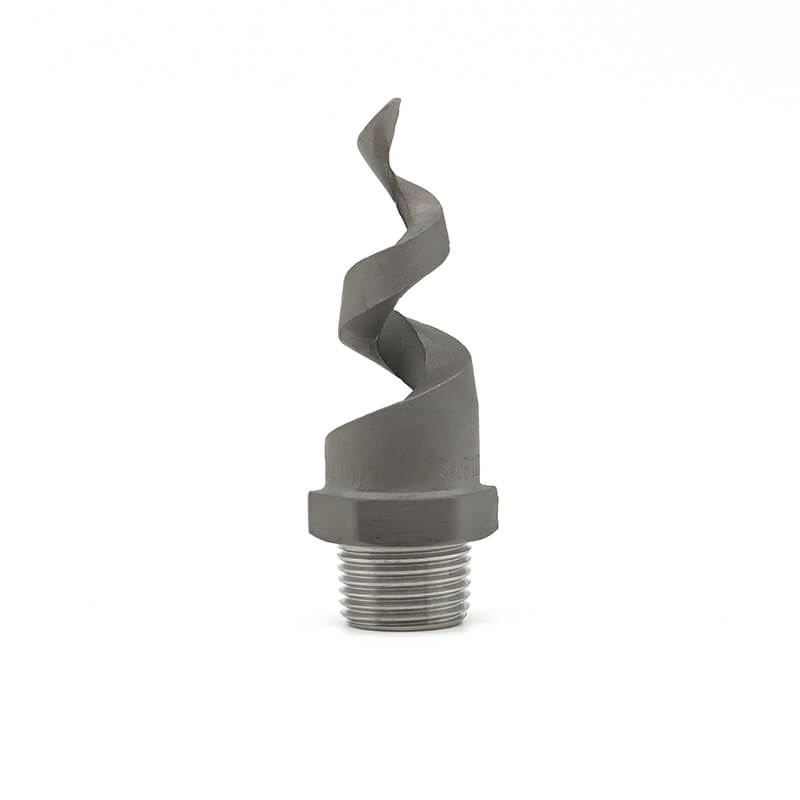
A vaned full cone nozzle (such as Jeltecn’s BB/BBG series) routes liquid through a set of internal vanes or a core insert that splits and redirects flow to build a uniform, evenly distributed cone pattern. That internal geometry is precisely what gives vaned nozzles their strength, consistent, repeatable distribution across the full spray cone, but it also creates the narrow passages where fibers and solids catch and build up over time. A spiral nozzle instead directs liquid along an open helical ramp with no small vanes or narrow channels; the liquid spins and breaks up as it travels the ramp and exits the orifice. This open geometry is inherently more tolerant of solids, at some cost to distribution uniformity compared with a vaned design.
Side-by-Side Comparison
| Factor | Spiral Nozzle | Vaned Full Cone Nozzle |
|---|---|---|
| Clog resistance | High – open passage | Moderate – narrower vaned channel |
| Distribution uniformity | Moderate | High – even grid coverage |
| Best liquid type | Slurry, high-solids, fibrous | Clean or lightly filtered water |
| Typical duty | Gas scrubbing, dust suppression, wastewater | Precise cooling, washing, coating coverage |
| Size range | 1/4″ to 4″ | Wide range, application-dependent |
Worked Scenario 1: Limestone Slurry in an FGD Scrubber
A flue gas desulfurization absorber sprays limestone slurry with meaningful suspended solids content into the exhaust stream continuously, with maintenance access limited to scheduled outages. Here, clog resistance is the dominant requirement, since a single blocked nozzle reduces coverage until the next planned shutdown. A spiral nozzle is the clear starting point. See our dedicated article on spiral nozzles for FGD systems for more detail on this application.
Worked Scenario 2: Precision Rinse on a Clean Water Line
A parts-washing rinse stage using filtered mains or treated water needs even, predictable coverage across a conveyor width, with no meaningful solids content to worry about. Here, distribution precision matters more than clog resistance, and the added uniformity of a vaned full cone nozzle is worth more than the anti-clogging advantage a spiral design would offer but not need. A vaned full cone nozzle is the better starting point in this scenario; see our Full Cone Spray Nozzle guide for selection details.
Worked Scenario 3: Recycled Water Dust Suppression
A crusher or conveyor transfer point using recycled pond water for dust suppression combines two factors that favor a spiral nozzle: the water carries sediment, and the application tolerates the moderate distribution precision a spiral nozzle provides. See our article on spiral nozzles for dust suppression for placement and sizing guidance specific to this use case.
Worked Scenario 4: Wastewater Cooling or Aeration
Wastewater and effluent streams often carry enough suspended solids and organic matter to make clog resistance the deciding factor, even when the specific process (cooling, aeration, or general treatment spraying) doesn’t sound as demanding as gas scrubbing. As a general rule, if you’re unsure whether your liquid is “dirty enough” to warrant a spiral nozzle, err toward spiral for any water source that isn’t filtered or treated to a known clean standard.
When the Choice Isn’t Obvious
Some applications sit in a gray zone: moderately clean water with occasional solids excursions, or a process where distribution precision matters but occasional clogging incidents are tolerable. In these cases, consider your maintenance access and the cost of an unplanned stop; if downtime is expensive or access is infrequent, the clog-resistance margin of a spiral nozzle is usually worth the moderate reduction in distribution precision. If you’re still unsure, share your liquid composition, distribution requirements, and maintenance constraints with our engineering team for a specific recommendation.
Frequently Asked Questions
Can I use a spiral nozzle even if my liquid is clean?
Yes, but you may be trading away distribution precision you don’t need to gain clog resistance you don’t need either; a vaned full cone nozzle is usually the more efficient choice for clean liquids.
Is there a nozzle that offers both high clog resistance and high distribution precision?
Not fully; the design tradeoff between open-passage clog resistance and vaned distribution precision is inherent to how each nozzle type builds its spray pattern. Selecting correctly for your specific liquid and priorities is the practical solution.
How do I know my solids content is high enough to need a spiral nozzle?
As a rule of thumb, any water source with visible sediment, recycled process water, or process slurry with intentional solids content (like limestone slurry) warrants a spiral nozzle; share your specific water source with us if you’re unsure.
Get a Selection Recommendation
Tell us about your liquid, application, and maintenance constraints, and we’ll help you decide between a spiral nozzle and a vaned full cone nozzle. Contact our team, or view the Spiral Spray Nozzle product page.