
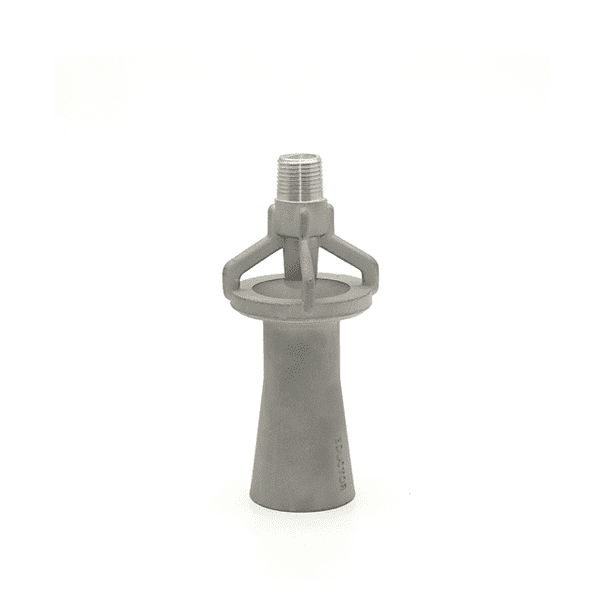
A tank mixing eductor nozzle uses a pressurized motive stream and the jet pump (Venturi) effect to entrain surrounding liquid and create circulation inside a vessel. It is typically considered when a process needs in-tank blending without a rotating shaft or when an existing recirculation loop can provide the required motive flow.
Jeltecn configures tank mixing eductors against the actual tank geometry, liquid properties, operating level, pump duty and mixing objective. A model should not be selected from connection size alone: induced flow, effective flow field and mixing time depend on the complete hydraulic system and must be checked against performance data.
Use the mixing eductor selection guide for the complete technology overview, or read what an eductor nozzle is and how it works before starting the calculation.
Where a Tank Mixing Eductor Nozzle Fits
- Blending compatible liquids in storage or process tanks
- Maintaining concentration uniformity during recirculation
- Reducing dead zones in tanks with fixed internal equipment
- Supporting suspension duties when particle size, settling behavior and passage size have been reviewed
- Retrofits where an external pump loop is already available
Once the application is confirmed, see Placement and Orientation for guidance on where to mount eductors inside the tank.
Materials, Connections and Typical Performance
Jeltecn tank mixing eductors are available in 316 stainless steel, PVC, polypropylene and PVDF, so the body and wetted parts can be matched to the liquid being handled and its temperature. Smaller sizes use NPT or BSPT threaded connections; larger models are supplied flanged. Entrainment ratio, the volume of tank liquid moved for every unit of motive liquid, is typically around 4:1, though the ratio actually achieved depends on the motive pressure available at the eductor inlet rather than on pump discharge pressure alone. Because the correct size and material depend on your tank and pump data, Jeltecn confirms the specific configuration against the inputs below rather than from a catalog number alone.
Engineering Information We Need From You
Send the six items below and Jeltecn will check them against verified performance data before recommending a configuration.
| Input | Why it matters |
|---|---|
| Tank dimensions and operating levels | Define volume, flow path, submergence and possible dead zones. |
| Liquid density, viscosity and temperature | Affect hydraulic performance, pressure loss and material choice. |
| Motive flow and pressure at the eductor | Determine the operating point; pump discharge pressure alone is not sufficient. |
| Mixing objective | Blending, turnover, solids suspension and temperature uniformity require different validation. |
| Solids and contamination | Drive passage-size, filtration, wear and maintenance decisions. |
| Connection and material requirements | Must match the piping system and process compatibility review. |
Not sure about the motive flow and pressure figures yet? Use the Sizing Calculator and the Pump Sizing guide to estimate them before you contact us.
How Jeltecn Selects and Verifies Your Configuration
- Define the process result and the worst-case operating condition.
- Calculate tank volume and a preliminary circulation requirement.
- Determine available motive flow after piping and fitting losses.
- Select an eductor configuration from verified performance data.
- Check quantity, location, orientation and submergence against the tank layout.
- Confirm the design through commissioning observations or process-specific testing.
See Quantity and Coverage to estimate how many eductors your tank needs, and Turnover and Mixing Time to check the circulation rate against your process target.
Tank Mixing Eductor vs. Mechanical Agitator
Specify a tank mixing eductor when the process needs blending, circulation or anti-settling without a motor, shaft seal or moving part inside the tank, particularly in hazardous, corrosive or hard-to-access vessels, or in retrofits where installing a side-entry mixer is impractical. A mechanical agitator is usually the better starting point when the process needs precise, high-shear mixing or blending of high-viscosity fluids. See the full comparison, including entrainment ratio and sizing math, in the mixing eductor guide. If an existing eductor installation is not performing as expected, see Troubleshooting.
Request an Engineered Recommendation
Send the tank drawing or dimensions, minimum and maximum liquid levels, liquid properties, pump curve or measured flow and pressure, connection standard, material restrictions and the required mixing result. Jeltecn will review these inputs before recommending a configuration. Published examples or ratios from another model should not be treated as a guaranteed result for a different system.
Send your tank and pump data for an eductor review and quotation.