
In marine exhaust gas scrubbing, there is no single nozzle that fits every wash-water condition, scrubber design, and duct layout. The nozzle that performs well in an open-loop seawater tower is frequently the wrong choice for a closed-loop caustic system, and a nozzle chosen for a fine polishing stage will usually underperform at a bulk-absorption stage lower in the same duct. Selection is driven by spray purpose (bulk absorption, wall wetting, or fine polishing), spray pattern, flow rate, operating pressure, droplet size, impact energy, coverage geometry, wash-water chemistry, gas temperature, material compatibility with acidic wash water, clogging risk from suspended solids or scale, and how the nozzle is mounted and serviced inside the tower. This guide compares the nozzle types actually used across exhaust gas cleaning systems (EGCS) so engineers, procurement teams, and OEMs can narrow the field before requesting a specific model.

Selection Matrix: Nozzle Options by Scrubber Application
| Application | Recommended Nozzle | Spray Pattern | Main Advantage | Key Selection Factor | Main Risk |
|---|---|---|---|---|---|
| Open-loop seawater bulk absorption (lower tower) | Spiral (vaned) full cone nozzle | Full cone | High resistance to clogging on untreated, particulate-laden seawater | Free passage diameter | Coarser, less uniform droplets reduce absorption efficiency per liter |
| Closed-loop caustic (NaOH) absorption | Standard hydraulic full cone nozzle | Full cone | Finer, more uniform droplets improve SO2 absorption per unit of liquid | Droplet size and liquid-to-gas ratio | Higher exposure to blockage from caustic scaling and precipitate |
| Upper spray deck / wall-wetting and fine polishing | Hollow cone nozzle | Hollow cone | Concentrated ring coverage that wets duct walls efficiently with less water in the open center | Spray angle and pattern overlap between adjacent nozzles | Leaves the duct core under-scrubbed if used alone without a full cone stage |
| Bulk gas quenching / cooling section | Large free-passage full cone nozzle | Full cone | High flow at low pressure drop, simple and robust | Flow rate and orifice size | Coarse droplets increase wash-water demand for the same cooling duty |
| Fine-mist polishing / inlet gas conditioning | Twin-fluid (air-atomizing) nozzle | Fine full cone / mist | Very fine, controllable droplets largely independent of liquid pressure | Compressed air availability and air-to-liquid ratio | Added onboard complexity and a compressed-air supply requirement |
| Wash-water effluent neutralization tank | Flat fan or plastic-lined full cone nozzle | Flat fan / full cone | Chemical resistance to treated, near-neutral effluent | Material compatibility with the specific effluent chemistry | Limited pressure and temperature range compared with metal nozzles |
Nozzle Types Explained
Spiral (Vaned) Full Cone Nozzle
Why it works: an open helical vane replaces the narrow internal core found in conventional full cone nozzles, giving debris and scale a path through the nozzle instead of a place to lodge.
Where it works: open-loop seawater towers and any stage where wash water is untreated, recycled, or carries suspended solids — which describes most bulk-absorption sections in marine EGCS.
Where it does not work: fine-polishing stages where droplet uniformity and smaller average droplet size matter more than clog resistance; a spiral nozzle used there wastes absorption potential.
What parameters matter most: free passage diameter relative to expected particulate size, operating pressure, and the number of nozzles needed to achieve full cross-sectional coverage of the tower.
What operators commonly get wrong: assuming a spiral nozzle’s coarser pattern is a defect rather than a deliberate trade-off, then specifying it in a polishing stage where a finer, uniform pattern was actually required.
Standard Hydraulic Full Cone Nozzle
Why it works: an internal vane shapes a uniform, evenly distributed circular spray with finer droplet control than a spiral design.
Where it works: closed-loop systems running filtered caustic wash water, where absorption efficiency benefits from smaller, more uniform droplets and clogging risk is lower because the liquid is cleaner.
Where it does not work: untreated seawater circuits or any point downstream of a filter that is not maintained on a strict schedule, since the narrower internal passage blocks more easily than a spiral design.
What parameters matter most: operating pressure (droplet size decreases as pressure increases), flow rate per nozzle, and the condition of upstream filtration.
What operators commonly get wrong: specifying a standard full cone nozzle on once-through seawater without adequate filtration, then treating the resulting clogging as a product defect rather than a filtration gap.
Hollow Cone Nozzle
Why it works: liquid is concentrated at the outer edge of the spray pattern, which is efficient for wetting the inner wall of a cylindrical duct without spraying water into open space where no gas contacts the liquid.
Where it works: upper spray decks intended for wall-wetting and fine polishing, and rings of hollow cone nozzles arranged around the duct perimeter.
Where it does not work: as the sole spray stage in a tower, since the dry center of each hollow cone pattern leaves gas passing through the middle of the duct with less liquid contact than gas passing near the wall.
What parameters matter most: spray angle, mounting radius relative to duct diameter, and the degree of pattern overlap between adjacent nozzles around the ring.
What operators commonly get wrong: relying on hollow cone nozzles alone for overall SOx removal instead of pairing them with a full cone bulk-absorption stage lower in the tower.
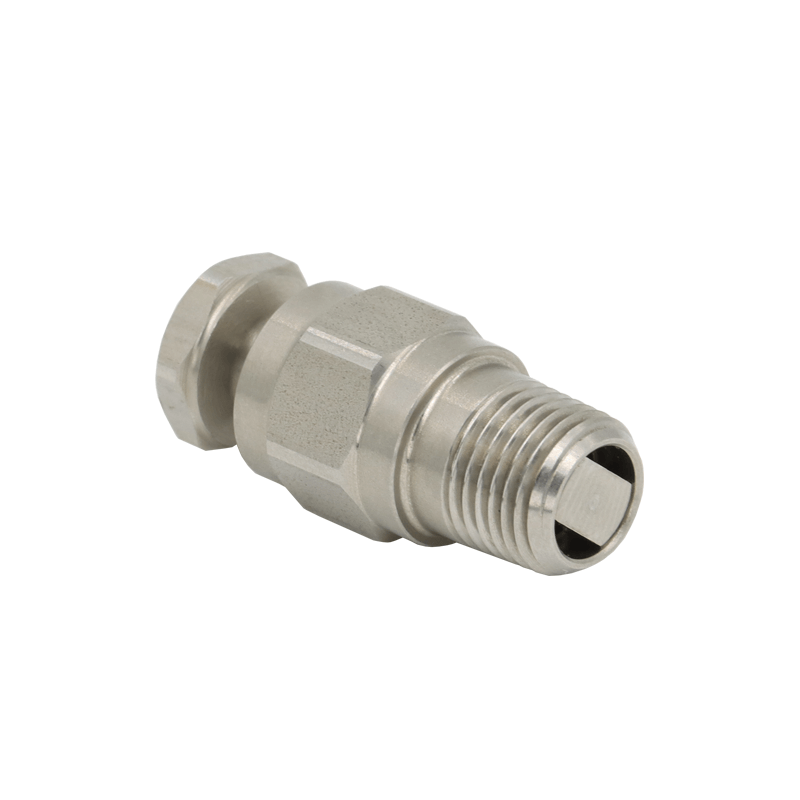
Large Free-Passage Full Cone Nozzle
Why it works: a large orifice and simple internal geometry allow high flow at comparatively low pressure, prioritizing throughput and reliability over droplet fineness.
Where it works: gas quenching and cooling sections where the main requirement is rapidly reducing exhaust gas temperature before it reaches absorption stages, rather than maximizing SOx absorption per liter.
Where it does not work: absorption-critical stages where droplet size directly affects removal efficiency and water consumption needs to stay within the vessel’s wash-water treatment capacity.
What parameters matter most: flow rate at the available pressure, and the resulting gas temperature drop across the quench section.
What operators commonly get wrong: using quench-section nozzles in absorption stages to save on equipment variety, which increases water consumption without improving SOx removal.
Twin-Fluid (Air-Atomizing) Nozzle
Why it works: compressed air, not liquid pressure, does most of the work of breaking the liquid into fine droplets, decoupling droplet size from water flow rate.
Where it works: fine-mist polishing or inlet gas conditioning stages where very fine, consistent droplets are valuable and a compressed air supply is already available onboard.
Where it does not work: bulk-absorption or quench stages that need high flow rates, since twin-fluid nozzles are generally lower-flow devices built for atomization quality rather than throughput.
What parameters matter most: air-to-liquid ratio, atomizing air pressure, and reliability of the compressed air supply under all engine load conditions.
What operators commonly get wrong: specifying twin-fluid nozzles for their fine droplets without confirming the vessel’s compressed air system can support continuous operation at full scrubber load.
Engineering Trade-offs: There Is No Universally Correct Answer
Pressure vs. flow: raising pressure at a fixed orifice size reduces droplet size but increases pump energy demand; increasing orifice size raises flow at a given pressure but produces coarser droplets. If fine atomization is the priority, favor higher pressure at a smaller orifice. If throughput with lower pump load is the constraint, a larger orifice at moderate pressure may be more suitable.
Droplet size vs. drift: very fine droplets absorb SOx more efficiently per liter but are more easily carried by exhaust gas velocity into the mist eliminator or stack, increasing wash-water carryover. If absorption efficiency is the priority, choose finer droplets and pair them with adequate mist elimination. If minimizing carryover and protecting downstream equipment is the constraint, a moderately coarser droplet may be more suitable.
Impact vs. coverage: a smaller number of higher-impact nozzles penetrate a dense gas stream more effectively at a single point, while a larger number of lower-impact, wider-pattern nozzles maintain even coverage across the full duct cross-section. If penetrating high-velocity gas at a specific point is the priority, choose fewer high-impact nozzles. If uniform absorption across the whole duct area is the constraint, more numerous wider-pattern nozzles may be more suitable.
Atomization vs. clogging: the finer and more uniform a spray pattern, the narrower the internal passages typically required to produce it, and the more exposed those passages are to blockage from scale, precipitate, or particulates. If absorption performance is the priority and wash water is clean and well filtered, a fine-atomizing design may be more suitable. If wash water is untreated or filtration cannot be guaranteed, an anti-clogging spiral design may be more suitable even at some cost to droplet uniformity.
Stainless steel vs. plastic: stainless alloys (including duplex and super duplex grades) tolerate higher pressure, temperature, and mechanical stress, while engineered plastics resist certain acidic or corrosive chemistries at lower cost and lower weight. If the nozzle sees high temperature or pressure, or must survive mechanical impact, stainless steel is generally more suitable. If exposure is primarily chemical, at moderate temperature and pressure, a compatible engineered plastic may be more suitable and more economical.
Fine orifice vs. maintenance: a smaller orifice generally improves atomization but requires more frequent inspection and cleaning to avoid partial blockage; a larger orifice tolerates more contamination but sacrifices droplet fineness. If maintenance access is difficult or infrequent, favor a larger free passage even if droplet size is not optimal. If the nozzle is easily accessible and on a regular service schedule, a finer orifice can be justified.
Water consumption vs. effectiveness: using more wash water at a coarser droplet size can partially compensate for lower absorption efficiency, but it increases pump load, treatment volume, and discharge management. If wash-water treatment capacity is limited, prioritize droplet size and coverage efficiency over simply increasing flow. If treatment capacity is ample and reliability is the priority, a higher-flow, lower-maintenance nozzle may be more suitable.
Procurement Checklist
Before requesting quotes or approving a nozzle model for a scrubber system, procurement and engineering teams should confirm the following: spray performance data (flow rate, pressure range, and droplet size or distribution) tested under conditions comparable to the actual application; body and internal material, including alloy grade or plastic type, matched to the actual wash-water chemistry rather than a generic “corrosion-resistant” label; orifice size and free passage diameter relative to expected particulate and scaling conditions; connection type and thread standard compatible with existing manifold hardware; whether the nozzle tip or full assembly is field-replaceable without removing the entire spray lance; realistic maintenance intervals and whether inspection requires tower access or class survey coordination; chemical compatibility confirmed against the specific wash-water additive package, not just “seawater” or “caustic” in general terms; wear resistance data relevant to the actual particulate load, if available; the rated operating pressure range with margin against the vessel’s actual pump curve; and any documentation required for class approval, type testing, or IMO/MEPC compliance records tied to the scrubber’s EGCS approval.
Common Questions on Marine Scrubber Nozzle Selection
What nozzle is best for marine exhaust gas scrubbing?
There is no single best nozzle for the whole system. Bulk-absorption stages on untreated seawater generally call for spiral full cone nozzles for clog resistance; closed-loop caustic stages with filtered water generally call for standard full cone nozzles for finer droplets; wall-wetting and polishing stages generally call for hollow cone nozzles. The right answer depends on which stage of the scrubber is being specified.
How do I select a nozzle for a marine scrubber system?
Start by identifying the stage (quench, bulk absorption, or polishing), the wash-water type (seawater, caustic, or hybrid), the available pressure and flow at that point in the manifold, and the material compatibility required for that wash-water chemistry. Those four factors eliminate most unsuitable nozzle types before droplet size or pattern is even discussed.
What spray pattern should I use in a scrubber tower?
Full cone patterns generally suit bulk-absorption and quench stages because they distribute liquid across the entire duct cross-section. Hollow cone patterns generally suit upper wall-wetting and polishing stages because several units arranged in a ring can cover the duct perimeter efficiently. Most towers use both pattern types at different heights rather than one pattern throughout.
What pressure is required for scrubber spray nozzles?
Required pressure depends on the droplet size needed at that stage and the nozzle’s orifice size; there is no single figure that applies across all EGCS designs. Bulk-absorption and quench stages often run at comparatively moderate pressure to prioritize flow, while polishing stages needing finer droplets typically run at the higher end of a hydraulic nozzle’s rated range or use air atomization to achieve fine droplets without relying on liquid pressure alone.
Which nozzle material should I choose for marine scrubbers?
Material choice should follow the actual wash-water chemistry at that point in the system rather than a general “marine grade” assumption. Acidic wash water downstream of SOx absorption often justifies duplex or super duplex stainless steel, or silicon carbide internals in the most abrasive or corrosive locations, while less aggressive effluent stages may be adequately served by a compatible engineered plastic at lower cost.
Getting to the Right Model
The comparisons above are enough to narrow a marine scrubber nozzle selection to one or two candidate types for most stages of a system. Confirming the final model still depends on details specific to the vessel and scrubber design: exact wash-water chemistry, manifold pressure and flow at that point, duct geometry, mounting and access constraints, and any class or flag-state documentation the EGCS approval requires. If you can send your operating conditions and required spray result to Jeltecn for application review, our engineering team can recommend a specific model rather than a general category.
References
International Maritime Organization, MARPOL Annex VI, Regulation 4 and Regulation 14, on equivalent means of SOx compliance for exhaust gas cleaning systems. U.S. Environmental Protection Agency, background documentation on exhaust gas scrubber washwater effluent and SOx removal performance. Published engineering guidance on gas scrubbing nozzle types from industrial spray nozzle manufacturers.