
Airborne dust in mining operations forms because crushing, screening, blasting, and vehicle movement release particles far finer than what settles naturally — a large share of it in the respirable range below 10 microns, small enough to stay suspended in air and drift past water bars or curtains. Spray systems address this by intercepting airborne particles with droplets sized close to the dust itself, so the two collide and fall out of the air together instead of missing each other. The nozzle families used most often are air-atomizing nozzles, hydraulic fine-spray nozzles, full cone nozzles, hollow cone nozzles, and spiral (anti-clogging) full cone nozzles. The single most important selection variable is matching droplet size and spray momentum to the dust particle size and airflow at that exact location — a nozzle that performs well at a crusher discharge will often fail on a haul road, and vice versa.
Why Dust Escapes Control on Mine Sites
Crushing and screening reduce rock to a wide range of particle sizes, and the finest fraction behaves almost like a gas rather than a solid. NIOSH defines respirable crystalline silica as particles with an aerodynamic diameter below 10 microns, and particles in this size range can remain airborne for long periods and travel well beyond the point where they were generated. The U.S. Mine Safety and Health Administration’s guidance on minimum dust control parameters is built around measured reductions in respirable dust concentration rather than visible dust suppression alone, because visible dust and respirable dust do not behave the same way in moving air.
Air velocity compounds the problem. At a crusher discharge, conveyor transfer, or truck dump point, dust-laden air can move at several meters per second, and a mist plume that cannot penetrate that airflow is simply pushed aside rather than capturing dust. On haul roads and stockpiles, wind adds a second, less predictable velocity component that changes from hour to hour and shift to shift.
Water chemistry and contamination affect nozzle life more directly than they affect dust capture, but a partially blocked orifice changes the spray pattern enough that dust control quietly fails without any obvious alarm. Mine process water is frequently hard, silty, or recycled from tailings circuits, and any of these conditions can leave scale or grit inside a nozzle body. Frequent clogging of spray nozzles is consistently reported as one of the most common operational problems in water-spray dust control systems.
Pressure fluctuation is common because dozens of spray points often share one pump and header, so pressure at the far end of a line drops as more nozzles open elsewhere. Abrasive particles in recycled or poorly filtered water accelerate wear on orifices, especially in hydraulic nozzles with narrow internal passages. Physical space is often tight around crusher housings, screen decks, and conveyor structures, forcing shorter throw distances and unusual mounting angles. Water consumption is a genuine operating constraint, not just a cost line item — over-wetting ore fines can create handling and stability problems downstream, so the goal is enough droplets to capture dust without producing surplus runoff or mud.
Problem 1: Fine Respirable Dust at Crushers, Screens, and Transfer Points
Required Spray Behavior: many small droplets matched closely to the 5–20 micron dust fraction, moving with enough velocity to penetrate turbulent air at the point of generation, without depositing so much water that fines turn to mud.
Suitable Spray Pattern: full cone or hollow cone fine mist, often several nozzles arranged to build a mist enclosure around the dust source rather than a single jet aimed at it.
Recommended Nozzle Type: air-atomizing nozzles are generally the first choice where compressed air is available, since they produce droplets in the same size class as the dust itself. Hydraulic fine-spray nozzles are the practical fallback where compressed air is not available, though they typically need higher liquid pressure to reach comparably fine droplets.
Air atomization vs. hydraulic atomization: air-atomizing nozzles use compressed air to shear the liquid into very fine droplets largely independent of water pressure, so they hold a stable fine mist even at low water flow — useful where water conservation matters. Hydraulic-only nozzles rely on liquid pressure alone, so reaching comparably fine droplets means higher pressure, more pump energy, and tighter orifices that clog more easily. Where compressed air is already on site, air-atomizing nozzles are usually the more effective, lower-water option; where it isn’t, a well-matched hydraulic fine-spray nozzle is the workable alternative.
Important Operating Parameters: air-to-water ratio and atomizing air pressure (commonly in the 2–4 bar range for air-atomizing types), liquid pressure, target droplet Dv50, and nozzle spacing and orientation relative to the dust source.
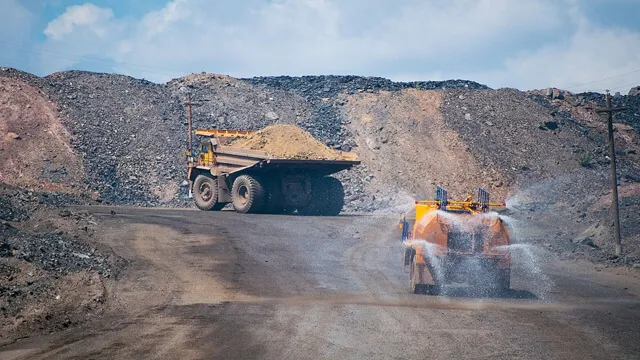
Problem 2: Stockpile and Haul Road Dust Under Wind and Long Throw Distances
Required Spray Behavior: droplets need enough mass and momentum to travel through open air and wind without evaporating or drifting off target; overly fine droplets here simply get blown away before reaching the dust.
Suitable Spray Pattern: full cone patterns with a larger average droplet size, typically mounted on oscillating cannons or fixed risers along stockpile perimeters and road edges.
Recommended Nozzle Type: standard full cone hydraulic nozzles for fixed, close-range wetting; spiral (vaned) full cone nozzles where the water carries grit or debris and clog resistance matters more than droplet fineness; low-pressure, large-orifice nozzles for simple road wetting from water trucks.
Fine droplets vs. large droplets: the very fine droplets that work well at a crusher are often the wrong choice outdoors, because wind carries them away before they contact the dust, and a portion evaporates in transit, especially in hot or arid climates. Larger droplets carry more momentum and reach the target more reliably, at the cost of using more water per unit of dust captured — the reverse of crusher-point logic, which is why haul road and stockpile systems generally specify coarser sprays than transfer-point systems.
Important Operating Parameters: operating pressure (commonly 3–8 bar depending on required throw distance), droplet size class matched to expected wind speed, mounting height and spray angle, and refill cycle time if the system is truck-mounted.
Problem 3: Conveyor Transfer Chutes — Abrasive Ore Dust and Clogging Risk
Required Spray Behavior: enough force to wet the ore bed and capture dust at the point of impact while penetrating a moving material stream, and enough resistance to clogging to keep working on grit-laden water.
Suitable Spray Pattern: full cone for general chute wetting; hollow cone where several nozzles are arranged in a ring around a falling material stream, since a ring of hollow cone patterns builds continuous coverage around the perimeter without wasting water in a center where no material passes.
Recommended Nozzle Type: anti-clogging spiral full cone nozzles are frequently specified here because their open, vaned design has fewer narrow internal passages to block. Conventional hydraulic full cone nozzles remain suitable where water is well filtered and clogging risk is lower.
Anti-clogging vs. fine atomization: spiral (vaned) nozzles produce a coarser, less uniform droplet pattern than a precision hydraulic full cone or air-atomizing nozzle, but their larger internal free passage lets debris pass through rather than lodge and block flow. Published engineering guidance for mining chute dust suppression from nozzle manufacturers indicates a minimum operating pressure of roughly 7 bar (100 psi) is generally needed for the spray to properly penetrate a falling ore bed, with higher pressure in the 10–12 bar range further improving penetration. On clean, filtered water a finer conventional full cone can be justified for better capture per liter; on untreated mine water, the anti-clogging design is usually the more reliable long-term choice even at some cost to droplet fineness.
Important Operating Parameters: minimum operating pressure for bed penetration, free passage diameter relative to expected debris size, orientation relative to material flow direction, and number of nozzles per chute needed to fully encircle the stream.
Engineering Selection Analysis: Making the Trade-offs Explicit
High impact vs. wide coverage: a small number of high-pressure, high-impact nozzles concentrated at one dust-generation point can penetrate a dense dust cloud that a wider, lower-pressure spray would not reach, but the same high-impact spray leaves gaps in coverage elsewhere. Sites with a small number of concentrated dust sources usually do better with fewer, higher-impact nozzles; sites with dust generated along a long boundary — haul roads, stockpile faces — usually do better with more numerous, wider-pattern nozzles at lower individual output.
Full cone vs. hollow cone: full cone nozzles distribute liquid across the entire circular pattern, suiting applications that need even wetting across a solid area, such as a stockpile face or open chute. Hollow cone nozzles concentrate liquid at the outer edge of the pattern, leaving the center comparatively dry, which is useful where several nozzles ring a falling material stream and the open center would otherwise waste water.
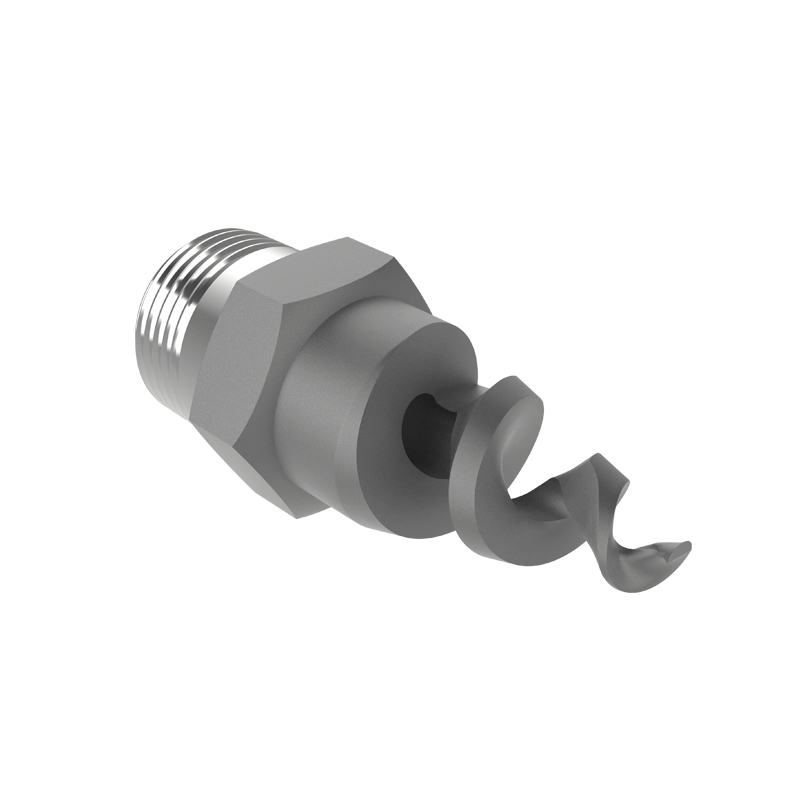
Spiral vs. conventional full cone: a conventional full cone nozzle shapes its spray with an internal vane or core that has narrow internal passages, producing a more uniform pattern and finer droplet control but more exposure to blockage from grit, scale, or fibrous debris. A spiral full cone nozzle replaces that narrow core with an open helical vane, trading some pattern uniformity for a much larger free passage — the standard recommendation anywhere the source water is untreated, recycled, or likely to carry solids, which describes most mine process water.
High pressure vs. low pressure: raising liquid pressure at a hydraulic nozzle reduces average droplet size and increases spray velocity and throw distance, which is why chute and crusher applications that need both fine droplets and bed penetration typically run near the upper end of the manufacturer’s rated pressure range. Low-pressure operation reduces energy use and pump wear and produces a coarser spray, which is acceptable — and often preferable — for simple road wetting or general area knockdown where fine atomization isn’t the goal.
Anti-clogging vs. fine atomization, revisited: this is fundamentally a reliability-versus-performance trade-off, and no single nozzle maximizes both at once. The decision should follow water quality and maintenance access: a remote or hard-to-reach spray point on untreated mine water should favor clog resistance even at some performance cost, since a clogged nozzle delivers zero dust control, while a fine-atomizing nozzle on filtered water can deliver better capture efficiency without the same clogging exposure.
Common Spray Nozzle Problems in Mining Dust Suppression
Clogging is usually caused by untreated or recycled water carrying grit, scale, or fibrous debris, and is most common in narrow-passage hydraulic nozzles. Upstream filtration sized to the smallest free passage in the system, combined with anti-clogging spiral nozzles on untreated lines, addresses most cases.
Wear from abrasive slurry gradually enlarges orifices, increasing flow while degrading spray pattern and droplet size. Wear-resistant materials such as hardened stainless steel, ceramic, or tungsten carbide inserts on high-abrasion lines, plus scheduled orifice inspection, limit the impact.
Corrosion occurs when mine water is acidic or carries dissolved salts that attack standard carbon steel or lower-grade stainless fittings over time; matching nozzle body material to actual water chemistry, rather than a generic “industrial” grade, prevents most premature failures.
Poor coverage usually traces back to incorrect nozzle spacing, the wrong spray angle for the mounting height, or a nozzle selected for the wrong throw distance; a spray layout calculated for the specific geometry of the transfer point or stockpile face, rather than a spacing rule copied from another site, resolves it.
Excess water creates handling problems — mud, frozen surfaces in cold climates, added load on discharge conveyors — without improving dust capture once droplets are already matched to particle size; right-sizing flow rate and droplet size to the actual dust load avoids the common assumption that more water is automatically safer.
Uneven spray is frequently the earliest visible sign of partial clogging, worn orifices, or incorrect nozzle orientation, and routine visual or flow-based inspection catches it before dust control is meaningfully affected.
Incorrect droplet size — a fine atomizing nozzle used outdoors, or a coarse nozzle used at an enclosed transfer point — reduces capture efficiency even when the spray system is otherwise functioning normally, so droplet size selection should be the first thing rechecked when a system underperforms despite normal flow and pressure.
Pressure loss along shared headers with many open nozzles silently degrades performance at the most distant spray points; pressure-balanced header design, pressure-compensating nozzles where available, or zoned control instead of one continuous header limits the effect.
Misalignment from vibration, physical impact, or maintenance work can shift a nozzle’s mounting angle so the spray no longer targets the dust source; secure, vibration-resistant mounting hardware and periodic alignment checks near moving equipment reduce this risk.
Getting the Right Nozzle for Your Site
Every trade-off described above depends on details specific to a single spray point, not to “mining” as a general category. The correct nozzle for a crusher discharge in one plant can be the wrong nozzle for an apparently similar crusher in another plant, because water chemistry, available pressure, and layout differ from site to site. Rather than defaulting to one general-purpose “mining dust nozzle,” it is worth documenting the fluid being sprayed, available pressure and flow rate, the spray angle and coverage needed, ambient and process temperature, the material or debris load in the water, and the physical installation constraints at the mounting point.
Jeltecn’s engineering team reviews these details against the operating conditions described in this guide and recommends a specific nozzle model rather than a generic category — which is the only reliable way to know in advance whether a spiral, full cone, hollow cone, or air-atomizing design is the right starting point for a given location. If you can share your fluid, pressure, flow rate, required spray angle, temperature, material, and installation conditions, our team can recommend a model suited to that specific application.
References
U.S. Mine Safety and Health Administration, Summary of Minimum Dust Control Parameters. National Institute for Occupational Safety and Health (NIOSH), criteria for respirable crystalline silica. Published engineering guidance on mining chute dust suppression from industrial spray nozzle manufacturers.