
A hollow cone nozzle produces a ring-shaped spray with a fine, well-distributed droplet spectrum, which is why it dominates gas scrubbing, evaporative cooling, and other gas-liquid contact duties where thorough sweep of the outer spray volume matters more than filling the center. This guide explains how hollow cone nozzles form their pattern, where they outperform full cone and flat fan designs, current specifications, and what to confirm before you order.
Quick answer: when should you specify a hollow cone nozzle?
Specify a hollow cone nozzle when your process depends on a fine, concentrated droplet spectrum around the outer edge of the spray, such as gas absorption, evaporative cooling, or gas-liquid contact, where thorough gas sweep through a ring of fine droplets matters more than filling the center of the cone. Because the spray concentrates in an annular shell rather than spreading evenly across the full cross-section, a hollow cone nozzle typically produces finer droplets than a full cone nozzle at the same pressure and flow rate. If your application instead needs uniform, gap-free coverage of a flat surface or moving web, such as parts washing or coating, a full cone or flat fan nozzle is usually the better starting point, and if the liquid carries solids or fibers, an open-channel spiral nozzle will resist clogging far better than any vaned hollow cone design.
How hollow cone nozzles work
A hollow cone nozzle builds its pattern by imparting a strong rotational, or swirling, motion to the liquid before it exits the orifice. As the swirling sheet leaves the nozzle, centrifugal force throws the liquid outward, so droplets concentrate in a thin, ring-shaped shell around the outside of the cone while the center remains largely free of liquid. Two internal designs are commonly used to create this swirl:
- Axial-flow (whirl chamber) design. Liquid enters along the nozzle’s centerline and passes through a swirl chamber or vane insert that spins the flow before it exits the orifice. This is the more common hollow cone design for industrial duty because it is simple to manufacture across a wide size range and fits standard threaded bodies.
- Tangential-flow design. Liquid enters through one or more tangential ports on the side of the swirl chamber, which imparts rotation directly without a separate vane insert. Tangential designs can offer a larger free passage for a given orifice size, which helps with liquids carrying light particulate, though they remain less clog-resistant than an open-channel design such as a spiral nozzle.
Spray angle and droplet size follow the same core pressure-flow relationship as other pressure nozzles, but with an added effect: raising the pressure increases flow with the square root of pressure, and it also intensifies the swirl, which produces measurably finer droplets than the same pressure increase would in a full cone nozzle. This is the main reason hollow cone nozzles remain the default choice whenever fine atomization and gas-liquid contact area matter more than filling the entire spray volume.

Sizing: flow, pressure and droplet size
Like other pressure-fed nozzles, hollow cone nozzle flow rate follows Q = K√P, where Q is flow, P is pressure at the nozzle, and K is a capacity constant fixed by the orifice geometry. Doubling the pressure does not double the flow; it increases flow by roughly 41%, while typically producing a noticeably finer droplet spectrum because the added energy intensifies the swirl. This is a useful lever when a process needs finer droplets without changing the nozzle: raising pressure within the manufacturer’s rated range can shift droplet size down without a full nozzle change.
As a worked example, a hollow cone nozzle rated for 4 L/min at 3 bar will deliver approximately 5.7 L/min at 6 bar, not 8 L/min, and the droplets at 6 bar will typically run finer than at 3 bar. Because the relationship is not linear, always confirm flow and droplet size against the manufacturer’s data sheet at your actual operating pressure rather than scaling flow rates by simple proportion. Also confirm the nozzle’s turndown ratio, since running well below the rated pressure range can collapse the swirl and distort the ring pattern into an inconsistent, streaky spray.
Where hollow cone nozzles are used
- Gas scrubbing and absorption. The fine droplet spectrum and large surface-area-to-volume ratio maximize the gas-liquid contact needed to absorb SO2, particulates, or other pollutants from an exhaust or process gas stream, which is why hollow cone designs appear throughout wet scrubber systems.
- Evaporative cooling and gas conditioning. Hollow cone nozzles cool flue gas or process gas faster than a coarser pattern at the same flow, because fine droplets present more surface area and evaporate more quickly, which shortens the duct length needed to hit a target outlet temperature.
- Dust suppression and fine misting. A fine, well-atomized mist wets airborne dust particles without oversaturating the surrounding floor or material, which matters in enclosed transfer points, crushers, and bagging stations where excess water creates handling problems.
- Humidification. Where fine droplets that flash-evaporate quickly are needed to raise ambient humidity without wetting product or flooring, hollow cone patterns are a common starting point alongside air atomizing nozzles, particularly in lower-pressure systems.
- Agricultural and horticultural spraying. Hollow cone patterns are widely used for pesticide and fungicide application, where fine coverage on the underside and edges of foliage improves chemical contact and reduces the volume of chemical needed per hectare.
- Fire and water-mist protection. Some water-mist fire suppression nozzles rely on a hollow cone-style swirl chamber to generate the very fine droplets that absorb heat rapidly and displace oxygen at the fire base without the water damage caused by a solid stream.
For applications where dirty, high-solids, or fibrous liquid rules out any vaned nozzle, compare this design against the open-channel spiral nozzle, which trades some distribution precision for much higher clog resistance.
Specifications and materials
| Parameter | Typical value |
|---|---|
| Pattern | Hollow, ring-shaped cone |
| Spray angle | 30°-120°, model dependent |
| Droplet size | Fine to medium; finer than a full cone nozzle at equal pressure |
| Material | 303SS / 316SS / Brass / PVDF, with PTFE-lined options for corrosive duty |
| Thread size | 1/8″ up to 2″, BSPT or NPT, male or female |
| Typical duty | Clean to lightly filtered liquids; fine atomization and gas-liquid contact |
These figures are selection references for Jeltecn’s hollow cone nozzle range. OEM/ODM branding and custom materials for corrosive or high-temperature duties are available on request. Confirm the exact operating point against a model-specific data sheet before releasing a purchase order.

Hollow cone vs. full cone, flat fan and air atomizing
| Factor | Hollow cone | Full cone | Flat fan |
|---|---|---|---|
| Coverage shape | Ring / annular | Filled circle or square | Flat, elongated oval |
| Droplet size at equal pressure | Finest of the three | Coarser than hollow cone | Varies with angle; generally coarser |
| Best starting fit | Gas-liquid contact, cooling, fine misting | Uniform surface coverage, washing, cooling of solids | Cleaning, coating, edge-to-edge line coverage |
| Center of spray | Little to no liquid | Fully filled | Not applicable, linear pattern |
For filled, uniform coverage on clean liquids where the center of the target also needs wetting, see the full cone spray nozzle guide. For a closer look at how flat fan and full cone patterns compare for cleaning and coating duty, see Flat Fan vs Full Cone Nozzle. A full side-by-side comparison against Jeltecn’s vaned full cone series is available in Hollow Cone vs Full Cone Nozzle: Which Spray Pattern Should You Choose?
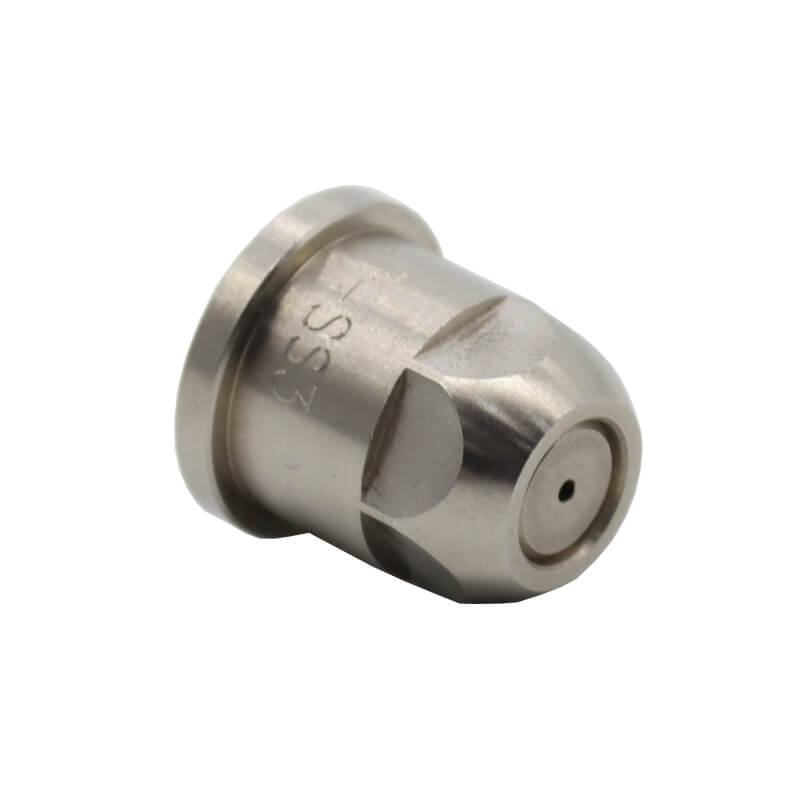
Hollow cone nozzles are also frequently compared against air atomizing nozzles, which use compressed air rather than liquid pressure alone to break up the spray. Air atomizing nozzles generally achieve even finer, more controllable droplet sizes and can run at lower liquid pressure, but they require a compressed air supply and add an operating cost that a purely hydraulic hollow cone nozzle avoids. Where a plant already has compressed air available and needs the finest possible mist, an air atomizing nozzle is worth evaluating; where simplicity and lower installed cost matter more, a hollow cone nozzle is usually the more practical starting point.
Engineering variables to verify before ordering
- Required droplet size. Confirm whether your process needs the finer droplet spectrum a hollow cone nozzle gives, or whether a full cone or air atomizing nozzle would serve the duty better at the pressure and flow available.
- Spray angle and mounting distance. Because the pattern is a ring, mounting height and angle must be set so the empty center does not leave a gap in required coverage; check the coverage diagram at your specific mounting distance before finalizing header layout.
- Liquid cleanliness. Vaned and swirl-chamber hollow cone nozzles have a smaller free passage than an open-channel spiral nozzle; confirm solids content and filtration level before specifying.
- Pressure and flow at the nozzle. Spray angle and droplet size both depend on the actual pressure delivered at the nozzle, not the pump discharge pressure, so account for line losses across the full header.
- Material compatibility. Match 316SS, PVDF, or other specialty materials to the specific acid, alkali, or process chemistry, including any elevated operating temperature or upset conditions.
- Multiple-nozzle overlap. In header or ring arrangements around a duct or chute, confirm that adjacent hollow cone patterns overlap enough to eliminate any gaps left by the empty centers of individual nozzles.
Installation and maintenance
Follow the plant’s isolation and depressurization procedure before removing or inspecting any nozzle.
- Match the connection. Confirm the specified NPT or BSPT thread and seal arrangement before installation; do not force incompatible thread forms together.
- Check swirl chamber orientation. Some hollow cone inserts are directional; installing them backward will distort or collapse the ring pattern and reduce coverage.
- Inspect the orifice and swirl insert regularly. Even modest wear on the orifice edge or swirl vanes changes spray angle and droplet size; replace worn tips rather than continuing to run a degraded pattern.
- Verify operation after maintenance. Confirm delivered pressure and flow at the nozzle, and visually check that the spray still forms a complete, evenly filled ring with no streaking or gaps.
If you are seeing streaks, partial rings, or unexplained coarse droplets, see our guide on why spray nozzles clog for the underlying causes and design factors worth checking before assuming a batch of nozzles is simply worn out.
What to include in an RFQ for hollow cone nozzles
Send the following so Jeltecn can confirm fit and quote accurately on the first pass:
- Application and required outcome (scrubbing efficiency, cooling load, dust capture, coverage pattern)
- Liquid composition: solids content, particle size, specific gravity, and chemical properties
- Required flow and available pressure at the nozzle
- Operating temperature, including startup or upset conditions
- Connection standard, material, and duct or vessel dimensions
- Quantity, destination, and required documentation
Send Jeltecn your hollow cone nozzle requirements for selection support and a quotation. For corrosive or high-temperature duties, request a material compatibility review before finalizing the order.
Frequently asked questions
What is the difference between a hollow cone and a full cone nozzle?
A hollow cone nozzle concentrates liquid in a ring around the outside of the spray cone with little or no liquid in the center, producing finer droplets. A full cone nozzle fills the entire cross-section evenly, giving uniform coverage but generally coarser droplets at the same pressure.
What are hollow cone nozzles used for?
Common uses include gas scrubbing and absorption, evaporative cooling, dust suppression, humidification, agricultural spraying, and water-mist fire protection, essentially any application where fine atomization and gas-liquid contact matter more than filling the center of the spray.
Why does a hollow cone nozzle produce finer droplets than a full cone nozzle?
The internal swirl chamber or tangential ports impart strong rotational energy to the liquid before it exits the orifice. That extra rotational energy breaks the liquid sheet into smaller droplets than the more direct flow path used in a full cone design.
Can hollow cone nozzles handle liquids with solids?
Only to a limited degree. The swirl chamber and orifice are narrower than an open-channel design, so hollow cone nozzles are best suited to clean or lightly filtered liquids. For slurry, sludge, or fibrous liquids, a spiral nozzle is typically a better starting point.
What spray angle should I choose for gas cooling or scrubbing?
Wider angles generally improve gas-liquid contact area for a given duct diameter, but the correct angle depends on gas velocity, duct geometry, and required contact time. Share your duct dimensions and gas conditions with Jeltecn’s engineering team for a recommendation.
Are hollow cone nozzles available in corrosion-resistant materials?
Yes. In addition to 303SS, 316SS, and brass, hollow cone nozzles are available in PVDF and PTFE-lined configurations for corrosive service. Confirm the exact chemistry and concentration when requesting a quote.
Related reading
See the full cone spray nozzle guide, the spiral nozzle guide, the air atomizing nozzle guide, and Hollow Cone vs Full Cone Nozzle for related selection criteria.
Pingback: Hollow Cone vs Full Cone Nozzle: Key Differences