
A mixing eductor blends, agitates, or circulates liquid in a tank using only pump pressure, with no motor, impeller, or moving part inside the tank. This guide explains how mixing eductors use the Venturi effect to multiply flow, where they replace mechanical agitators and air spargers, current specifications, and what to verify before you order.
Quick answer: when should you specify a mixing eductor?
Specify a mixing eductor when you need to blend, circulate, or prevent stratification and settling in a tank without installing a motor, mechanical agitator, or moving parts inside the vessel, and when you already have (or can economically add) a pump to supply motive liquid at adequate pressure. Because an eductor entrains several times its own motive flow from the surrounding tank contents, it can move a large volume of liquid using a comparatively small, continuously running pump, which is why eductors are common in tanks that are difficult to access for mechanical agitator maintenance, in hazardous or corrosive service where a shaft seal is a liability, and in retrofits where cutting a hole for a side-entry mixer is not practical. If your process needs precise, high-shear mixing or blending of high-viscosity fluids, a mechanical agitator is usually the better starting point.
How a mixing eductor works
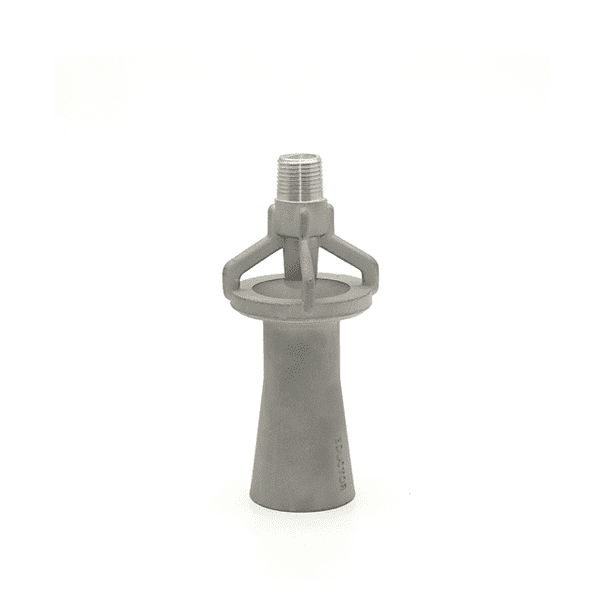
A mixing eductor operates on the Venturi principle: motive liquid, supplied by a pump, is forced through a narrow nozzle inside the eductor body, which accelerates the liquid and drops its pressure at that point. That pressure drop draws in, or entrains, surrounding tank liquid through suction ports around the nozzle. The motive stream and the entrained liquid then mix inside a diffuser section, which recovers some of the velocity as pressure before the combined, higher-volume stream discharges back into the tank. No electrical motor, shaft, seal, or impeller is involved; the only moving part in the entire system is the pump supplying motive liquid, which sits outside the tank.
The key performance figure for a mixing eductor is its entrainment, or mixing, ratio: the volume of tank liquid drawn in and discharged for every unit volume of motive liquid pumped through the nozzle. A typical industrial mixing eductor delivers roughly a 4:1 entrainment ratio, meaning 1 unit of motive flow moves a combined 5 units of liquid back into the tank. This multiplication effect is what allows a modestly sized pump to create meaningful bulk motion and turnover across a large tank.
Mixing ratio, NPSH and sizing
Sizing a mixing eductor starts with the total turnover rate the tank needs, expressed as how many times the full tank volume should be circulated per hour to prevent settling, stratification, or thermal layering. Divide the required total flow (motive plus entrained) by the eductor’s rated entrainment ratio to find the motive flow the pump must supply; for example, a tank that needs 200 m³/h of total circulation through eductors rated at a 4:1 ratio requires only 40 m³/h of motive flow from the pump, with the eductors supplying the remaining 160 m³/h from the tank itself.
Motive pressure at the eductor inlet, not just pump discharge pressure, determines both the entrainment ratio actually achieved and the discharge velocity available to drive bulk tank motion; confirm the pressure at the eductor after accounting for line losses, elevation change, and any strainer or valve in the motive supply line. Net positive suction head (NPSH) at the motive pump also needs the usual verification, since eductors add no suction lift of their own; they only multiply the flow the pump already delivers. Finally, confirm the discharge throw distance the selected model can achieve, since eductors positioned too far from the tank’s dead zones or corners will not effectively sweep the areas most prone to settling.
Where mixing eductors are used
- Tank mixing and agitation. Eductors placed around a tank’s circumference or along its floor create a rolling bulk motion that keeps suspended solids from settling and blends chemical additions into the bulk liquid without a mechanical agitator.
- Preventing sludge and stratification. In storage or process tanks holding liquids with settleable solids, periodic or continuous eductor operation resuspends material before it compacts into hard-to-remove sludge at the tank bottom.
- Chemical dilution and blending. Eductors can draw a concentrated chemical into a dilution stream and disperse it through a tank quickly and evenly, which is useful in water treatment and chemical process tanks.
- Wastewater and effluent treatment. Aeration basins, equalization tanks, and neutralization tanks use eductors to keep solids suspended and to blend incoming flow with the existing tank contents, improving treatment consistency.
- Temperature blending. Circulating tank contents through eductors helps eliminate thermal stratification in large storage tanks, which improves the accuracy of temperature-dependent processes downstream.
- Tank cleaning support. Eductors are sometimes used alongside dedicated tank cleaning nozzles to keep cleaning solution circulating and prevent redeposition of loosened residue during a wash cycle.

Specifications and materials
| Parameter | Typical value |
|---|---|
| Operating principle | Venturi entrainment, no moving parts |
| Typical entrainment ratio | Approximately 4:1 (entrained : motive), model dependent |
| Material | 316SS / PVC / Polypropylene / PVDF for corrosive duty |
| Connection | NPT or BSPT threaded, flanged on larger models |
| Mounting | Submerged, fixed to tank wall or floor, or on a portable stand |
| Typical duty | Tank mixing, agitation, dilution, and anti-stratification |
These figures are selection references for Jeltecn’s mixing eductor range. OEM/ODM branding and custom materials for corrosive or abrasive duties are available on request. Confirm the exact entrainment ratio and discharge throw against a model-specific data sheet before releasing a purchase order.
See the Tank Mixing Eductor Nozzle product page for available materials, connection types and to request an engineered configuration.
Eductor vs. mechanical agitator vs. air sparging
| Factor | Mixing eductor | Mechanical agitator | Air sparging |
|---|---|---|---|
| Moving parts in tank | None | Shaft, impeller, seal | None, but requires compressed air/blower |
| Maintenance access | Low; no in-tank service typically needed | Requires periodic seal and bearing service | Diffuser can foul; needs periodic cleaning |
| Best for | Bulk turnover, anti-settling, dilution | High-shear blending, viscous fluids, precise mixing | Aeration-driven mixing, biological treatment |
| Energy source | Pump (external to tank) | Electric motor (often on tank roof or side) | Compressor or blower |
| Hazardous/corrosive service | Favorable; no shaft seal to fail | Requires seal rated for the service | Generally favorable |
Where a tank is difficult to access for motor or gearbox maintenance, where a shaft seal would be a reliability or safety liability, or where an existing pump can be repurposed to drive mixing, a mixing eductor is usually the more practical starting point than a mechanical agitator. Where the fluid is highly viscous or requires intense, localized shear to blend properly, a mechanical agitator remains the better choice.
If an eductor fits your process, see Jeltecn tank mixing eductor nozzle options on the Tank Mixing Eductor Nozzle product page to request a sizing recommendation.
Engineering variables to verify before ordering
- Required turnover rate. Confirm how many tank volumes per hour need to circulate to meet your anti-settling or blending target, then size motive flow against the eductor’s rated entrainment ratio.
- Motive pressure and flow available. Confirm the actual pressure and flow delivered at the eductor inlet, accounting for line losses, not just the pump’s rated discharge.
- Tank geometry and dead zones. Map corners, baffles, and low-flow areas in the tank, and position eductors so their discharge throw actively sweeps those zones rather than only stirring the open center.
- Liquid properties. Confirm viscosity, solids content, and specific gravity, since higher-viscosity fluids reduce entrainment ratio and discharge throw versus the manufacturer’s water-based rating.
- Material compatibility. Match 316SS, PVC, polypropylene, or PVDF construction to the specific chemistry, temperature, and any abrasive solids content.
- Number and placement of eductors. Larger or irregularly shaped tanks typically need multiple eductors positioned to create a continuous rolling flow pattern rather than a single unit expected to move the entire volume alone.
Installation and maintenance
Follow the plant’s isolation and depressurization procedure before removing or servicing any eductor or its motive supply line.
- Confirm submerged orientation. Most mixing eductors are designed to discharge horizontally near the tank floor or wall; verify the manufacturer’s recommended mounting orientation and depth before installation.
- Protect the motive supply. Install a strainer ahead of the eductor’s motive nozzle if the pumped liquid can carry debris, since the motive orifice is the smallest passage in the system and the most likely point to foul.
- Inspect suction ports periodically. Because eductors have no seals or bearings to service, routine maintenance is largely limited to checking that suction ports and the discharge diffuser remain free of buildup or fouling.
- Verify circulation pattern after startup. Confirm that the discharge pattern reaches intended dead zones and that no visible settling or stratification persists after the eductors have run through a full turnover cycle.
If your tank also needs periodic wash-down or residue removal alongside mixing, see our tank cleaning nozzle options, which are often specified together with eductors in the same vessel.
What to include in an RFQ for mixing eductors
Send the following so Jeltecn can confirm fit and quote accurately on the first pass:
- Tank volume, dimensions, and internal obstructions such as baffles or coils
- Required turnover rate or blending outcome (anti-settling, dilution, temperature blending)
- Liquid properties: viscosity, solids content, specific gravity, and chemical compatibility needs
- Available motive pump flow and pressure at the eductor inlet
- Mounting preference: fixed, submerged, or portable
- Quantity, destination, and required documentation
Send Jeltecn your mixing eductor requirements for a sizing recommendation and quotation. Our engineering team can review your tank drawing and existing pump capacity before you commit to a layout.
Signs Your Tank Needs Better Mixing
Several field symptoms typically point to inadequate tank mixing before an operator ever measures turnover rate directly. A hard, compacted layer of solids at the tank bottom that requires manual or high-pressure cleanout between batches usually indicates that bulk motion near the floor is too weak to keep solids in suspension. Inconsistent product quality between the top and bottom of a batch tank, particularly for temperature-sensitive or concentration-sensitive processes, often points to thermal or chemical stratification that a properly placed eductor circuit would eliminate. Slow or incomplete chemical dissolution after an addition, where operators report needing to wait far longer than expected for a batch to reach uniform concentration, is another common sign that the tank’s circulation pattern is not sweeping the full volume effectively. In all three cases, adding or repositioning mixing eductors is frequently a lower-cost fix than installing a new mechanical agitator, particularly in tanks that were not originally designed with a mounting boss for a top-entry or side-entry mixer.
Frequently asked questions
What is a mixing eductor used for?
A mixing eductor is used to blend, circulate, or agitate liquid in a tank, typically to prevent settling of suspended solids, blend added chemicals evenly, eliminate thermal stratification, or support dilution, all without a mechanical agitator or moving parts inside the tank.
How does a mixing eductor multiply flow?
It uses the Venturi effect: a pump forces motive liquid through a narrow nozzle, which accelerates the flow and lowers pressure locally, drawing in surrounding tank liquid through suction ports. The combined motive and entrained streams discharge together, typically at roughly four times the motive flow rate.
Do I need a special pump for a mixing eductor?
Not necessarily a special pump, but the pump must deliver adequate flow and pressure at the eductor’s motive inlet after line losses. Many installations use an existing process or transfer pump, provided its capacity matches the eductor’s rated motive requirements.
Can a mixing eductor replace a mechanical agitator entirely?
In many bulk mixing, anti-settling, and blending applications, yes. For high-viscosity fluids or processes that need intense, localized shear to break up agglomerates or emulsify ingredients, a mechanical agitator typically still performs better.
What materials are mixing eductors available in?
Common materials include 316 stainless steel, PVC, polypropylene, and PVDF for corrosive service. Confirm your liquid’s chemistry, temperature, and any abrasive solids content when selecting a material.
How many eductors does a tank need?
It depends on tank volume, shape, and the location of dead zones such as corners or areas around internal obstructions. Larger or irregular tanks typically need multiple eductors positioned to create a continuous rolling flow pattern rather than relying on a single unit.
Related reading
See our guide on What Is an Eductor Nozzle? for a broader introduction to eductor terminology and uses, and the tank cleaning nozzle product page for related tank-service equipment.
Pingback: What Is an Eductor Nozzle? Definition & How It Works
Pingback: Paper Mill Spray Nozzles: Complete Application Guide