
An eductor nozzle is a fixed-geometry fitting that uses a pumped or pressurized motive fluid to draw in, or entrain, a second fluid through the Venturi effect, then discharges the combined flow, with no motor, impeller, or moving parts. Eductor nozzles are used to move liquids, gases, or a mix of both, and the same basic principle appears under several names depending on the industry: eductors, jet pumps, ejectors, and injectors all describe close variations on this idea.
What Is an Eductor Nozzle?
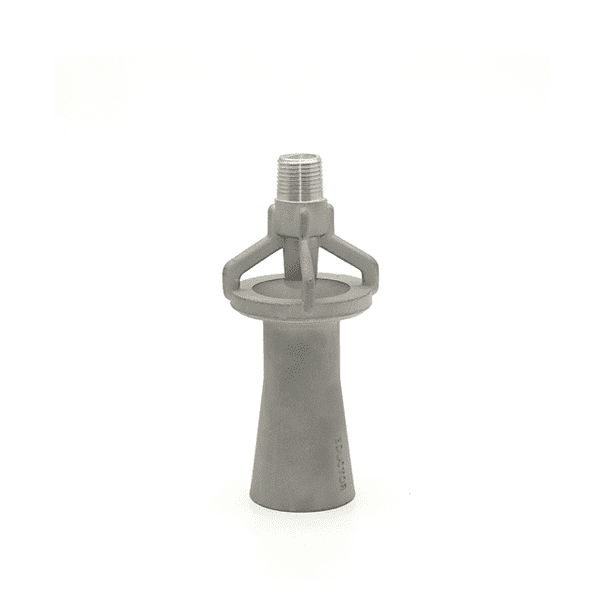
An eductor nozzle is a simple, static device with no moving internal parts. It consists of a motive nozzle that accelerates an incoming pressurized fluid, a suction chamber where the accelerated jet creates a localized low-pressure zone, and a diffuser that recovers velocity as pressure before the combined stream discharges. Because it has no shaft, bearing, or seal, an eductor nozzle is mechanically simple and has very little to wear out or maintain compared with a pump, blower, or mechanical mixer performing a similar duty.
The term “eductor” is often used interchangeably with jet pump, ejector, or injector, though in practice these terms carry slightly different regional and industry conventions. In water and wastewater engineering, “eductor” commonly refers to liquid-liquid devices used for tank mixing or chemical dilution. In vacuum and steam systems, similar devices are more often called “ejectors.” In boiler and steam trades, “injector” often describes a specific type used to feed water into a pressurized boiler. All three rely on the same underlying Venturi principle.
How Does an Eductor Nozzle Work?
An eductor nozzle works by converting pressure energy into velocity energy, then back into pressure, using nothing but the shape of its internal passages. Motive fluid, supplied at pressure from a pump, compressor, or steam source, is forced through a narrowing nozzle that speeds it up dramatically. As the fluid’s velocity increases, its local pressure drops, following the same physical principle described by Bernoulli’s equation. That drop in pressure at the throat of the eductor is lower than the pressure of the surrounding fluid at the suction port, so surrounding fluid is drawn in and entrained into the high-velocity motive stream. The two streams mix together as they travel through a diffuser section, which gradually widens and slows the combined flow, recovering some of the velocity back into usable discharge pressure.
The ratio of entrained fluid to motive fluid is the single most important performance number for an eductor nozzle, commonly called the entrainment ratio or mixing ratio. A typical liquid eductor nozzle might entrain three to five units of surrounding liquid for every one unit of motive liquid pumped through it, though the exact ratio depends heavily on the nozzle’s internal geometry and the pressure differential available.
Types of Eductor Nozzles
- Liquid-liquid mixing eductors. Used to blend, circulate, or agitate liquid within a tank; motive liquid, usually drawn from the same tank by a pump, entrains surrounding tank contents to create bulk motion. See our dedicated mixing eductor guide for sizing and selection detail, or go straight to the Tank Mixing Eductor Nozzle product page to request a configuration.
- Vacuum eductors. Use a motive liquid or gas stream to create a vacuum at the suction port, commonly used to evacuate air, generate suction for pumps that cannot self-prime, or pull a vacuum in tanks and process vessels without an electric vacuum pump.
- Gas eductors and air movers. Use compressed air or another gas as the motive fluid to move, exhaust, or circulate gases, commonly used for fume extraction, tank ventilation, or moving air through ductwork without an electric fan.
- Chemical dilution and dosing eductors. Entrain a concentrated chemical from a drum or tote into a dilution water stream, producing an in-line diluted solution without a metering pump.
- Steam eductors and ejectors. Use pressurized steam as the motive fluid, commonly used to create vacuum in condensers, evaporators, and distillation systems in power and process plants.
Common Industrial Uses of Eductor Nozzles
- Tank mixing and agitation to prevent settling of suspended solids and blend chemical additions without a mechanical agitator.
- Chemical dilution and blending, drawing concentrated product into a carrier stream for accurate, low-maintenance dosing.
- Dust and fume extraction, using a compressed air or steam eductor to move contaminated air away from a process without an electric fan in a hazardous zone.
- Vacuum generation for priming pumps, evacuating tanks, or supporting vacuum filtration where an electric vacuum pump is impractical or unsafe.
- Wastewater and effluent treatment, keeping solids suspended in aeration and equalization tanks and blending incoming flow into the bulk liquid.
- Tank cleaning support, circulating wash solution alongside dedicated tank cleaning nozzles to keep loosened residue from redepositing during a wash cycle.
Eductor Nozzle vs. Ejector vs. Injector: Is There a Difference?
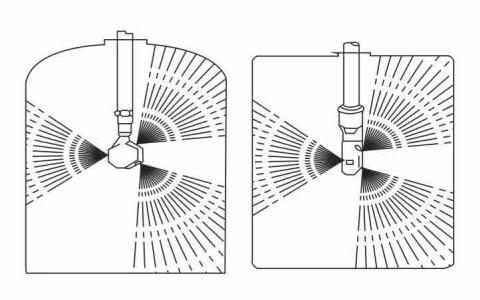
In everyday industrial use, eductor, ejector, and injector often describe the same underlying Venturi device, and the terms are frequently used interchangeably even within the same industry. Where a distinction is drawn, “eductor” most often refers to liquid-liquid mixing and dilution duty, “ejector” is more common in vacuum and steam service, and “injector” often specifically describes a boiler feedwater device or a chemical injection point. If a supplier or specification uses one term over another, it is worth confirming the exact duty (liquid, gas, vacuum, or steam) rather than assuming the terminology alone defines the application, since regional and industry conventions vary.
Advantages and Limitations of Eductor Nozzles
Advantages
- No moving parts inside the process fluid, which removes shaft seals, bearings, and impellers as failure points.
- Low maintenance requirements, since there is little to service beyond keeping the motive nozzle and suction ports clear of debris.
- Can be installed in hazardous or classified areas without the electrical concerns of a motor-driven alternative.
- Multiplies the flow of an existing pump, compressor, or steam source, often avoiding the cost of a separate agitator, blower, or vacuum pump.
Limitations
- Lower energy efficiency than a well-matched mechanical pump, agitator, or blower performing the same duty, since some energy is lost in the mixing and diffusion process.
- Performance depends on maintaining adequate motive pressure; a drop in motive supply pressure reduces both entrainment ratio and discharge force.
- Not well suited to high-viscosity fluids or duties that need intense, localized shear rather than bulk flow.
- Fixed geometry means the entrainment ratio cannot be adjusted on the fly the way a variable-speed mechanical mixer can.
How to Choose the Right Eductor Nozzle
Selection starts with identifying the motive fluid you have available (liquid, compressed air, or steam), the fluid you need to entrain, and the outcome you need, whether that is bulk mixing, dilution, vacuum generation, or gas movement. From there, confirm the required entrainment ratio or total flow, the motive pressure and flow you can supply, and the materials needed for chemical or temperature compatibility. For tank mixing and agitation specifically, our mixing eductor guide covers sizing, entrainment ratios, and installation in detail. For duties involving vacuum generation, gas movement, or steam service, share your process conditions with an applications engineer, since these ratings depend heavily on motive fluid type and available pressure.
Why Use an Eductor Nozzle Instead of a Direct Pump, Fan, or Mixer?
The case for an eductor nozzle usually comes down to reliability and simplicity rather than raw efficiency. Because an eductor has no internal moving parts, it introduces nothing inside the tank or duct that can wear out, seize, or require a scheduled seal replacement, which matters most in tanks that are difficult or hazardous to access for maintenance. Eductors also let a single motive source, such as one pump or one compressed air line, serve multiple entrainment points around a tank or system simply by branching the motive supply, which can be simpler to install than running separate electrical power to several mechanical mixers or fans. In classified hazardous areas where electrical equipment must meet strict explosion-proof standards, an eductor driven by compressed air or a remotely located pump avoids the cost and complexity of installing electrically rated motors at every mixing or extraction point. The tradeoff, as with any energy conversion device, is that some of the motive fluid’s energy is lost converting velocity back into usable discharge pressure, so an eductor will generally use more total energy than a precisely matched mechanical alternative performing the identical duty.
Eductor Nozzle Sizing Basics
While detailed sizing depends on the specific duty, a few basics apply across nearly all eductor nozzle types. First, performance scales with motive pressure: higher pressure at the motive nozzle produces a higher-velocity jet, which generally improves both entrainment ratio and discharge throw, up to the limits of the specific nozzle design. Second, entrainment ratio is not fixed across all operating conditions; it typically declines as the back-pressure at the discharge outlet increases, since the diffuser has less pressure recovery margin to work with. Third, fluid properties matter: entraining a higher-viscosity liquid, or moving a denser gas, reduces the entrainment ratio compared with the manufacturer’s typical water- or air-based rating. Because these variables interact, always confirm expected performance against a model-specific data sheet or a supplier’s engineering review rather than assuming published ratios will transfer directly to your exact fluids and pressures.
Frequently Asked Questions
What does an eductor nozzle do?
An eductor nozzle uses a pressurized motive fluid to draw in and entrain a second fluid through the Venturi effect, then discharges the combined flow. It is used to mix, dilute, move, or evacuate fluids without a motor or moving parts.
Is an eductor the same as a jet pump?
Yes, in most practical usage. Both terms describe a device that uses a high-velocity motive jet to entrain and move a second fluid through the Venturi effect. “Jet pump” is common in water well and irrigation contexts, while “eductor” is more common in process and industrial tank mixing contexts.
What is the difference between an eductor and an injector?
Both work on the same Venturi principle, but “injector” often specifically refers to a device that feeds water into a pressurized boiler or injects a chemical at a dosing point, while “eductor” more broadly covers mixing, dilution, and vacuum applications. Confirm the specific duty rather than relying on terminology alone.
Do eductor nozzles need electricity?
The eductor nozzle itself has no motor and needs no electrical supply. However, the pump, compressor, or steam source supplying motive fluid to the eductor typically does require power, so the overall system is not entirely electricity-free unless the motive source is already pressurized without electric assistance.
Can an eductor nozzle create a vacuum?
Yes. A vacuum eductor, sometimes called a vacuum ejector, uses a motive liquid or gas stream to create a localized low-pressure zone strong enough to generate usable vacuum for priming pumps, evacuating vessels, or supporting vacuum filtration.
What materials are eductor nozzles made from?
Common materials include 316 stainless steel, brass, PVC, polypropylene, and PVDF for corrosive service. Material choice depends on the motive and entrained fluid chemistry, temperature, and any abrasive content.
How efficient is an eductor nozzle compared to a pump or mixer?
Eductor nozzles are generally less energy-efficient than a well-matched mechanical pump, agitator, or blower for the same duty, because some energy is lost during the mixing and diffusion process. Their advantage is mechanical simplicity, low maintenance, and the ability to multiply the flow of an existing motive source rather than raw energy efficiency.
Can eductor nozzles run continuously?
Yes, most eductor nozzles are designed for continuous duty, since there are no bearings or seals to wear from constant operation. The main continuous-duty consideration is ensuring the motive pump, compressor, or steam source is also rated for continuous operation at the required pressure.
Does a higher motive pressure always improve eductor performance?
Generally yes, up to the design limits of the specific nozzle, since higher motive pressure increases jet velocity and improves entrainment. However, exceeding the manufacturer’s rated pressure range can cause cavitation, excess noise, or accelerated wear at the nozzle throat, so always stay within the rated range.
Talk to Jeltecn’s Engineering Team
Share your motive fluid source, target fluid, and required outcome, and Jeltecn’s engineering team can help identify the right eductor nozzle type and size for your application. Contact us for a selection recommendation and quotation, or read the complete Mixing Eductor Guide for tank mixing and agitation sizing detail.