
Paper mill spray nozzles run from the moment stock leaves the headbox to the moment the finished roll is slit and trimmed, and again through the recovery, chemical, and effluent systems that keep the mill running. This guide walks through where nozzles are used at each stage of paper manufacturing, which nozzle types fit each duty, and the materials and maintenance practices that keep them running in a mill’s demanding water and chemical environment.
Wet End: Headbox, Forming and Stock Prep
At the wet end, spray nozzles handle chemical dosing into the stock, dilution water control, and continuous cleaning of the forming fabric and wire. Full cone nozzles are common in stock chests and approach flow piping for dispersing retention aids, sizing agents, and other additives evenly into the stock before it reaches the headbox, since a filled, uniform spray pattern mixes chemical into a flowing stream more completely than a hollow or fan pattern would. See our full cone spray nozzle guide for pattern and flow selection.
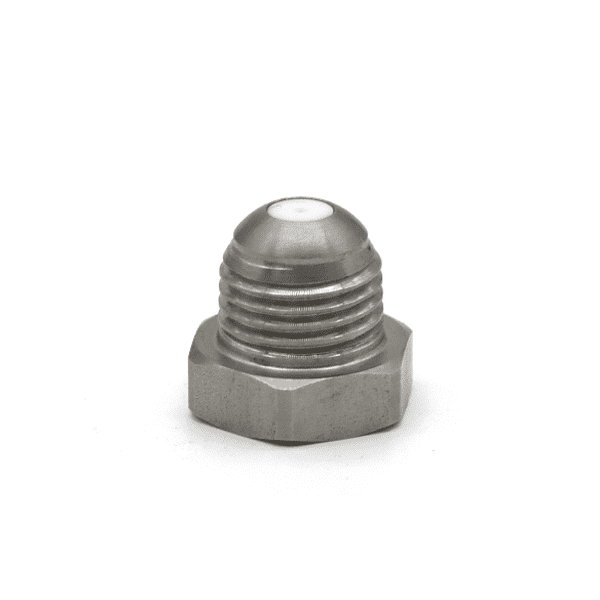
Forming fabric and wire cleaning is one of the highest-duty nozzle applications in the entire mill. High-pressure solid stream, or needle jet, nozzles produce a narrow, high-impact 0-degree stream specifically to dislodge fiber and filler buildup from the fabric weave without damaging it. Because these showers run continuously against a moving fabric carrying abrasive filler and fines, nozzle wear resistance matters more here than almost anywhere else in the mill.
Press Section: Felt Cleaning and Conditioning
The press section relies on felt cleaning showers to remove fiber, filler, and pitch that would otherwise reduce the felt’s ability to absorb water from the sheet. Uniform, self-cleaning flat fan nozzles are the standard choice here, spraying across the full felt width in a header arrangement. Because felts run continuously at high speed and any single clogged or misaligned nozzle creates a visible wet or dry streak in the finished sheet, self-cleaning or quick-release nozzle designs that resist blockage are widely specified in this position. Our guide on flat fan nozzles for cleaning duty covers the pattern and spacing principles that apply to felt showers as well.
Felt conditioning showers, which apply a lighter, more controlled spray to adjust felt moisture and permeability rather than aggressively clean it, typically use a finer flat fan or full cone pattern at lower flow than the main cleaning shower.
Dryer Section: Moisture Profiling and Web Cooling
In the dryer section, nozzles perform two related but distinct jobs: correcting uneven moisture across the sheet’s width (moisture profiling) and cooling or remoistening the web before size press or calendering. Air atomizing nozzles are the preferred choice for cross-machine moisture profiling because they produce a very fine, precisely controllable mist that can be zoned across the sheet width without oversaturating any single area. See our air atomizing nozzle guide for how droplet size is controlled by adjusting air and liquid pressure independently.
Edge sheet cooling and controlled remoistening ahead of the size press use similar fine-mist principles, since the goal is to add a controlled, small amount of moisture without creating wet streaks or affecting sheet formation.
Reel and Winder: Edge Trimming and Slitting
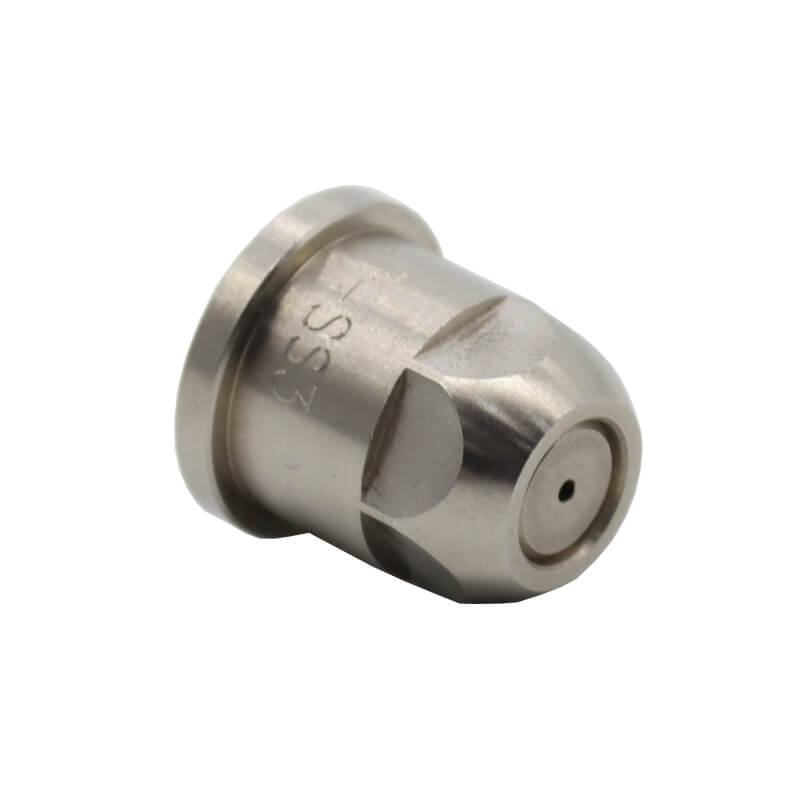
Edge trimming is one of the most specialized nozzle duties in the entire paper mill. A high-pressure, narrow liquid column, capable of withstanding pressures up to roughly 140 bar, cuts a clean, controlled edge on the moving sheet at the reel or winder. These trim nozzles are typically made from 316 stainless steel or high-alumina ceramic to withstand the combination of high pressure, continuous duty, and the abrasive wear of trimming a moving paper edge day after day. Jeltecn’s paper industry solid stream nozzle is purpose-built for this duty, delivering a precise, high-impact linear stream for clean edge trimming and slitting.
Coating and Surface Treatment
Coated grades add another nozzle duty: spray application of coating color, size, or surface treatment chemicals. Flat fan and full cone patterns are both used depending on whether the coating station needs a linear curtain-style application or a broader, more diffuse spray. Nozzle wear and consistency matter significantly here, since even minor spray angle drift changes the coat weight profile across the sheet and can create visible streaks or coating weight variation that shows up as a quality defect in the finished roll.
Chemical Recovery, Pulping and Lime Kiln
Behind the paper machine itself, the pulping and chemical recovery process runs its own demanding set of spray applications. Recovery boilers and evaporators use spray nozzles to atomize black liquor for combustion and to distribute liquor evenly across evaporator surfaces. These duties typically call for wear- and corrosion-resistant nozzles similar in construction to the spiral nozzles used in flue gas desulfurization, since the liquid carries dissolved and suspended solids that would quickly block a fine vaned nozzle. Lime kiln and causticizing operations use nozzles for slaking water addition and for gas conditioning ahead of scrubbing, drawing on the same full cone and spiral nozzle principles used in general industrial gas cooling.
Effluent, Water Treatment and Odor Control
A pulp and paper mill’s effluent treatment plant and white water recovery systems use spray nozzles for aeration, chemical dosing, and tank mixing, much like any other industrial wastewater plant. Mixing eductors are commonly used in equalization and neutralization tanks to keep suspended solids from settling without a mechanical agitator; see our mixing eductor guide for sizing this equipment. Odor control at pulping and recovery areas, a well-known challenge in the kraft process specifically, uses fine misting nozzles to disperse odor-neutralizing chemicals into vent streams and building air handling systems.
Materials and Wear Resistance
| Duty | Typical material | Why |
|---|---|---|
| Wire and fabric cleaning | 316L stainless steel, tungsten carbide inserts | Continuous high-pressure duty against abrasive filler and fines |
| Edge trimming and slitting | 316 stainless steel, high-alumina ceramic | Sustained pressure up to ~140 bar with constant wear at the orifice |
| Bleaching and chemical showers | 316L stainless steel, PVDF, PTFE-lined | Resistance to chlorine dioxide, peroxide and other bleaching chemistry |
| Felt cleaning and conditioning | Stainless steel, brass for lower-duty positions | Balance of cost and adequate wear life for felt-contact showers |
| Recovery and black liquor spraying | Corrosion- and erosion-resistant alloys | Handles dissolved solids and elevated temperature in the recovery cycle |
Selecting the right material is as important as selecting the right spray pattern in a paper mill, since replacing worn nozzles on a running machine often means a costly, scheduled shutdown rather than a quick swap.
Sizing Header Spacing and Flow for Continuous Duty
Paper machines run continuously, often for weeks between planned shutdowns, which makes header design a bigger factor in paper mill nozzle performance than in many batch or intermittent industrial processes. Overlap between adjacent nozzles must be calculated at the actual mounting distance and pressure the header will run at, not a nominal catalog value, since even small deviations compound into visible streaks across a fast-moving, full-width sheet. Because unplanned nozzle replacement on a running paper machine usually means either reaching into a hazardous, fast-moving area or waiting for the next scheduled shutdown, many mills standardize on slightly oversized headers with extra nozzle positions, or on quick-change nozzle bodies, so a single failed nozzle can be swapped without disrupting the full header. Flow rate at each position should also account for gradual wear over the service interval: a nozzle sized exactly to the minimum required flow when new may fall short of that requirement well before its scheduled replacement date as the orifice wears and effectively enlarges.
Common Problems and How to Prevent Them
- Clogging from white water solids. Recycled white water carries fiber fines and filler that can block small orifices; filtration ahead of the header and periodically inspecting free passage size reduces unplanned stoppages. Our guide on why spray nozzles clog covers the underlying causes in more detail.
- Uneven spray causing sheet defects. A single worn, misaligned, or partially blocked nozzle in a felt cleaning or moisture profiling header can show up directly as a visible streak or moisture variation in the finished sheet, so header inspection should be part of routine quality troubleshooting, not just mechanical maintenance.
- Erosion at high-pressure trim nozzles. Continuous high-pressure edge trimming wears the orifice over time, gradually widening the cut and changing edge quality; scheduled replacement based on runtime hours, rather than waiting for a visible failure, keeps edge quality consistent.
- Chemical attack in bleaching and coating showers. Standard stainless steel can degrade faster than expected in chlorine dioxide or peroxide bleaching environments; confirming the exact bleaching chemistry with your nozzle supplier before ordering avoids premature material failure.
Selection Checklist for Paper Mills
Before specifying nozzles for a new or upgraded position in the mill, confirm the following:
- Process stage and specific duty (cleaning, chemical dosing, cooling, trimming, coating)
- Required spray pattern, angle, and flow rate at the actual operating pressure
- Liquid or gas composition, including solids content and chemical properties
- Operating temperature, including any elevated dryer-section or recovery-cycle conditions
- Material compatibility with the specific bleaching, coating, or process chemistry
- Connection standard and header spacing to match existing or planned piping
Send Jeltecn your paper mill nozzle requirements for a selection recommendation and quotation. Our engineering team can review your process stage, water chemistry, and pressure conditions before you finalize an order.
Do paper mills need different nozzles for different paper grades?
Often yes, particularly for coating and moisture profiling duties, since tissue, packaging grades, and fine printing papers have different moisture, coat weight, and formation requirements. Cleaning and trimming duties are generally more consistent across grades, though flow and pressure may still be adjusted.
What causes uneven moisture profile across the sheet width?
Uneven moisture is frequently traced back to a partially blocked, worn, or misaligned nozzle in the moisture profiling header rather than a process control issue elsewhere in the dryer section. Checking individual nozzle spray patterns is a common first troubleshooting step before adjusting broader process setpoints.
Frequently asked questions
What type of nozzle is used for paper machine wire cleaning?
High-pressure solid stream, or needle jet, nozzles are standard for wire and forming fabric cleaning, producing a narrow, high-impact 0-degree stream that dislodges fiber and filler buildup without damaging the fabric.
What material should paper mill nozzles be made from?
316 or 316L stainless steel is the most common baseline, with high-alumina ceramic or tungsten carbide inserts for the highest-wear positions such as edge trimming, and PVDF or PTFE-lined options for aggressive bleaching chemistry.
Why do felt cleaning showers use self-cleaning nozzles?
Felt cleaning showers run continuously against a fast-moving felt, and a single blocked nozzle immediately shows up as a streak in the finished sheet. Self-cleaning or quick-release designs reduce the frequency of unplanned stoppages caused by clogging.
What pressure do paper mill edge trimming nozzles operate at?
Edge trimming and slitting nozzles commonly operate at pressures up to approximately 140 bar to produce the high-impact, linear liquid column needed for a clean cut on a moving sheet.
How often should paper mill nozzles be replaced?
Replacement intervals depend heavily on duty; high-pressure trim nozzles and abrasive wire-cleaning showers typically need scheduled replacement based on runtime hours rather than waiting for visible failure, while lower-duty positions can often be inspected and replaced reactively during planned maintenance.
Can the same nozzle be used for both cleaning and moisture profiling?
Generally no. Cleaning showers need higher impact and flow to dislodge buildup, while moisture profiling needs fine, precisely controlled droplets that will not oversaturate the sheet. These duties call for different nozzle types, typically solid stream or flat fan for cleaning and air atomizing for profiling.
Related reading
See the full cone spray nozzle guide, the air atomizing nozzle guide, the spray nozzle clogging guide, and the paper industry solid stream nozzle product page for related equipment.