
Spiral nozzle selection starts with the required process result and the actual pressure at the nozzle. Then match the model’s flow, spray pattern, angle, connection and material to the liquid and installed geometry. Thread size alone is not a sizing method, and an open spiral path should not be treated as a guarantee against clogging.
Use this page to prepare an engineering specification. For working principle and applications, see the spiral nozzle engineering guide. For available products, see Jeltecn spiral spray nozzles.
1. Define the Required Duty Point
The duty point is the required flow per nozzle at the pressure difference across the nozzle. For a nozzle spraying into an atmospheric space, this is normally based on inlet gauge pressure. If the nozzle discharges into a pressurized vessel, use the pressure difference between the inlet and the vessel.
| Input | Required information |
|---|---|
| Flow | Required flow per nozzle and total header flow. |
| Pressure | Minimum, normal and maximum pressure at the nozzle inlet. |
| Receiving space | Atmospheric duct or vessel operating pressure. |
| Liquid | Density, viscosity, temperature, chemistry and solids. |
| Operating range | Normal duty, startup, shutdown and upset conditions. |
General spray-nozzle engineering uses a model-specific relationship such as Q = K(ΔP)x. The K factor and exponent depend on the nozzle series, so the selected model’s flow table remains the controlling source. BETE’s engineering information also notes that nozzle flow is determined by differential pressure and that fluid specific gravity changes the result.
2. Calculate Pressure at the Nozzle, Not Only at the Pump
Pump discharge pressure is reduced by pipe friction, fittings, filters, control valves and elevation. On a long header, pressure may also vary between nozzle positions. Verify pressure at the nozzle under the expected total flow instead of assuming the pump nameplate value reaches every nozzle.
- Include clean and dirty filter pressure loss.
- Include elevation between the pump and nozzle.
- Check the last nozzle on a multi-nozzle header.
- Confirm vessel pressure when spraying into a pressurized process.
- Recheck the duty point after piping or valve changes.
3. Select Full-Cone or Hollow-Cone Distribution
| Pattern | Starting selection reason | Installed check |
|---|---|---|
| Full-cone spiral | Liquid should occupy the cone volume. | Distribution, overlap, dry zones and wall wetting. |
| Hollow-cone spiral | Liquid should be concentrated toward the cone perimeter. | Ring coverage, spray distance, gas flow and carryover. |
The published spray angle is measured under defined test conditions. The usable wetting width may differ with pressure, liquid properties, gravity, gas flow and spray distance. Do not use the simple geometric cone width as the only acceptance test.
4. Match the Jeltecn Family Range to the Application
| Parameter | Current published family range |
|---|---|
| Pattern | Full cone or hollow cone |
| Spray angle | 60°–180° |
| Thread size | 1/4, 3/8, 1/2, 3/4, 1, 1-1/4, 1-1/2, 2, 3 and 4 inch |
| Connection | Male or female; BSPT or NPT |
| Orifice diameter | 2.4–63.5 mm |
| Water pressure | 0.7–25 bar |
| Published capacity | 2.6–11,960 L/h; confirm model and pressure |
| Materials | 303 stainless steel, 316 stainless steel, brass and PVDF |

The family range does not mean every angle, thread, flow and material can be combined in one model. Send the target duty point so the available model and data sheet can be checked.
5. Evaluate Solids and Deposit Risk
An open spiral passage can improve solids passage compared with an internal-vane design, but the nozzle can still be obstructed by particles larger than the selected passage, long fibers, scale, crystals or dried deposits. Current website data does not publish a free-passage value for every model, so do not infer one from the outlet diameter.
- Provide maximum particle size, not only average size.
- Describe fibers, sticky solids and crystallization tendency.
- State the available filtration or strainer opening.
- Define flushing method and shutdown conditions.
- Confirm safe access for inspection and replacement.
6. Choose Material from Actual Process Conditions
Jeltecn currently publishes 303 stainless steel, 316 stainless steel, brass and PVDF options for this product family. The correct choice depends on the exact chemical, concentration, temperature, abrasion, mechanical load and required service life.
Do not assume that a material name establishes suitability for every acid, alkali, solvent or slurry. Provide operating and upset conditions and obtain process-owner approval. When compatibility is uncertain, use applicable supplier data or a controlled test.
7. Confirm NPT or BSPT and the Installation Drawing
NPT and BSPT are different tapered thread standards and should not be forced together. Record the mating standard, nominal size and male or female requirement. Also confirm insertion length, wrench clearance, sealing method, orientation and space required to remove the nozzle.
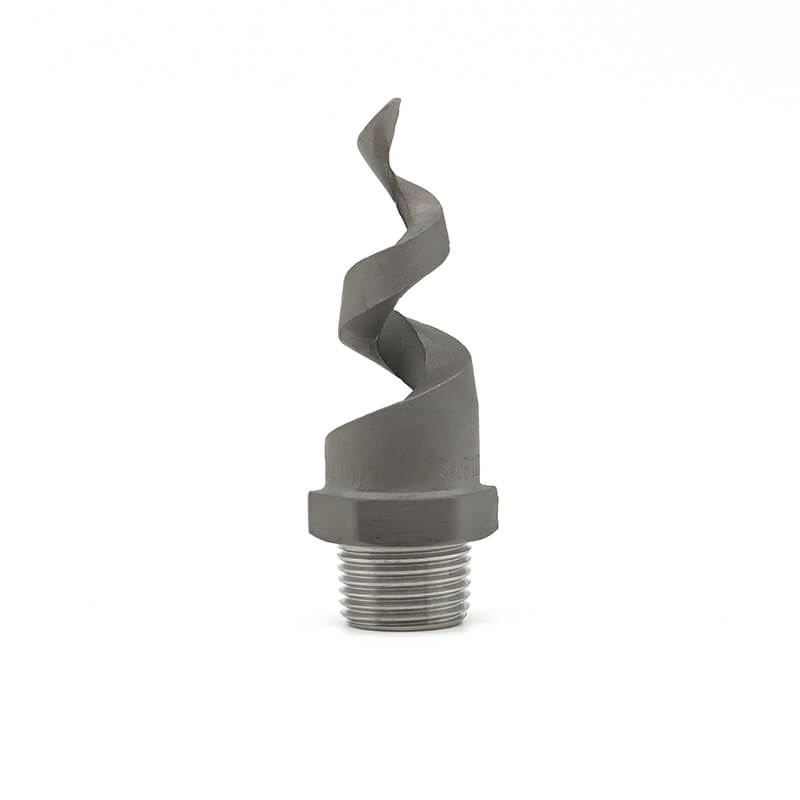
Spiral Nozzle Ordering Checklist
- Application and required outcome.
- Liquid name, concentration, temperature, density, viscosity and solids.
- Required flow per nozzle and total flow.
- Minimum, normal and maximum pressure at the nozzle.
- Vessel pressure, where applicable.
- Full-cone or hollow-cone pattern and preferred angle.
- Spray distance, target dimensions and nozzle arrangement.
- Thread standard, size, gender and installation drawing.
- Material restrictions and inspection access.
- Quantity, delivery country and required documentation.
For low flow, distorted pattern, dry zones or repeated deposits, use the spiral nozzle troubleshooting and maintenance guide before changing the nozzle model.
Frequently Asked Questions
Can flow be estimated at another pressure?
A model-specific pressure-flow relationship can be used for an initial estimate, but the correct K factor and exponent must come from the applicable nozzle data. Recheck when specific gravity or viscosity differs materially from the test liquid.
Is free passage the same as outlet diameter?
No. Free passage describes the limiting internal path for a particle. Do not publish or specify it unless it is confirmed for the selected model.
Can I select material from a generic compatibility chart?
A chart can be a screening tool, but final approval should reflect concentration, temperature, impurities, stress, abrasion and the consequence of failure.
Send the duty point for model review
Jeltecn is a registered brand of Melinco Precision Technology Co., Ltd. Final system suitability remains the responsibility of the process and equipment owner.
Pingback: Spray Nozzle Materials Guide: Stainless Steel, Brass & Plastic