
Spiral nozzles are evaluated for wet flue-gas desulfurization when the scrubber needs broad liquid distribution and a comparatively open flow path for recirculating slurry. The nozzle is only one part of the absorber system. Final selection must be checked against slurry properties, required liquid flow, pressure at the nozzle, tower geometry, gas flow, material compatibility and maintenance access.
View the Jeltecn spiral spray nozzle product range for published sizes and options.
What Must an FGD Spiral Nozzle Do?
In an absorber or scrubber, the spray system must distribute liquid through the intended gas-contact region without unacceptable dry zones, wall wetting, carryover or pressure imbalance. A spiral nozzle may be a candidate where full-cone or hollow-cone coverage and an open discharge geometry suit the process design.
No nozzle alone establishes sulfur-removal performance. System results also depend on liquid-to-gas duty, reagent chemistry, pH control, gas velocity, residence path, droplet behavior, absorber dimensions, recirculation and downstream mist elimination.
FGD Nozzle Selection Inputs
| Design input | Information required | Selection effect |
|---|---|---|
| Slurry | Solids concentration, maximum particle size, density, viscosity, chemistry and temperature. | Flow behavior, wear, deposits, material and passage requirements. |
| Hydraulic duty | Flow per nozzle and minimum, normal and maximum pressure at the nozzle. | Model, quantity, pump and header operating range. |
| Absorber geometry | Diameter, spray level, lance position, wall clearance and nozzle spacing. | Angle, orientation, overlap and spray development. |
| Gas conditions | Flow, velocity, temperature, direction and operating range. | Droplet trajectory, contact path and carryover risk. |
| Maintenance | Isolation, flushing, access, inspection interval and replacement clearance. | Reliability and serviceability. |
Full-Cone or Hollow-Cone Pattern for FGD?
A full-cone spiral nozzle distributes liquid through the cone volume and is a starting point when filled-area contact is required. A hollow-cone spiral nozzle concentrates liquid toward the cone perimeter and may suit a different contact or perimeter-coverage objective.
The pattern must be evaluated within the actual absorber arrangement. The same nominal angle can produce different useful coverage when pressure, slurry properties, gas velocity, spray distance or nearby structures change.
Slurry Passage and Deposit Control
The absence of an internal vane can reduce the number of internal surfaces where solids may bridge, but it does not make an FGD nozzle clog-proof. Limestone slurry can still produce obstruction or deposits when particles are too large, solids settle, chemistry changes, flushing is inadequate or wet surfaces dry during shutdown.
- Provide maximum particle size and solids concentration.
- Confirm upstream screen or strainer opening.
- Check slurry velocity and settling risk in branches and headers.
- Define startup and shutdown flushing.
- Inspect the orifice and spiral surface for deposits and wear.
Material Selection for FGD Duty
Jeltecn currently publishes 303 stainless steel, 316 stainless steel, brass and PVDF options for the spiral nozzle family. This list is not a universal FGD material recommendation. Selection depends on chloride level, slurry chemistry, concentration, temperature, abrasion, mechanical loading and required service life.
Provide operating and upset conditions. The plant or system owner should approve material compatibility using applicable supplier data, operating history or testing where necessary.
Published Jeltecn Spiral Nozzle Range
| Parameter | Published family range |
|---|---|
| Pattern | Full cone or hollow cone |
| Spray angle | 60°–180° |
| Thread size | 1/4–4 inch |
| Connection | Male or female; NPT or BSPT |
| Orifice diameter | 2.4–63.5 mm |
| Water pressure | 0.7–25 bar |
| Published capacity | 2.6–11,960 L/h; select by model and duty point |
| Materials | 303SS, 316SS, brass and PVDF |
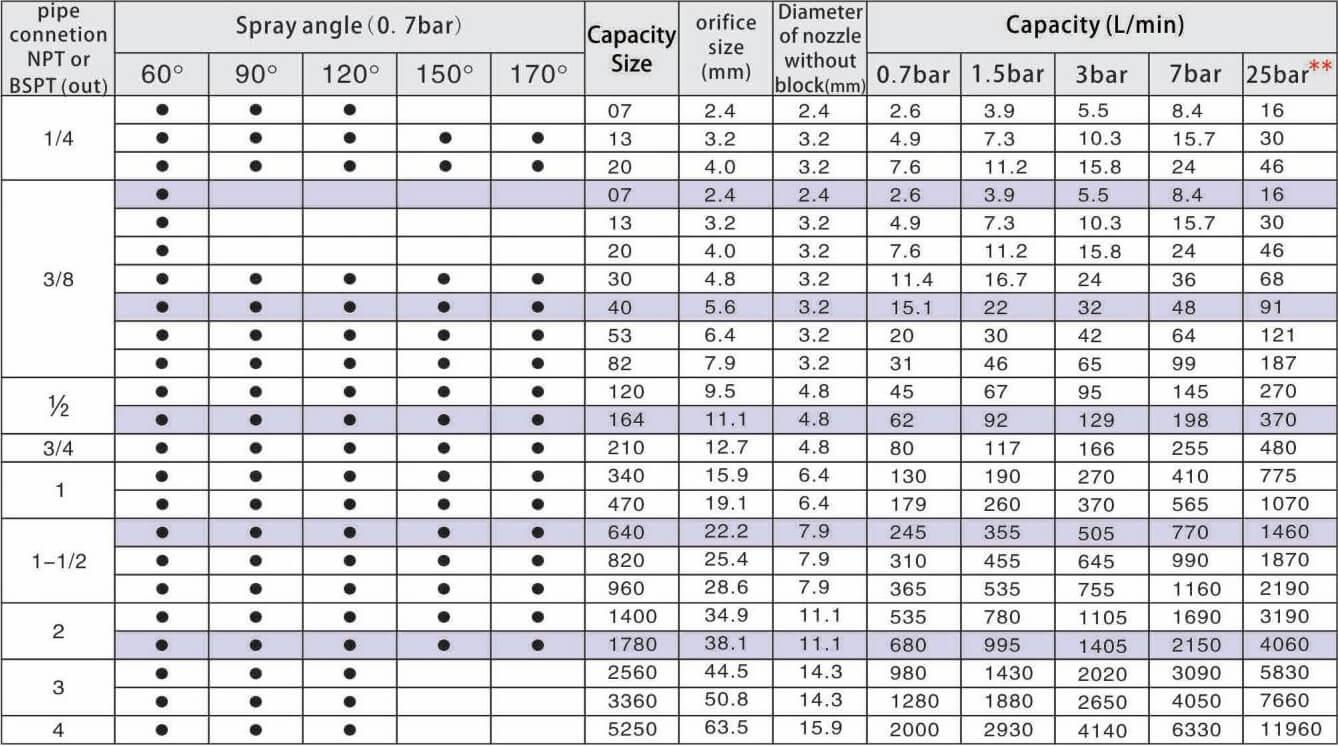
Common FGD Spray Problems
| Observed condition | First checks |
|---|---|
| Uneven coverage | Nozzle pressure, orientation, spacing, blocked passage, damaged spiral and header balance. |
| Wall wetting | Angle, lance position, spray distance, gas deflection and overlap. |
| Flow drift | Orifice erosion, deposits, pressure measurement and slurry density. |
| Repeated blockage | Particle size, strainer, settling, shutdown flushing and chemistry. |
| Excess carryover | Droplet behavior, gas velocity, nozzle position and mist eliminator conditions. |
FGD Spiral Nozzle RFQ Checklist
- Absorber type, dimensions and spray-level drawing.
- Gas flow, temperature, direction and operating range.
- Slurry chemistry, density, viscosity, solids and maximum particle size.
- Required flow per nozzle and pressure at the nozzle.
- Pattern, angle, nozzle quantity, orientation and connection.
- Material restrictions and abrasion or corrosion history.
- Flushing, inspection and replacement requirements.
- Quantity, delivery country and required documentation.
For hydraulic sizing, use the spiral nozzle flow, pressure and material selection guide.
Request an FGD nozzle application review
Final absorber design, environmental performance and regulatory compliance remain the responsibility of the system owner and qualified process engineer.