
Roll Cooling Flat Fan Nozzles deliver controlled spray impact and overlapping coverage for rolling mills when flow, pressure, angle and header spacing match the cooling zone.
Steel and metal rolling mills run some of the most demanding spray applications in industry: water hitting hot steel at high temperature, high line speed, and continuous duty cycles measured in years, not months. Flat fan nozzles are a core tool in two very different but related jobs on a mill: cooling work rolls and strip between passes, and removing scale from the steel surface before it can be rolled into the finish. Getting spray pattern, impact force, and coverage wrong in either job shows up directly as roll wear, surface defects, or reduced throughput.
Quick answer: Flat fan nozzles are used in rolling mills to apply high-impact, linear spray curtains for descaling ahead of the roll stand and for even, full-width cooling of work rolls and strip between stands, because their elongated pattern matches the geometry of a moving strip or roll far better than a round spray pattern.
Roll Cooling Flat Fan Nozzles vs. Descaling: Two Distinct Jobs
Descaling nozzles operate at high pressure, often well above 150 bar in hot strip mills, using a narrow, high-impact flat fan jet to blast oxide scale off the steel surface immediately before it enters the roll gap. Because scale rolled into the surface becomes a permanent defect, descaling headers are engineered for maximum mechanical impact within a narrow, controllable strip. Roll and strip cooling, by contrast, generally runs at lower pressure with a wider flat fan angle, prioritizing even heat removal across the full roll or strip width over raw impact force, since the goal is temperature uniformity rather than scale removal. Our Roll Cooling Spray Nozzles for Rolling Mills page covers cooling header layout in more detail, while this article focuses specifically on where flat fan geometry fits into both jobs.
Why Flat Fan Geometry Fits Mill Applications
Roll cooling flat fan nozzles rely on this geometry to produce the even curtain that mill duty requires. For background on the rolling process itself, see this overview of metal rolling.
Work rolls, backup rolls, and strip are all essentially long cylindrical or flat surfaces moving past a fixed spray header. A flat fan pattern oriented along the roll or strip axis creates a continuous line of coverage, so multiple nozzles can be spaced along a header to build an even curtain across the full width with minimal overlap or gaps. A round cone pattern would require tighter nozzle spacing to avoid uncooled gaps between circles, adding nozzle count and header complexity without improving uniformity. This is the same reason flat fan nozzles dominate other continuous-strip and continuous-cast applications; see our page on Secondary Cooling Nozzles for Continuous Casting for a related use case earlier in the steelmaking process.
Selecting Spray Angle and Pressure for Mill Duty
Descaling headers typically specify narrow-angle, high-pressure flat fan tips to concentrate mechanical force into a tight impact zone, often arranged in oscillating or multi-row headers to fully clear the strip surface at line speed. Roll and strip cooling headers typically specify standard to wide-angle flat fan tips at moderate pressure, arranged in rows along the roll barrel to achieve uniform heat transfer without over-cooling the roll edges relative to the center. In both cases, nozzle body material has to withstand continuous exposure to hot water, scale particles, and mill scale slurry, which is why abrasion-resistant stainless steel and hardened orifice inserts are standard for this duty.
| Product | Typical Spray Angle | Mill Duty Fit |
|---|---|---|
| Narrow Angle Flat Fan Nozzle | ~15°–25° | High-impact descaling headers |
| Standard Flat Fan Spray Nozzle | ~40°–65° | Work roll cooling, general strip cooling |
| Wide-Angle Flat Fan Spray Nozzle | ~80°–110° | Wide roll barrel or strip cooling with fewer header rows |
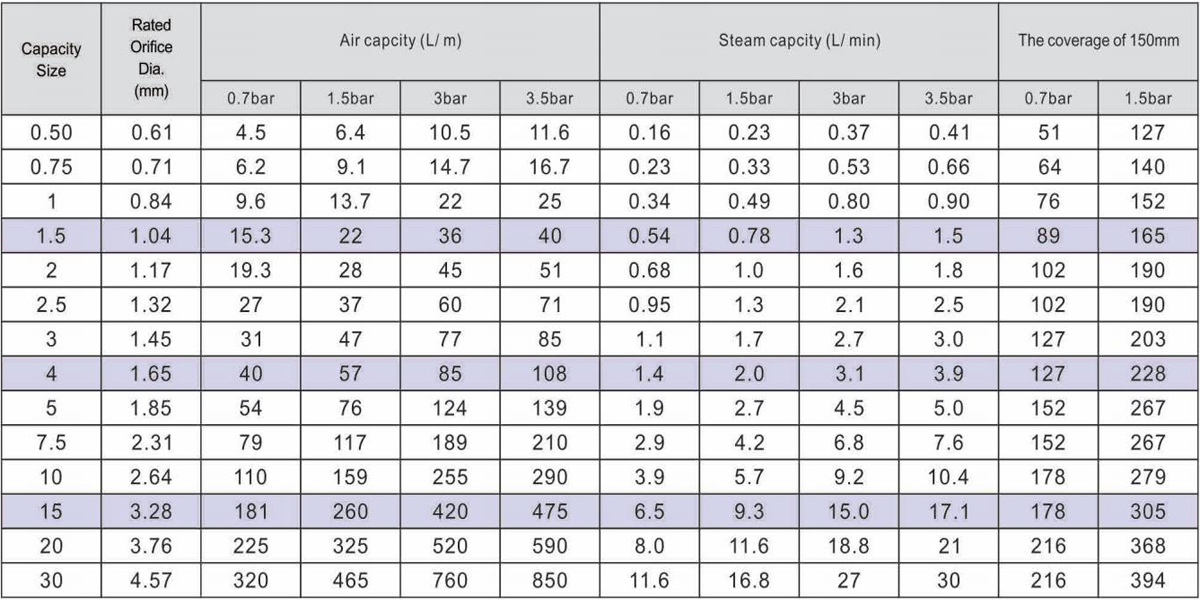
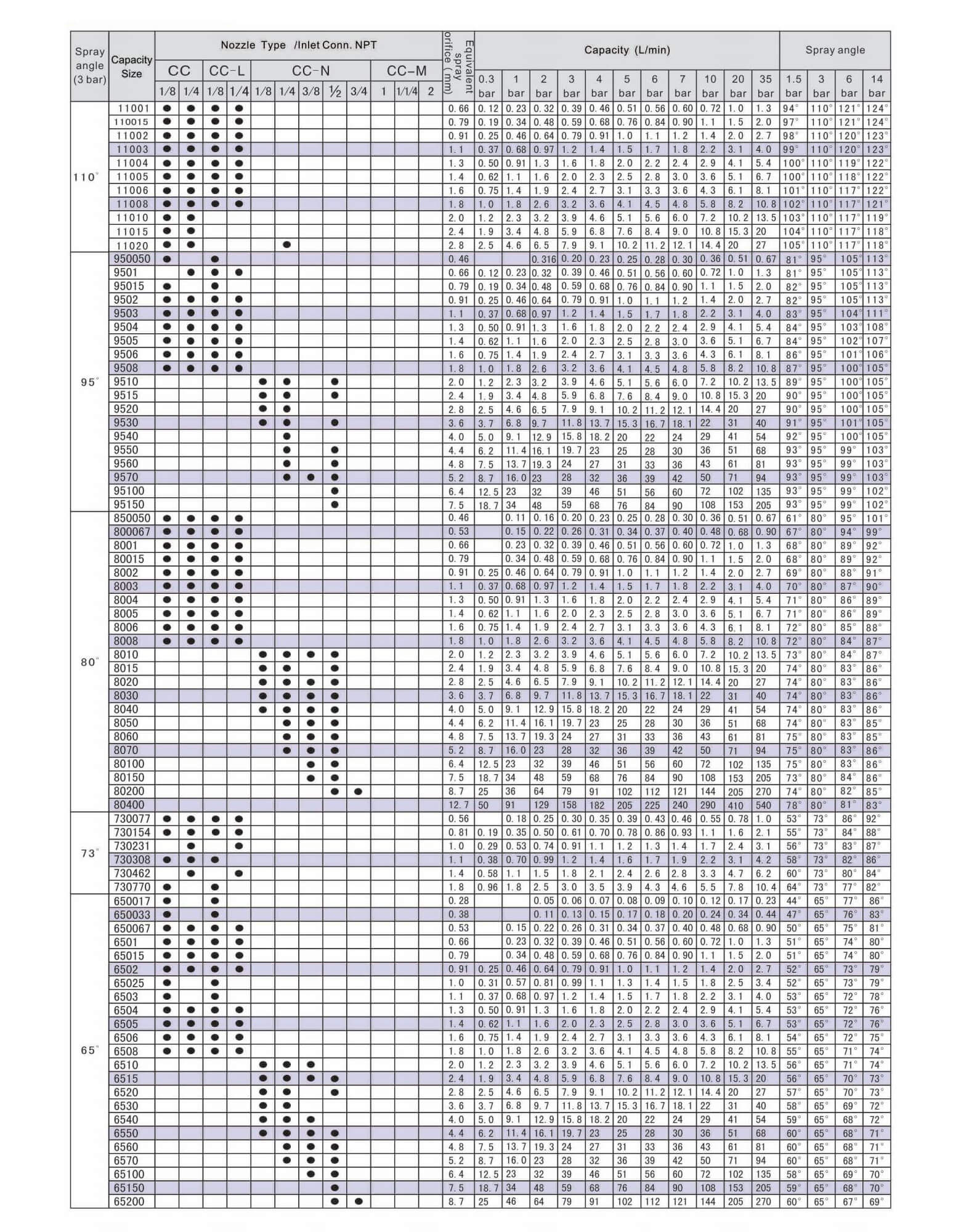
For complete orifice size, pressure, and capacity tables across our range, see the Flat Fan Spray Nozzle selection guide. If your application also needs to compare flat fan coverage against a full cone pattern for less directional cooling zones, our Flat Fan vs Full Cone Nozzle comparison walks through several worked mill and process scenarios.
Durability Considerations for Continuous Mill Duty
Selecting durable roll cooling flat fan nozzles up front avoids unplanned changeouts during a production run.
Mill nozzles rarely fail from a single event; they wear gradually as high-velocity water and entrained scale erode the orifice edge, which slowly widens the orifice, drops pressure, and distorts the spray pattern until cooling or descaling becomes uneven. Scheduling routine pattern checks and orifice measurement during planned maintenance windows, rather than waiting for a visible surface defect to appear, is the most reliable way to catch this wear before it affects product quality. Hardened stainless steel or ceramic-insert tips extend service intervals significantly compared with standard brass in high-pressure descaling duty.
Specifying Nozzles for Your Mill
To get an accurate recommendation, share your application (descaling vs. cooling), available header pressure, roll or strip width, line speed, water quality (including scale/solids content), and current nozzle spacing or header drawing if available. Our engineering team can recommend spray angle, orifice size, and material to match your throughput and quality targets.
Frequently Asked Questions
What pressure is typical for descaling nozzles?
Hot strip mill descaling commonly runs at high pressure, often 150–250+ bar, depending on scale thickness and steel grade; your specific mill design and pump capacity will set the practical limit.
Can the same flat fan nozzle be used for both descaling and cooling?
Generally no. Descaling needs a narrow, high-impact pattern at high pressure, while cooling needs broader, more even coverage at lower pressure; most mills use different nozzle specifications for each duty.
How often should mill spray nozzles be inspected?
Orifice wear is gradual, so periodic inspection during scheduled maintenance (rather than only after a defect appears) is recommended; frequency depends on water quality and pressure but is often monthly to quarterly for high-pressure descaling duty.
Talk to Our Engineering Team
Share your mill’s cooling or descaling requirements and we’ll help you specify the right flat fan nozzle, spray angle, and material for continuous, high-duty operation. Contact us for an application review, or explore the full Flat Fan Nozzle range.
Pingback: Strip Cooling Nozzle Design: Flat Fan Overlap & Impact
Pingback: Controlled Cooling of Steel Strip: A Plain-English Guide