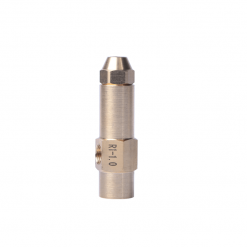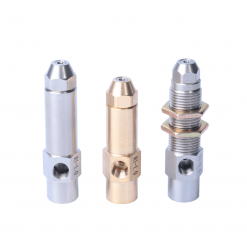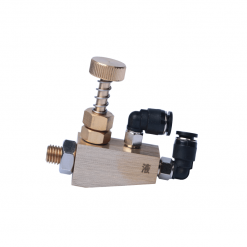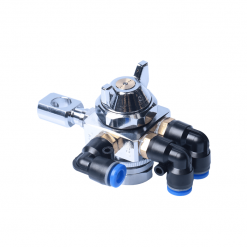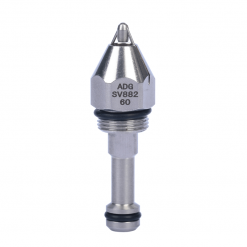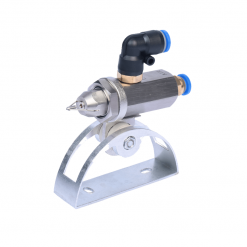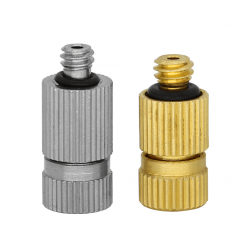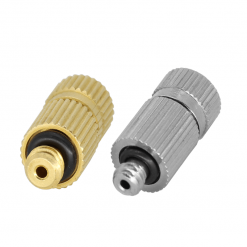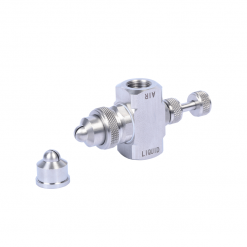

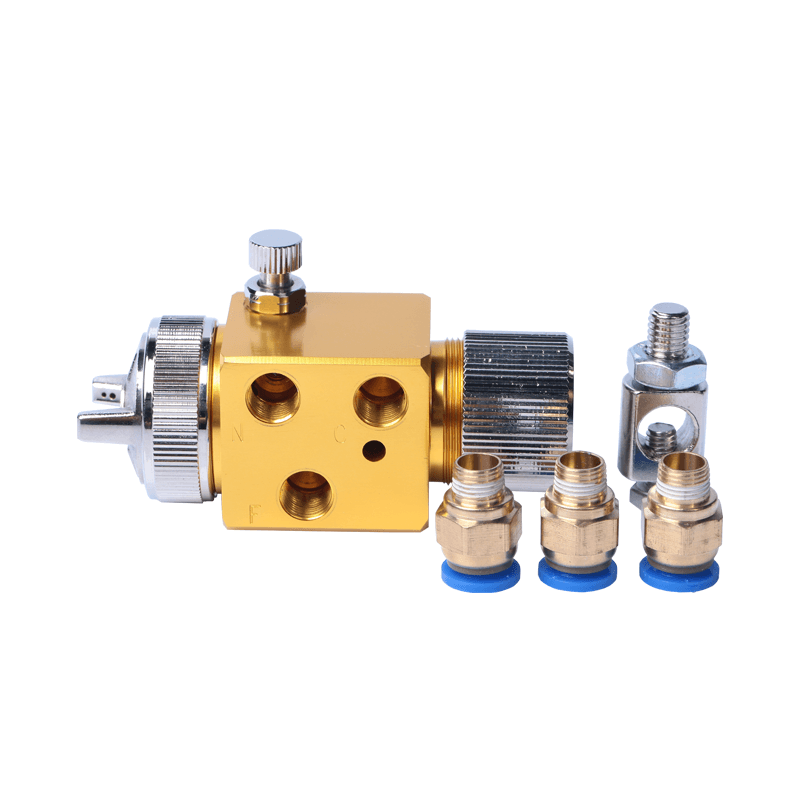


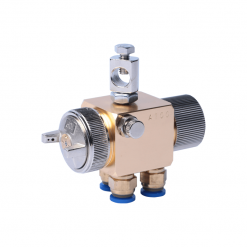
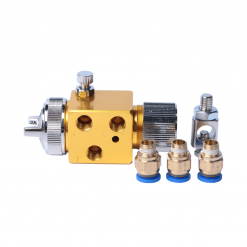
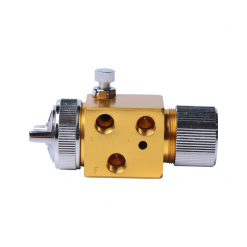
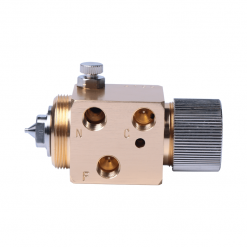
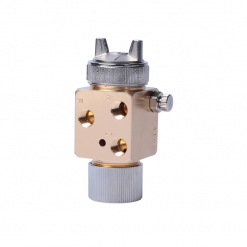
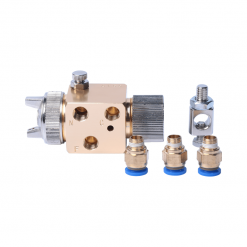
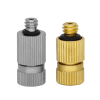
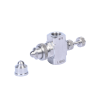
A100 atomizing automatic nozzle is a compact spray-control solution for processes that need repeatable atomization and automatic on-off operation. It can be evaluated for coating, lubrication, humidification, marking and other precision applications where spray timing and mounting space matter.
A100 Atomizing Automatic Nozzle System Overview
An automatic atomizing assembly combines fluid delivery, atomizing air where required and an actuation mechanism. Spray quality is governed by the nozzle setup and by the stability of each supply. Selection should define the desired pattern, droplet fineness, cycle frequency, response time, liquid properties and available control signals.
Typical Applications
- Release-agent, oil or lubricant application on moving equipment
- Controlled coating of parts, webs and formed products
- Humidity and light cooling in compact processing zones
- Marking, moistening and intermittent precision spraying
- Test rigs and automated equipment requiring synchronized spray cycles
Key Selection Criteria
Correct nozzle selection depends on the complete operating envelope, not flow rate alone. Confirm the required coverage, droplet or atomization target, liquid properties, available pressure, duty cycle, installation space and allowable maintenance interval before specifying a model.
| Selection factor | Engineering question |
|---|---|
| Atomization target | Describe droplet fineness, transfer efficiency and acceptable overspray. |
| Pattern and coverage | Define shape, width, distance and target movement. |
| Liquid supply | Provide flow, pressure, viscosity, temperature and solids information. |
| Air supply | For air-atomizing configurations, state available pressure, quality and capacity. |
| Actuation | Confirm signal type, cycle rate, duty cycle and required response. |
| Mounting and service | Provide space, orientation, connection and access constraints. |
Performance and System Integration
Use regulated, clean supplies and place controls close enough to avoid delayed response. For air-atomizing service, oil-free filtered air may be required by the process. Route hoses to prevent sharp bends and pressure loss, and coordinate spray timing with conveyor or machine motion. A trial should confirm pattern, transfer efficiency and overspray at production speed.
Final performance should be verified under actual process conditions. Pump pulsation, pressure loss through filters and valves, fluid temperature, viscosity, suspended solids, nozzle spacing and target distance can all change the delivered pattern. For multi-nozzle headers, balance branch losses and provide pressure measurement near the spray points.
Materials, Filtration and Maintenance
Small liquid and air passages are sensitive to contamination. Flush compatible fluids before shutdown when deposits are possible, inspect the needle and seat area for wear and keep seals matched to the chemistry. Establish baseline spray appearance, flow and cycle response so gradual deterioration can be identified.
- Use filtration matched to the smallest internal passage and the contamination load.
- Inspect pattern quality, flow consistency, seals and connections on a documented schedule.
- Clean with a compatible non-damaging method; avoid tools that can enlarge the orifice.
- Replace worn components when flow, coverage or shutoff performance moves outside the process tolerance.
Information to Include with Your RFQ
For an application-specific recommendation, provide the liquid name and concentration, temperature, viscosity, target flow per nozzle, available liquid and air pressure where applicable, spray distance, required coverage, duty cycle, connection preference, material restrictions and site environment. Photos or a simple installation drawing help our engineers evaluate mounting and access.
Frequently Asked Questions
What information is needed to select an automatic atomizing nozzle?
Provide the liquid properties, required flow, desired pattern and droplets, air and liquid pressures, actuation method, cycle rate, target distance and available mounting space.
Can the A100 be used with viscous liquids?
Suitability depends on viscosity at operating temperature, required flow, atomization target and available pressures. Application testing is recommended instead of assuming water-like performance.
Can Jeltecn help validate the selection?
Yes. Jeltecn can review your operating data, installation constraints and spray objective before quotation. Sample or application testing may be recommended when liquid properties or coverage requirements are critical.
Request an Engineering Recommendation
Send your process data to Jeltecn for a practical A100 atomizing automatic nozzle recommendation. We will help compare configuration, material, connection and operating requirements for your application.
Contact Jeltecn for a quotation or explore our industrial spray nozzle range, applications and industry solutions.
A100 Automatic Atomizing Nozzle: Engineering Decision Guide
Specify the A100 when a compact machine-mounted spray point must combine controlled atomization with repeatable automatic on/off operation. The engineering decision is not simply nozzle size: liquid rheology, atomizing energy, pattern geometry, actuation timing and overspray tolerance must work together.
When this nozzle is the right fit
This product is a strong candidate when its spray mechanism matches the process objective and the site can maintain the required utilities, liquid quality, installation geometry and inspection routine. Use the following decision points to qualify the application before selecting a connection or ordering quantity.
| Decision variable | What to confirm |
|---|---|
| Spray objective | Fine coating, lubrication, moistening, humidification or marking determines the acceptable droplet and transfer target. |
| Cycle profile | State cycles per minute, on-time, duty cycle and required response so the valve and supply system can be evaluated. |
| Liquid behavior | Provide viscosity at operating temperature, density, solids, surface tension information when known and cleaning constraints. |
| Air and liquid supply | Record pressure and capacity at the nozzle under flow, not only compressor or pump nameplate values. |
| Pattern geometry | Define target width, distance, orientation and part or web speed. |
| Environment | Identify heat, corrosion, wash-down, explosive atmosphere or food-contact constraints for verification. |
How it compares with alternative spray technologies
Choose an automatic atomizing nozzle when spray timing and droplet control are more important than the simplicity of a continuously flowing hydraulic nozzle. For larger continuous coverage with fewer controls, a flat fan or hydraulic fine-spray nozzle may be a better fit. For very low liquid flow or exceptionally fine non-pressure atomization, evaluate ultrasonic atomization separately.
Common performance problems and diagnostic checks
| Observed problem | What to investigate first |
|---|---|
| Large droplets or unstable pattern | Check air-to-liquid balance, liquid viscosity, pressure loss, cap cleanliness and supply pulsation. |
| Drip at shutoff | Review needle/seat condition, actuation timing, trapped line volume and liquid pressure. |
| Excess overspray | Reduce unnecessary atomizing energy, correct distance and alignment, and confirm the selected pattern. |
| Uneven deposit | Check machine speed synchronization, nozzle orientation, overlap and liquid delivery stability. |
Recommended validation before production release
A practical trial should reproduce the production liquid, temperature, target distance, cycle rate and substrate motion. Evaluate coverage, transfer, edge definition, overspray, start-stop response and cleanability. Record the accepted settings so procurement and maintenance can reproduce them.
Core-product RFQ checklist
Send the liquid name and concentration, temperature, viscosity, solids or water-quality information, target flow per nozzle, available pressure, air data where applicable, spray distance, coverage geometry, duty cycle, connection preference, material restrictions, installation drawing and photos of the spray zone. State the process result you need and the failure mode you want to avoid. Jeltecn can then review the application and identify points requiring test confirmation.
Related technical routes: Flat fan spray nozzles · Ultrasonic atomizing nozzle · all spray nozzle products · request an engineering quotation.
Frequently Asked Questions About the A100 Atomizing Automatic Nozzle
Can the A100 atomizing automatic nozzle run continuously? Duty cycle depends on air supply stability and liquid delivery; confirm continuous-duty suitability with the engineering team before specifying it for round-the-clock operation.
What liquids are compatible with the A100 atomizing automatic nozzle? Most low-to-medium viscosity liquids are compatible, but abrasive or high-solids liquids may need a wear-resistant orifice; send the liquid data sheet for confirmation. For background on atomization principles, see this atomizer nozzle reference.