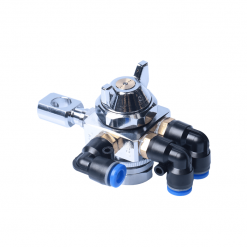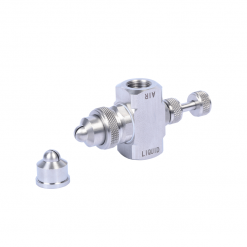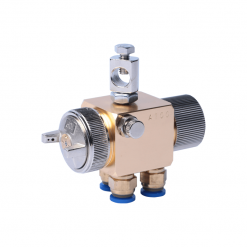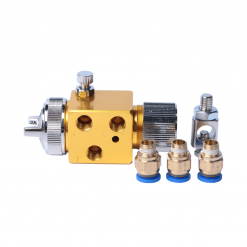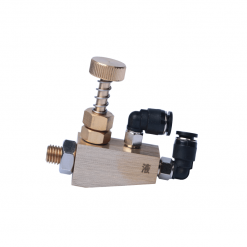
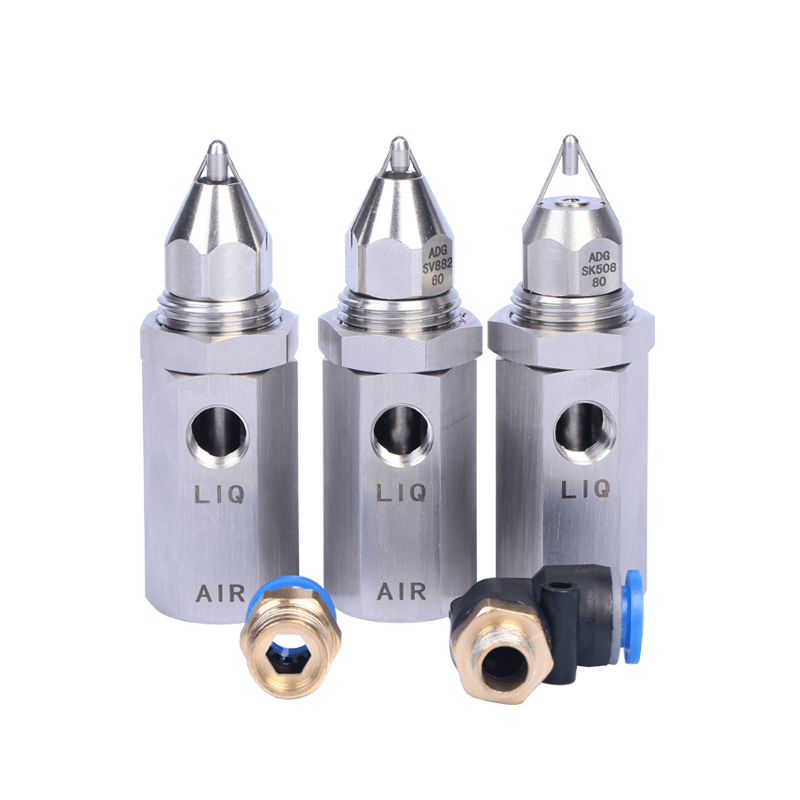
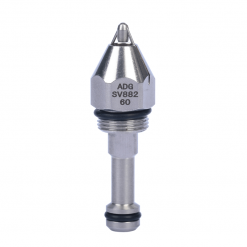
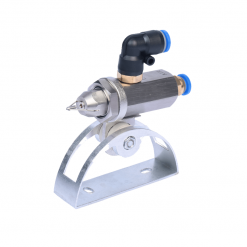
Description
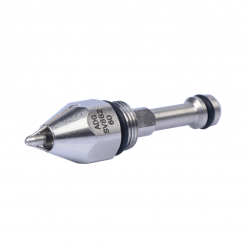
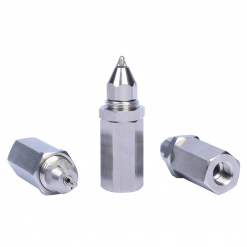
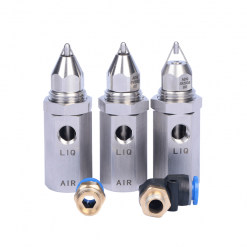
Ultrasonic atomizing nozzles can continuously generate dense fog with a size of 1-10 microns to cover the dust source and maintain the mixing ratio with dust particles. The ultrasonic atomizing nozzle passes through high-frequency mechanical sound waves. Through a specially designed vibrating head that meets and vibrates with compressed air. The principle is to accelerate the speed of the impulsive air in the connection part of the airflow.
Ultrasonic atomizing nozzles do not rely on high pressure to achieve the effect of atomizing water, almost completely eliminating the need for high-pressure water pump wear. Clean the nozzle cavity while the nozzle vibrates. The nozzle has no moving parts and is constructed of 100% stainless steel. compared to brass nozzles. This eliminates wear and corrosion, extending service life.
In the high-speed camera recording, a 2-micron droplet directly spanned a distance of 2 meters. Any dust particles surrounded by dense fog droplets have no chance of escape.
In order to further improve the atomization ability, the airflow path of the resonance chamber is reflected in the airflow amplification function of the nozzle itself, which has a strong impact. Once this powerful shock wave is generated, the water is sheared into relatively small droplets. These small water droplets are then carried away by the high-speed air in the explosion of droplets of thousands of microns in size, which then undergo intense acoustic energy conversion.
Spray dust suppression uses very little water, no chemicals, and does not increase the overall moisture content of the transported material by more than 1 in 10,000. The principle is mainly based on the collision of similar-sized water and dust particles, agglomeration, continuous growth in scale and mass, and agglomeration into larger and heavier powders that fall. The whole process does not have any special handling.
Compared with the heating atomization method, the energy is saved by 90%. In addition, a large number of negative ions will be released during the atomization process, which will have an electrostatic reaction with the smoke and dust floating in the air to precipitate them. At the same time, it can effectively remove harmful substances such as formaldehyde, carbon monoxide, bacteria, etc., so that the air can be purified. Reduce the incidence of disease.
Video
Advantages
- Professional industry spray nozzle with over 15 years of experience.
- Complete QC system and strong after-sales concept.
- 3 R&D Engineers with over 10 years of experience.
- ISO9001:2015/SGS/CE certification.
- Third-party audit.
- Fast delivery.
- Accept OEM/ODM
Specs
| Brand | Jeltecn |
| Nozzle Type | Atomization |
| Thread Size | 1/4 |
| Spray Angle | 30°, 60°, 80° |
| Spray Pattern | Atomization |
| Thread Type | Male, BSPT, NPT |
| Orifice Dia. (MM) | / |
| Air Pressure | 3Bar – 5Bar |
| Capacity(L/H) | 0.359L-0.688L |
| Material | 303SS/316SS |
| Packaging | Carton |
| Certificates | ISO9001/SGS/CE |
| Payment Terms | T/T, Western Union, Paypal |
Application
Paper Industry, Electronics Industry, Automobile Industry, Textile Industry, Electric Heating Plant, Steel Plant,
Petrochemical Industry, Drying Equipment, Coal And Cement Industry, Food And Pharmaceutical Industry.
Humidification, Spraying, Cooling, Spraying, Lubrication, and other applications.
Spray Pattern
Performance Date
Image

Jeltecn Factory

Certification

Cooperative Customers

How to Select Ultrasonic Atomizing Nozzle
ultrasonic atomizing nozzle uses high-velocity compressed air and a resonating atomizing head to create fine droplets without relying only on high liquid pressure. This page should be evaluated as an engineered component: final performance depends on the liquid, pressure at the nozzle, installed geometry and the selected configuration.
Technical selection criteria
- Process fluid: identify composition, temperature, specific gravity, viscosity, suspended solids and any corrosion or erosion risk.
- Required duty: state flow per nozzle, minimum and maximum inlet pressure, operating cycle and acceptable turndown.
- Spray result: define pattern, angle, coverage width or diameter, stand-off distance, droplet requirement and allowable overspray.
- Installation: confirm thread standard, connection size, orientation, header spacing, available clearance and access for inspection.
- Materials and maintenance: match body, insert, seals and accessories to the fluid and environment; include filtration and cleaning requirements.
Where this nozzle type fits
Typical evaluation areas include dust suppression, humidification, cooling and fine process spraying. When comparing ultrasonic atomizing nozzle with air-assisted ultrasonic nozzle, fine fog nozzle, dust suppression atomizer, select the pattern and construction that solve the actual process duty. A wider angle does not automatically mean better atomization, and a higher pressure does not automatically deliver the best coverage.
Engineering limits and installation checks
Published flow and spray data are normally based on defined test liquids and conditions. Viscosity, specific gravity, pressure loss, solids, temperature, nozzle wear, pulsation and nearby airflow can change field performance. Confirm the installed pressure at the nozzle—not only pump discharge pressure—and verify overlap or target coverage before finalizing a production header.
Information to include with an RFQ
Provide liquid properties, target flow, pressure range, spray angle or coverage, distance to target, material, connection, quantity, duty cycle and installation drawings. Jeltecn can use these inputs to compare the requested configuration with related spray nozzle application guidance and the complete industrial spray nozzle range.
Frequently asked questions
What determines the flow of ultrasonic atomizing nozzle?
Flow depends primarily on the selected orifice and pressure differential, then must be corrected for liquid density, viscosity and the actual piping losses.
How should this nozzle be validated before production use?
Confirm the exact model and material, review the performance table, test coverage under representative conditions and document inspection or replacement criteria.
Ultrasonic Atomizing Nozzle: Engineering Decision Guide
An ultrasonic atomizing nozzle is best considered when a process needs fine droplets with relatively low spray velocity and controlled liquid delivery. It uses high-frequency energy in the atomization zone; depending on the design, air may shape or transport the mist. Selection therefore starts with liquid properties, required feed rate, desired droplet behavior and the surrounding airflow.
When this nozzle is the right fit
This product is a strong candidate when its spray mechanism matches the process objective and the site can maintain the required utilities, liquid quality, installation geometry and inspection routine. Use the following decision points to qualify the application before selecting a connection or ordering quantity.
| Decision variable | What to confirm |
|---|---|
| Liquid feed | Define stable flow, allowable pulsation, viscosity, solids and wetting behavior at operating temperature. |
| Atomization objective | State whether rapid evaporation, uniform thin coating, cooling, humidification or airborne capture is required. |
| Air interaction | Describe ventilation, cross-drafts and any shaping or transport air because fine droplets closely follow local airflow. |
| Working distance | Set the distance and target geometry while allowing for plume expansion and evaporation. |
| Process cleanliness | Identify deposit, crystallization and contamination risks near the atomizing surface. |
| Control strategy | Define modulation, start-stop frequency, interlocks and how the liquid feed is synchronized. |
How it compares with alternative spray technologies
Choose ultrasonic atomization when gentle, low-velocity fine mist and low liquid throughput are central to the process. Air-atomizing nozzles may offer stronger plume shaping and wider operating ranges but require compressed air. Hydraulic fine-mist nozzles are simpler where sufficient liquid pressure is available. Compare the complete system cost, droplet need, control range and maintenance environment.
Common performance problems and diagnostic checks
| Observed problem | What to investigate first |
|---|---|
| Intermittent or coarse atomization | Check liquid feed stability, contamination, viscosity, energy input and the condition of the atomizing surface. |
| Mist drifts away from target | Map local airflow, extraction and plume momentum; add suitable containment or shaping only after testing. |
| Deposits on the atomizing zone | Review water or chemical quality, shutdown flushing and cleaning compatibility. |
| Uneven coating or humidification | Verify feed uniformity, nozzle position, target motion, plume overlap and environmental airflow. |
Recommended validation before production release
Testing should use the production liquid and realistic ventilation. Measure usable coverage, evaporation or deposition at the target, not only the visible plume. For coating, examine deposit uniformity and overspray. For humidification, monitor spatial humidity response and condensation risk. Record liquid feed, air settings, position and ambient conditions.
Core-product RFQ checklist
Send the liquid name and concentration, temperature, viscosity, solids or water-quality information, target flow per nozzle, available pressure, air data where applicable, spray distance, coverage geometry, duty cycle, connection preference, material restrictions, installation drawing and photos of the spray zone. State the process result you need and the failure mode you want to avoid. Jeltecn can then review the application and identify points requiring test confirmation.
Related technical routes: Brass air atomizing nozzle · AAZ fine atomizing nozzle · all spray nozzle products · request an engineering quotation.